Customer-Feedback
How to Collect Customer Feedback After Purchase in E-commerce Without Relying Only on Surveys



Premium Humanoid AI Voice Agents for your business.
Most e-commerce brands know they should collect customer feedback. The problem is that many collect it too passively.
They send a survey email, wait for product reviews, and look through support tickets when something goes wrong. These channels are useful, but they do not capture the full customer experience.
Many customers never respond to surveys. Some customers are unhappy but stay silent. Others are satisfied but never leave a review. Some only speak up after the issue has already turned into a refund, complaint, cancellation, or bad review.
That is why the question is not only about how to collect customer feedback. The real question is how to collect useful feedback after purchase, at the right moment, through the right channel, and turn it into action.
In this post, we’ll walk you through simple ways ecommerce brands can collect better feedback after a purchase, without relying solely on surveys. We’ll also examine when to ask, what to ask, and how to listen to customers who typically remain silent.
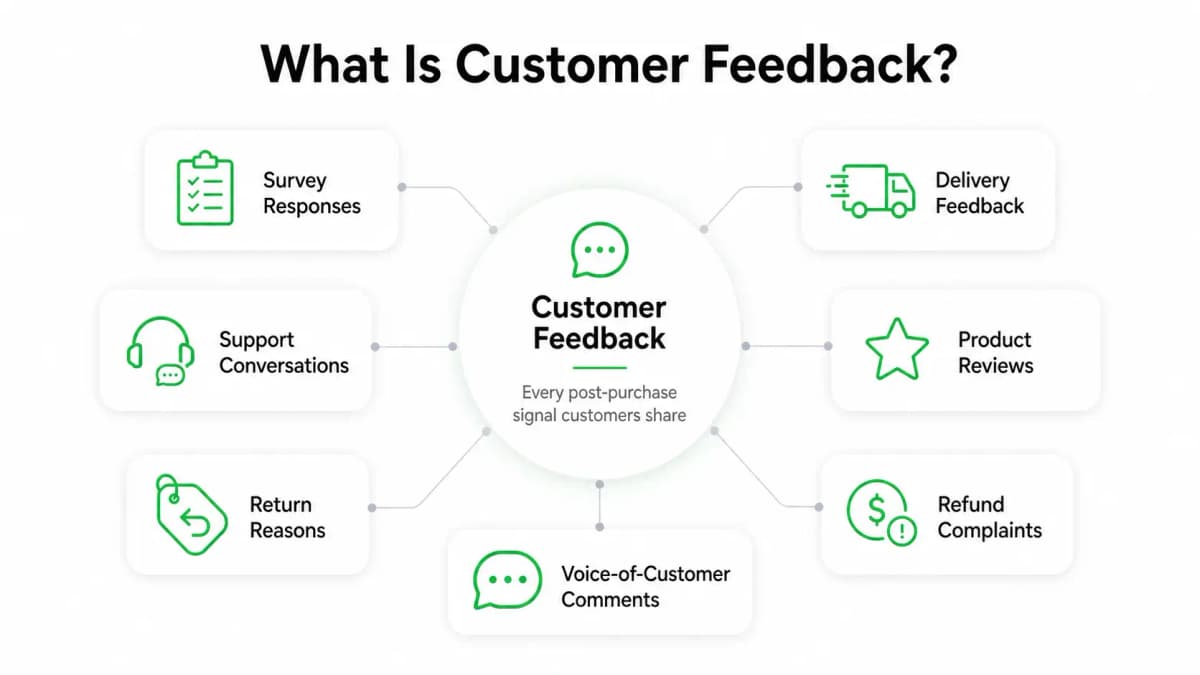
Customer feedback is information customers share about their experience with a product, service, delivery, support interaction, or brand. In e-commerce, it can include;
Post-purchase survey responses
Delivery satisfaction feedback
Support conversations
Return and cancellation reasons
Refund complaints
Customer satisfaction scores
Voice-of-customer insights
Comments shared through email, SMS, chat, or phone calls
Customer feedback helps ecommerce teams understand what customers actually experienced after checkout. It shows whether the product matched expectations, whether delivery was smooth, etc.
Customer feedback is important because e-commerce brands do not have the same in-person visibility as physical stores.
For instance In a store, customers can ask questions, check the products live, raise concerns, or speak to staff before and after purchase. But in Online shopping, most of that behavior is hidden unless the brand creates ways to capture it.
Customer feedback helps ecommerce brands understand the following:
Why customers are satisfied or disappointed
Which product details create confusion
Where delivery or packaging falls short
Why customers return or cancel orders
What support issues repeat most often
Which customers are ready to leave reviews
What improvements could increase repeat purchase
Without feedback, teams often make decisions based on assumptions or gut instinct. Feedback gives ecommerce teams a structured way to improve customer experience, reduce repeated issues, increase review volume, and identify problems before they become larger retention risks.
Post-purchase feedback is more actionable than generic feedback because it relates to the real customer journey.
After purchase, the customer has experienced more than your website. They may have gone through checkout, payment, delivery tracking, packaging, product usage, returns, support, or follow-up communication.
That means their feedback can reveal problems across the full ecommerce experience.
For example, a customer may say the product was good, but delivery updates were unclear. Another may return an item because the size guide created the wrong expectation.These are not abstract opinions. But they are operational signals.
Post-purchase feedback helps teams understand the difference between product problems, communication problems, delivery problems, support problems, and expectation-setting problems.
That is why ecommerce brands should collect feedback after key moments, not only through generic quarterly surveys or occasional review requests.
Surveys are useful, but they are limited.
A short post-purchase survey can capture customers’ satisfaction, product fit, delivery experience, and improvement suggestions. But if surveys are the only feedback channel, the brand will miss a large part of the customer base.
The main problems with relying only on surveys are:
Many customers ignore survey emails
Long forms reduce completion rates
Poor timing leads to shallow answers
Customers may not remember details later
Unhappy customers may go straight to support or reviews instead
Silent customers remain invisible
Survey answers may lack context
Surveys also depend on the customer doing the work. They need to open the message, click the link, understand the questions, and complete the form.That creates a feedback gap.
The customers who respond may not represent all customers. Some are extremely happy. While some are extremely frustrated.
This does not mean ecommerce brands should stop using surveys. It means surveys should be one part of a broader post-purchase feedback system.
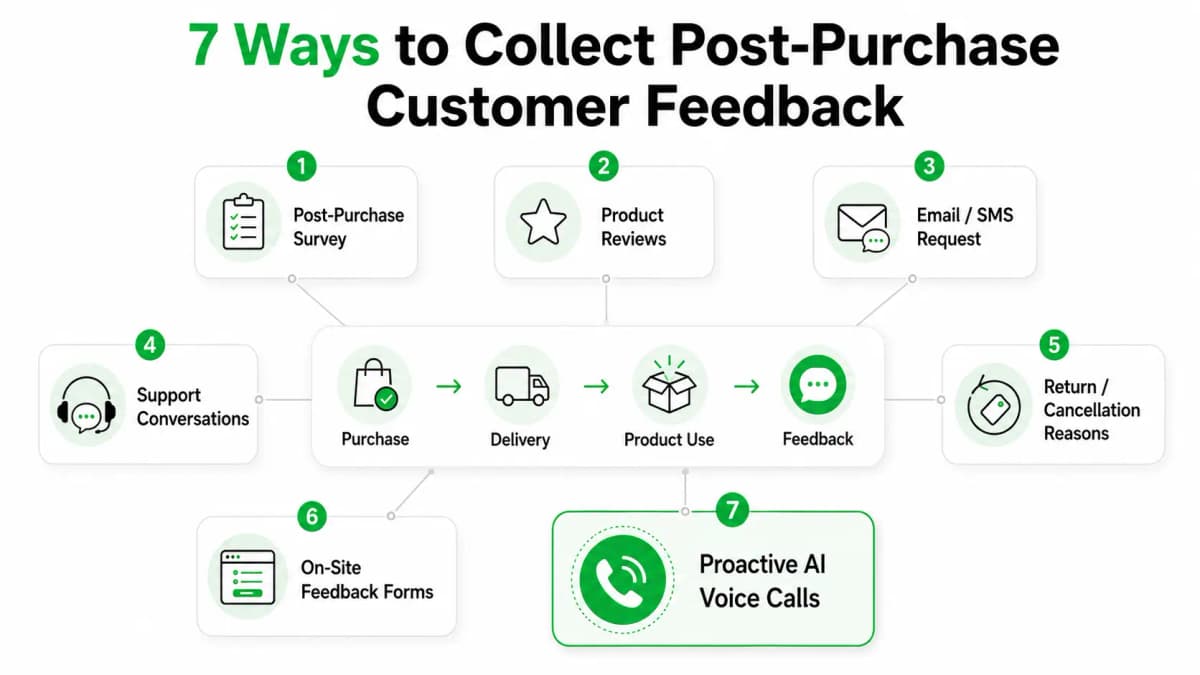
To collect better customer feedback, e-commerce brands need multiple feedback methods working together. Each method captures a different part of the customer experience.
A post-purchase survey is one of the simplest ways to gather customer feedback after an order.
Keep it short. Ask only the questions that matter for the moment. Useful post-purchase survey questions include:
How satisfied are you with your order?
Did the product match your expectations?
Was the delivery smooth?
What could we have done better?
Would you buy from us again?
The goal is not to collect more answers for the sake of it. The goal is to collect feedback that can guide action.
Reviews are a public form of customer feedback. They help future buyers understand product quality, fit, usage, and trust.
But many brands ask every customer for a review at the same time, with the same message. A better approach is to identify positive satisfaction signals first.
For example, if a customer confirms that delivery went well and the product met expectations, they are more likely to be review-ready. That customer can be routed into a review request flow.
This creates a better customer experience and improves the quality of review collection.
Email and SMS are useful for scalable feedback collection. They work well for simple prompts, quick ratings, delivery confirmation, and review requests.
Email works well when the customer may need more context or a link. SMS works well for quick responses, short satisfaction checks, or simple follow-ups.
For example:
“Your order was delivered yesterday. Was everything okay with your delivery?”
This type of message is easy to answer and tied to a specific customer moment.
Support conversations are one of the richest sources of customer feedback.
Customers often tell support teams exactly what went wrong like unclear delivery updates, damaged packaging, confusing sizing, delayed refunds, etc. The problem is that this feedback often stays trapped inside individual tickets.
Ecommerce brands should tag and categorize support feedback so recurring themes become visible. If customers repeatedly ask the same question, complain about the same issue, or misunderstand the same policy, that is feedback the business can act on.
Returns and cancellations are not only operational events. They are feedback moments.
A reason behind return can reveal whether the issue was in product quality, delivery,damaged items, etc.
Instead of treating return reasons as dropdown data only, ecommerce brands should use them to improve product pages, size guides, quality control, delivery communication, and exchange workflows.
For example, if many customers return a product because it “looked different than expected,” the issue may be product imagery or description clarity. If many customers cancel because delivery took too long, the issue may be expectation-setting or delivery communication.
On-site feedback forms can help customers share quick comments while they are logged in, checking order status, managing returns, or browsing help content.
These forms should be simple and contextual.
For example:
“Was this order update helpful?”
“Did you find what you were looking for?”
“What made you consider returning this item?”
These forms work because they appear close to the customer action.
7. Use Proactive Voice Calls After Purchase
Some feedback is too valuable to wait for a survey response.
Proactive voice calls can help ecommerce brands reach customers after delivery, especially when the brand wants richer feedback, faster issue detection, or review intent.
A post-purchase feedback call can ask structured questions, detect customer sentiment, capture complaints, identify happy customers, and route the next step automatically.
For example, a voice call after delivery can ask:
Did your order arrive as expected?
Are you satisfied with the product?
Was there anything we could improve?
Would you like to share a review?
Is there anything our team can help with?
This is especially useful because passive channels miss silent customers. A customer may ignore an email survey but respond naturally during a short call.
AI voice agents make this approach more scalable. Instead of asking support teams to manually call every customer, an AI voice agent can handle structured post-purchase feedback calls, capture responses, detect sentiment, and trigger the right workflow.
The best feedback requests feel timely, relevant, and easy to answer.Customers are more likely to respond when the request is connected to something they just experienced.
To ask for feedback without annoying customers:
Ask at the right moment
Keep the request short
Explain why the feedback matters
Personalize the message with order context
Avoid sending too many requests
Make it easy to respond
Route unhappy customers to help
Do not ask for a public review before checking satisfaction
A good feedback request should feel like service, not an interruption.
For example, asking “Was everything okay with your delivery?” after delivery confirmation feels relevant. Asking for a long brand survey before the customer has used the product feels premature.
The right timing depends on what kind of feedback you want.
If you ask too early, the customer may not have enough experience to answer. If you ask too late, the details may no longer be fresh.
Here is a practical timing framework:
This helps you understand whether checkout was smooth, confusing, or frustrating.
This helps you identify issues with shipping speed, delivery communication, damaged packaging, or missed expectations.
The right timing depends on the product. Some products can be reviewed within a day. Others need several days or weeks of usage.
This helps you understand whether the customer felt helped, heard, and satisfied with the outcome.
Do not rush every customer into a review request. First, identify whether the customer had a good experience.
This can reveal what would bring the customer back, what almost stopped them, and what would improve retention.
The best post-purchase feedback questions are simple, specific, and tied to action.
Useful questions include:
How satisfied are you with your purchase?
Did the product match your expectations?
Was the delivery experience smooth?
Was the packaging in good condition?
What could we have done better?
Would you buy from us again?
Would you recommend this product?
Is there anything our team can help with?
Avoid asking too many questions at once because a customer who is willing to answer one or two questions may abandon a long form.
Also avoid vague questions like “Tell us your thoughts.” Specific questions create better answers.
Collecting feedback is only useful if the business does something with it.
A strong customer feedback workflow should include these steps:
Collect feedback from multiple channels
Categorize feedback by issue type
Tag customer sentiment
Send urgent issues to support
Send happy customers into review request workflow
Share product issues with product or merchandising teams
Share delivery issues with operations or logistics teams
Track repeated issues over time
Close the loop with customers when needed
For example, if a customer says the product arrived damaged, that should not sit inside a survey report. It should trigger a support follow-up. Feedback should move into workflows, not just dashboards.
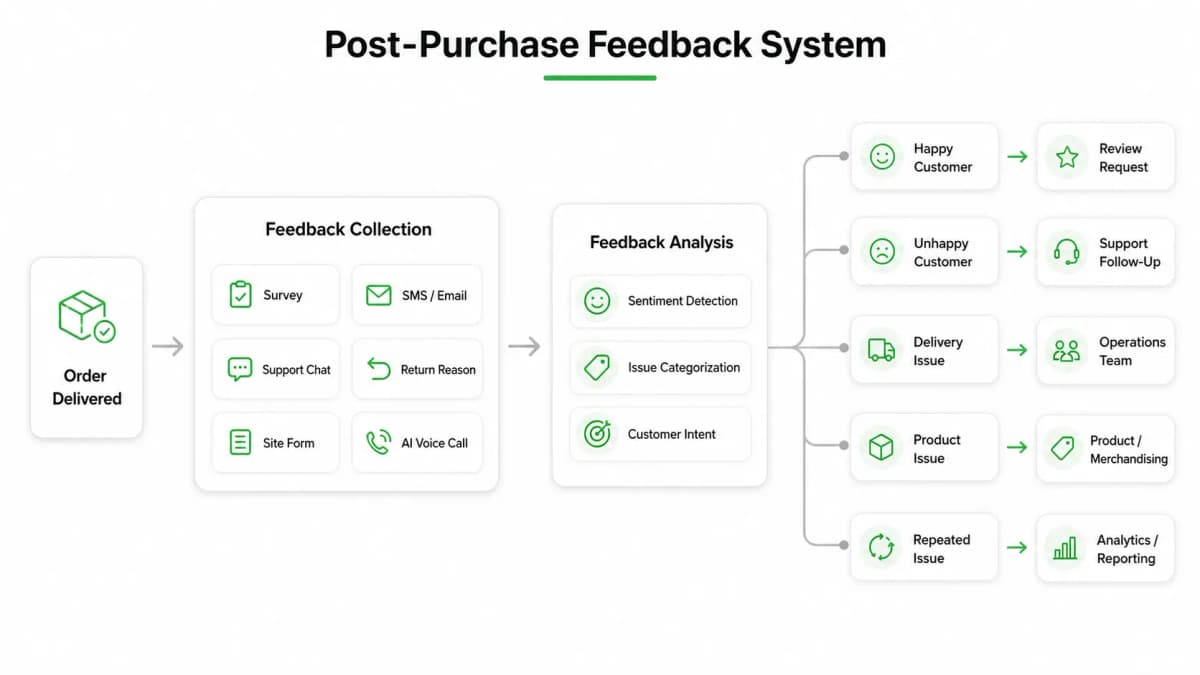
The best way to gather customer feedback is to build a post-purchase feedback system.
A feedback system listens across the full customer journey, identifies what the response means, and sends it to the right next step.
That system may include:
Post-purchase surveys
Product review requests
Delivery satisfaction checks
Support conversation tagging
Return reason analysis
Cancellation feedback
Website (on-site) feedback forms
Proactive voice calls
Sentiment analysis
Automated routing
This approach gives ecommerce brands a more complete view of the customer experience.
AI voice agents for ecommerce can act as a proactive feedback layer for ecommerce brands.
After delivery, an AI voice agent can call the customer, confirm whether the order arrived as expected, ask a few structured questions, detect sentiment, capture feedback, and trigger the right workflow.
For example:
Positive feedback can trigger a review request
Negative feedback can trigger a support escalation
Delivery complaints can be routed to operations
Product issues can be tagged for merchandising or product teams
Repeat complaints can be tracked in analytics
This makes feedback collection more conversational and action-oriented.
Salesix helps e-commerce brands automate human-like post-purchase feedback and review collection calls.
Instead of depending only on surveys or manual follow-ups, brands can use AI voice agents to collect feedback, identify review-ready customers, and route unhappy customers before the issue becomes a public complaint or repeat purchase risk.
Customer feedback is any information customers share about their experience. Customer reviews are public feedback usually tied to a product or brand. Reviews help future buyers, while feedback can also guide internal improvements.
Yes. AI voice agents can call customers after purchase or delivery, ask structured feedback questions, detect sentiment, capture review intent, and route negative feedback to support or the right internal workflow.
Ecommerce brands should ask for feedback based on the experience they want to measure. Ask for checkout feedback after purchase, delivery feedback after delivery, product feedback after usage, support feedback after resolution, and review requests after positive satisfaction signals.

Get $5 free credit on signup — no credit card required. Set up your AI voice agent in minutes and start converting more leads today.