Delivery-Updates
How to Reduce WISMO Tickets in Ecommerce with Better Delivery Updates



Premium Humanoid AI Voice Agents for your business.
Customers usually ask, “Where is my order?” because they feel uncertain, not because they want to contact support.
After a customer places an order, the waiting period becomes one of the most sensitive parts of the ecommerce experience. If the delivery timeline is unclear, tracking does not update, and uncertainty turns into a support request. That support request becomes a WISMO ticket.
For ecommerce brands, WISMO is not only a customer service issue. It is a delivery communication problem.
That is why learning how to reduce WISMO tickets is less about hiding support channels and more about improving post-purchase communication.
In this post, we’ll explain why ecommerce brands receive so many “Where is my order?” tickets and how better delivery updates can reduce that support volume. Let’s dive in.
What Are WISMO Tickets in Ecommerce?
WISMO stands for “Where is my order?”
In ecommerce, WISMO tickets are customer support interactions about order status, delivery timelines, tracking updates, delays, failed delivery attempts, or shipment uncertainty.
These tickets can come through many channels, including:
Phone calls
Emails
Live chat
WhatsApp messages
Helpdesk tickets
Social media DMs
Common WISMO customer questions include:
“Where is my order?”
“Why has my tracking not updated?”
“When will my package arrive?”
“Is my order delayed?”
“The carrier says out for delivery. Why has it not arrived?”
“Do I need to do anything?”
On the surface, these seem like simple order status inquiries. But at scale, they can create a major burden on the support team.
WISMO tickets are usually low-complexity but high-volume.
That makes them dangerous for ecommerce support teams. A single “Where is my order?” question may be easy to answer. Hundreds or thousands of them can overwhelm agents, slow response times, and pull attention away from more complex customer issues.
High WISMO volume can create several problems:
Support team agents spend too much time answering repetitive delivery questions.
Customers wait longer for replies to urgent or complex cases.
Post-purchase anxiety increases because customers feel left in the dark.
Delivery and support teams operate with disconnected information.
Repeat purchase confidence drops when delivery feels uncertain.
Customer expectations around ecommerce delivery expectations are now a major part of the post-purchase experience, which means unclear delivery communication can quickly turn into support demand.
The real issue is not that customers are asking questions. The real issue is that avoidable uncertainty is turning into support volume.
When delivery communication is weak, customers use support as their tracking system.
Customers ask, “Where is my order?” when the delivery experience feels unclear, delayed, or risky.
The most common causes include:
late delivery updates
fake delivery timelines
confusing carrier statuses
tracking pages that do not refresh, and delivery exceptions that are not explained in plain language.
A customer may receive a tracking link but still not understand what is happening.
WISMO tickets also increased in volume when orders are high-value, urgent, or time-sensitive. A customer waiting for a gift, event item, medical product, business supply, or expensive purchase is more likely to seek reassurance.
Tracking pages are useful, but they are passive.
They answer questions only if customers open them, understand them, and trust the information they see. That does not always happen.
A strong order tracking page UX can help customers understand delivery progress, but it still depends on the customer checking the page, understanding the status, and trusting the information shown.
A tracking page may tell the customer where the package is, but it may not answer the more important emotional question: “Should I be worried?”
This is where many ecommerce delivery updates fall short. A customer may see that tracking has not moved for two days. The system may know this is normal because the package is between carrier scans. But the customer does not know that.
Tracking pages also struggle when action is required. If the delivery address needs confirmation, the customer is unavailable, COD confirmation is needed, or a failed delivery attempt has occurred, a passive page does not always create a timely response.
A tracking page is a source of information. It is not always a source of reassurance.
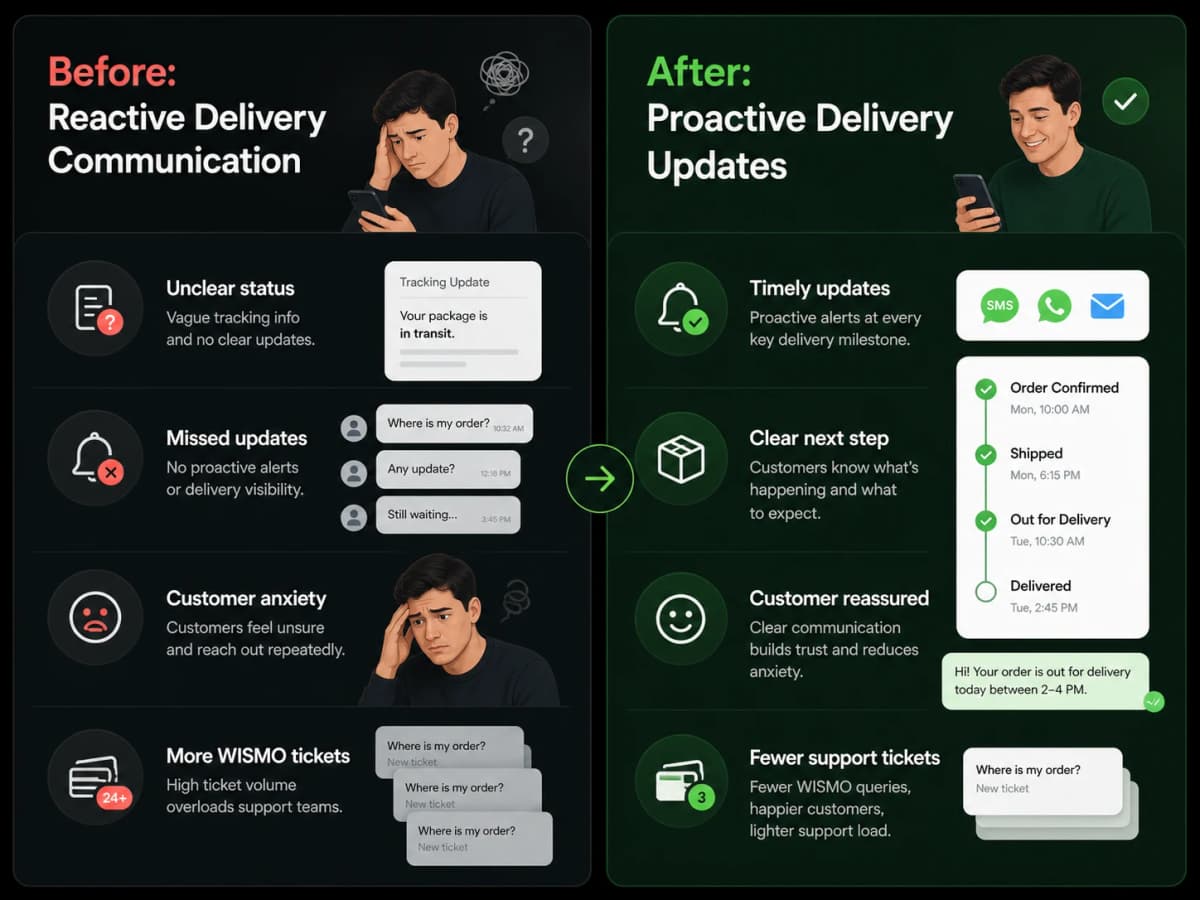
Better delivery updates reduce WISMO tickets by giving customers the right information before they ask for it.
The goal is not to send more notifications. The goal is to send clearer, more timely, more useful updates at the delivery moments that create uncertainty.
Strong delivery update automation should include:
Order confirmation after purchase
Shipment dispatch updates
In-transit updates when delivery is progressing normally
Delay updates when timelines change
Out-for-delivery alerts
Failed delivery attempt follow-ups
Delivery exception explanations
Customer action requests when needed
The language matters. “Your order is delayed” creates anxiety. “Your order is still moving through the carrier network and is now expected by Friday” is more useful.
The channel also matters. Email may work for standard updates. SMS or WhatsApp may work for quick alerts. Phone calls may work better for urgent, high-risk, high-value, or action-required delivery moments.
The best delivery communication system does not only push tracking data. It explains what is happening, what it means, and what the customer should do next.
Most WISMO reduction methods help, but only partially:
Knowledge bases can explain shipping policies, but customers may not search them when they are anxious or worried.
Chatbots can answer basic order status questions, but they are often reactive and depend on the customer starting the conversation.
Email updates are scalable, but they can be missed, ignored, or buried.
SMS and WhatsApp updates are useful, but many are one-way and too generic.
Manual calls can reassure customers, but they are expensive and hard to scale.
The problem is not that these methods are bad. The problem is that they do not match the moment.
A delayed order may need proactive reassurance. A failed delivery may need a fast customer response. A confusing tracking status may need explanation. A high-value order may need human-like communication.
When WISMO reduction depends only on passive or reactive tools, support teams still end up handling repetitive order status inquiries.
The better approach is proactive, conversational delivery of communication.
This means ecommerce brands should not wait until customers ask where their order is. They should identify the delivery moments most likely to create uncertainty and communicate before the support ticket appears.
Effective delivery communication should be:
Proactive: sent before customers chase support
Clear: written in customer-friendly language
Contextual: based on order, carrier, and delivery status
Two-way: able to collect customer responses when action is needed
Actionable: telling customers what happens next
Scalable: automated across high order volume
This is the point where ecommerce brands can connect delivery communication to a stronger post-purchase operating system.
AI voice agents for ecommerce fit into WISMO reduction as a proactive delivery update layer.
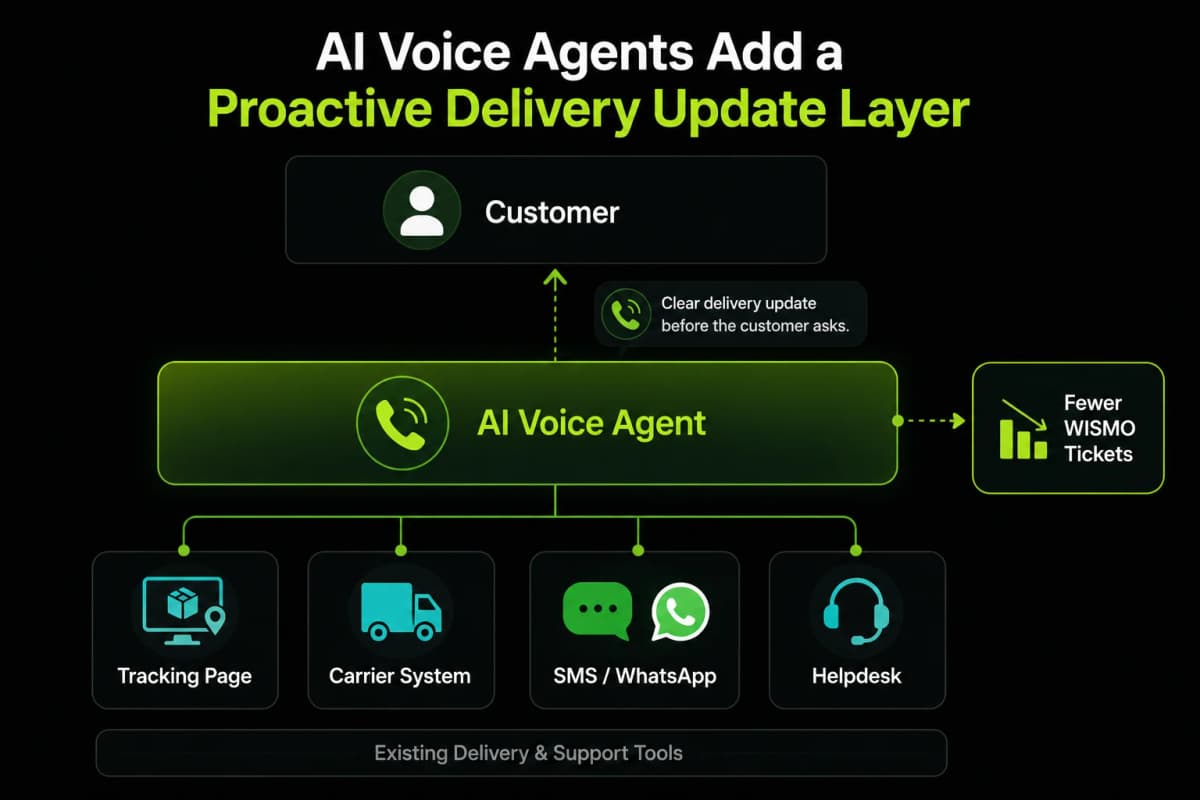
They do not replace tracking pages, carrier systems, SMS tools, or helpdesks. Instead, they help ecommerce brands communicate at the moments where passive updates are not enough.
For example, an AI voice agent can call a customer when an order is delayed, explain the new expected timeline, and reassure them that the order is still moving. It can call when an order is out for delivery and confirm customer availability.
AI voice agents can also support COD confirmation, explain confusing tracking statuses, escalate complex delivery issues to human agents, and log conversation outcomes for operations teams.
This is where Salesix’s Ecommerce Delivery Updates use case becomes relevant. For brands trying to reduce delivery support tickets, AI voice agents can automate repetitive delivery update calls while still making the customer experience feel clear, timely, and human-like.
To reduce WISMO tickets, ecommerce brands need a practical delivery communication workflow.
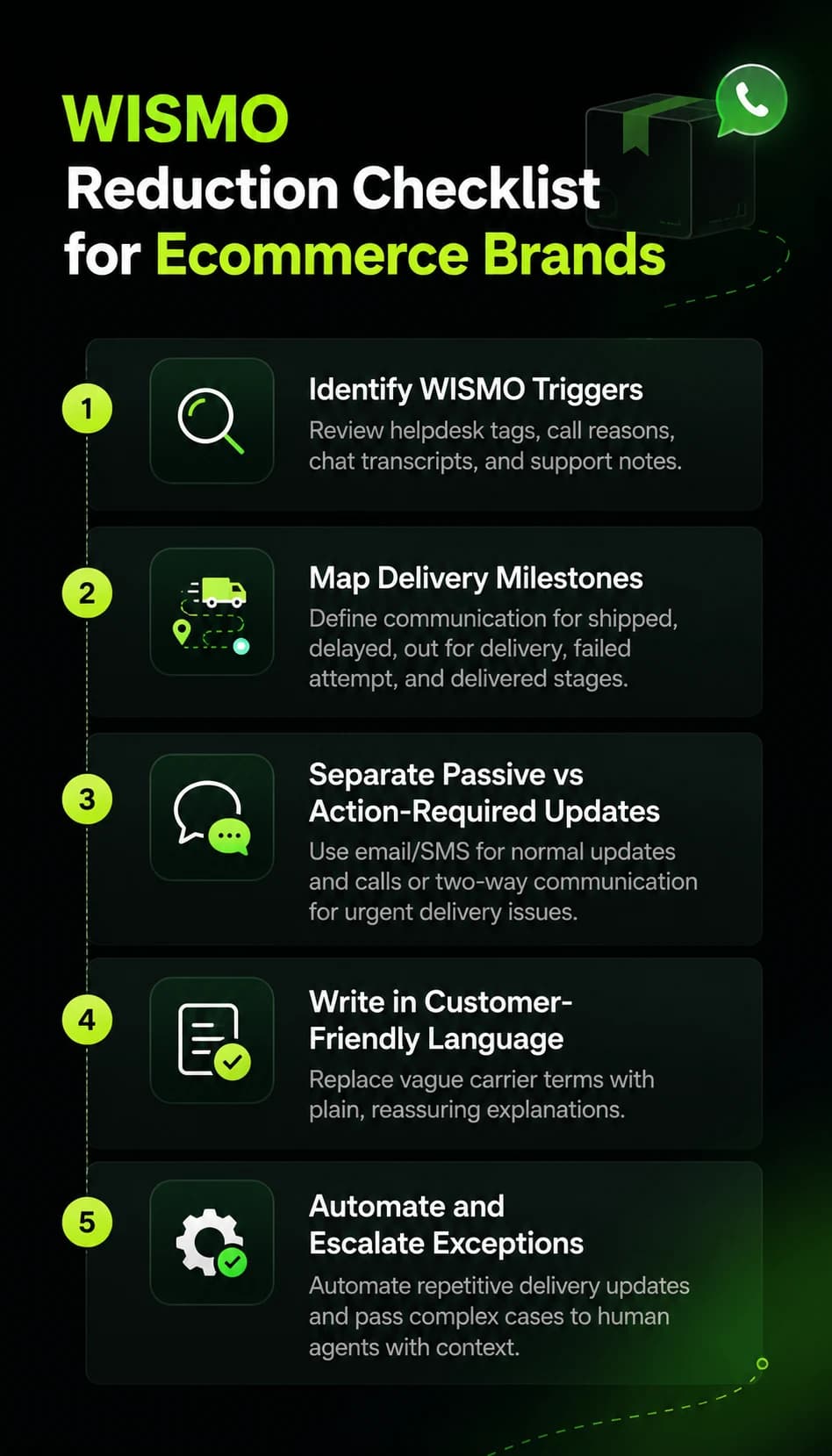
For implementation details, check the Salesix - Ecommerce Delivery Updates Playbook.
To know whether delivery updates are reducing WISMO tickets, track both support and delivery metrics.
Key metrics include:
Total WISMO ticket volume
Percentage of support tickets related to order status
Delivery-related call volume
Failed delivery attempt rate
Support response time
Cost per support interaction
Customer satisfaction after delivery
Repeat purchase rate
Delivery exception resolution time
Percentage of delivery updates handled automatically
The most important metric is not just whether customers receive updates. It is whether fewer customers need to contact support for information the brand could have provided proactively.
The first mistake is assuming that adding a tracking page will solve WISMO. Tracking pages help, but they do not always reassure customers or collect responses.
The second mistake is sending vague delivery updates. “Your order is delayed” is not enough. Customers need to know what changed, what happens next, and whether they need to take action.
The third mistake is treating every customer the same. A low-value standard order and a high-value delayed order may need different communication.
The fourth mistake is waiting until the customer complains. By the time a customer contacts support, the brand has already lost the chance to prevent the ticket.
The fifth mistake is not connecting support and logistics data. If support agents cannot see delivery status, failed attempts, or previous customer conversations, WISMO handling becomes slow and repetitive.
The final mistake is ignoring phone-based delivery anxiety. Some delivery moments need more than a passive message, especially when urgency, confusion, or customer action is involved.
WISMO tickets are a symptom of post-purchase uncertainty.
Customers ask “Where is my order?” when delivery communication is late, vague, passive, or hard to understand. Tracking pages and self-service tools help, but they are not enough on their own.
The best way to understand how to reduce WISMO tickets is to look at the customer’s delivery journey. Where do they become uncertain? Where does tracking fail to reassure them? Where is action needed? Where could proactive communication prevent a support request?
Ecommerce brands reduce WISMO tickets by communicating proactively, clearly, and at the right delivery moments. With better ecommerce delivery updates, teams can lower repetitive support volume, improve customer confidence, and give human agents more time for complex issues.

Get $5 free credit on signup — no credit card required. Set up your AI voice agent in minutes and start converting more leads today.