Customer-Feedback
How to Get More Ecommerce Reviews Without Annoying Customers



Premium Humanoid AI Voice Agents for your business.
Ecommerce brands need reviews to build trust, increase product confidence, and help new shoppers make decisions. But the real problem is that many review collection strategies feel pushy.
A customer places an order. A review request email arrives too soon. Then another reminder follows. Then an SMS. Then a discount offer. Instead of feeling heard, the customer feels chased.
That is not the best way to get more customer reviews. A better way is to ask customers after they’ve used the product. First, check if they are satisfied. Then, make the review request feel like a natural part of their buying experience.
In this post, we’ll discuss how to get more customer reviews without annoying customers, why traditional review requests often fail, and how to build a feedback-first workflow that asks happy customers at the right moment while routing unhappy customers to support first.
Customer reviews are one of the strongest trust signals in ecommerce because they come from people who have already bought and experienced the product.
Reviews help new shoppers answer questions that product pages often cannot fully answer. For example:
Does the item look the same in real life?
Is the sizing accurate?
Was the delivery smooth?
Did the product solve the problem the customer bought it for?
These are only a few examples; the list of questions goes on and on.
For ecommerce teams, reviews also support growth in several ways:
They give new shoppers confidence before purchase.
They add social proof to product pages.
They reveal product quality, fit, shipping, packaging, and support issues.
They help brands understand what customers value most.
They can reduce hesitation around unfamiliar products or new brands.
But reviews only work when they feel real & authentic. If a review strategy forces every buyer with repeated requests, it can damage the trust & brand reputation.
Customers usually ignore ecommerce review requests because the request does not match their experience.
Like - The order may have just arrived, the customer may not have used the product yet, they may have had a delivery issue. They may have contacted support and received no resolution. Or they may simply be too busy to complete a long review form.
Common reasons customers ignore review requests include:
The request arrives too early.
The message feels generic.
The customer has already received too many emails.
The review process takes too much effort.
The request does not mention the product or experience.
The customer is unhappy and does not want to help the brand.
The channel does not match how the customer usually engages.
This is why “how to collect customer feedback without annoying them” is not just a marketing question. It is a workflow question.
If every customer receives the same review request at the same time, the brand is ignoring the context.
For example, A first-time customer, a repeat buyer, a delayed delivery customer, and a customer who just raised a complaint should not all receive the same review request.
More emails can produce more reminders, but they do not always produce more reviews.
When review collection relies only on repeated emails, the experience can quickly feel transactional. The brand appears interested in public praise, not the customer’s actual satisfaction.
This creates three problems.
First, repeated requests create review fatigue. Customers already receive order confirmations, shipping updates, discount emails, support messages, and promotional campaigns. Another generic request can easily be ignored or land inside the spam folder.
Second, asking unhappy customers for public reviews too soon can backfire. If a customer had a poor delivery, damaged product, refund delay, etc, a review request may push them to share that frustration publicly.
Third, repeated review requests can reduce future engagement. A customer who feels spammed is less likely to open future post-purchase messages, even if those messages are important.
A better ecommerce review strategy does not ask harder. It asks smarter.
To get more ecommerce reviews without annoying customers, brands need to make the review request timely, relevant, easy, and based on customer satisfaction.
Do not ask for a product review immediately after checkout. At that point, the customer has only completed a purchase. They have not experienced the product.
The right timing depends on the product category. Like a fashion product may need a few days after delivery, and a home appliance or wellness product may require a longer usage window.
“The Rule is simple: ask when the customer has had enough time to form a real opinion.”
Before asking for a public review, ask a simple satisfaction question.
For example:
“How was your experience with your recent order?”
“Did the product meet your expectations?”
“Is there anything we should fix before asking for your review?”
This creates a safer review workflow. Happy customers can be guided to leave a public review. Neutral customers can be asked for more context. Whereas, Unhappy customers can be routed to support, returns, replacement, refund, or recovery workflows.
This approach protects the customer experience and reduces the risk of turning a private issue into a public complaint.
Generic review requests feel like automation. Specific requests feel more human.
Instead of saying, “Please leave us a review,” refer to the actual order or product experience.
A better request might say:
“How did the running shoes fit after your first few uses?”
“Was the setup process for your new desk easy?”
“How did the moisturizer feel after your first week?”
Specific questions make it easier for customers to respond. They also lead to more useful reviews because the customer knows what to comment on.
Even satisfied customers will abandon the review process if it feels like a lenghty work.
Keep the review flow short.
Use direct links.
Avoid unnecessary logins.
Make the review page mobile-friendly.
Let customers leave a star rating first, then add written feedback if they want.
The review request should not ask the customer to think too hard, search for the product, create an account, or fill out a long form.
The easier the process feels, the more likely customers are to complete it.
The best time to ask for a review is after a positive customer moment.
That moment could be after:
a successful deliver.
a resolved support interaction.
a repeat purchase.
a successful exchange.
a positive feedback response.
This is where many ecommerce brands miss the opportunity. They treat review requests as a fixed email sequence instead of a customer moment.
Incentives can increase review participation, but they should be handled carefully.
If customers feel rewarded only for positive reviews, the program can lose credibility. If the incentive is too aggressive, the review may feel less authentic. If the brand uses discounts too often, customers may wait for rewards before giving feedback.
A safer approach is to use incentives barely and position them as a thank-you for honest feedback, not payment for praise.
The strongest reviews come from customers who genuinely had something useful to say.
Email is useful, but it is not always the best channel for every customer or every situation.
Some customers respond better to SMS, WhatsApp, phone calls, support follow-ups, or post-purchase account prompts. The right channel depends on the urgency, customer preference, order type, and previous engagement.
For low-friction review requests, email may work well. For higher-context feedback, such as checking satisfaction after delivery, a conversation may work better.
The point is not to use every channel. The point is to use the right channel for the right customer moment.
Traditional review collection often feels annoying because it skips customer context.
Most advice focuses on tactics like:
send a personalized email
include a direct link
add a reminder
offer an incentive
request a review after delivery.
These tactics are useful, but incomplete.
They do not always answer the most important question: is this customer actually ready to leave a positive public review?.
Without context, the brand is guessing.
That is why review collection should be connected to the post-purchase experience. Before asking customers to review the brand publicly, ecommerce teams need to understand whether the customer experience was smooth, unresolved, or at risk.
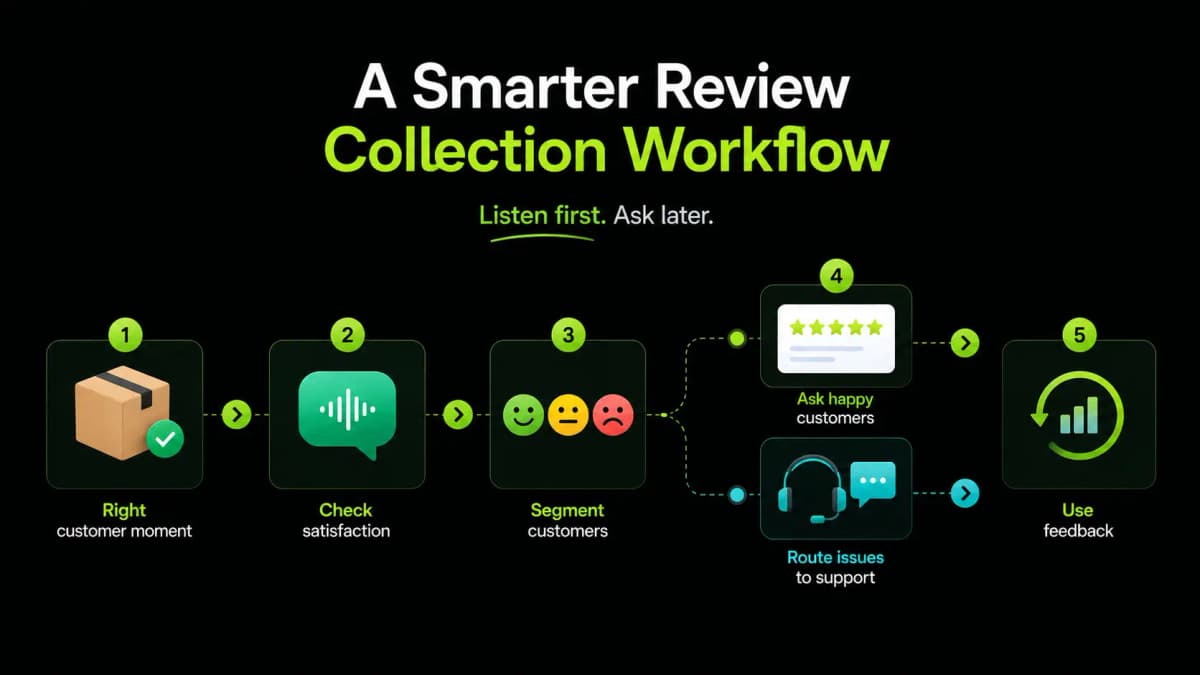
A better workflow starts with listening, then asking.
Instead of sending the same review request to every customer after a fixed number of days, trigger feedback based on delivery, product usage window, support resolution, or repeat purchase behavior.
This makes the request more relevant and less unwanted.
Start with a simple satisfaction check. This could be a quick rating, yes-or-no question, or short conversation.
The goal is to understand whether the customer is happy enough to be asked for a public review.
Not every customer should receive the same next step. They might be:
Happy customers can be asked to leave a review.
Neutral customers can be asked what would have improved the experience.
Unhappy customers should be routed to support, replacement, return, refund, or escalation workflows.
This turns review collection into customer experience management, not just review collection.
Once a customer is review-ready, make the next step simple.
Send them directly to the review page. Mention the product. Keep the request short. Use a clear call to action. Avoid unnecessary form fields.
The customer has already shown satisfaction, so the review process should not slow them down.
Reviews and feedback should not sit in a dashboard only.
Product complaints should inform product teams. Delivery complaints should inform logistics. Support complaints should inform CX teams. Positive reviews should support merchandising, product pages, retention campaigns, and social proof.
This is how ecommerce customer feedback becomes operationally useful.
As you know now review collection works better when the brand listens before asking.
A short post-purchase conversation can confirm that the customer received the order, check whether the product met expectations, capture context, and identify whether the customer is review-ready.
This is especially useful when email is too passive or when the brand needs more than a star rating.
Conversational feedback can help ecommerce brands understand:
Whether the delivery experience was smooth.
Whether the customer used the product.
Whether the product met expectations.
Whether the customer needs help.
Whether the customer is likely to leave a positive review.
Whether a negative experience should be recovered before any public request.
This makes the review request feel more natural because it comes after the brand has shown interest in the customer’s experience.
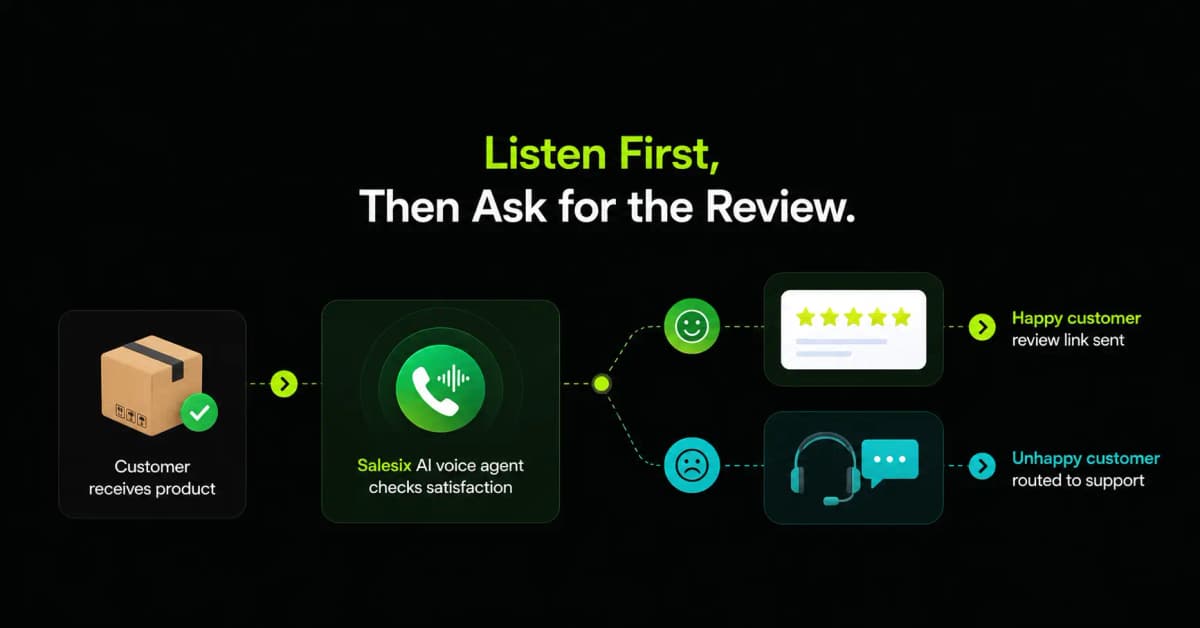
AI voice agents for ecommerce fit into feedback & review collection as a conversational feedback layer before the public review request.
For ecommerce brands, Salesix AI can help automate post-purchase feedback calls that feel more natural than another generic reminder.
Instead of simply asking every customer to “leave a review,” Salesix can first check satisfaction, capture customer context, and identify customers who are ready to share a positive experience publicly.
For example, an AI voice agent can call after the product usage window and ask questions like:
whether the order arrived properly?
whether the product met expectations?
whether the customer needs help?
Based on the response, the workflow can guide happy customers toward a review link, route unhappy customers to support.
This makes review collection more useful for both sides. Customers feel heard before they are asked for a review. Ecommerce teams get more context, cleaner segmentation, and a better way to recover problems before they become public complaints.
Salesix is not replacing the review platform. It strengthens the customer conversation before the review request.
Use this checklist to build a less pushy ecommerce review strategy:
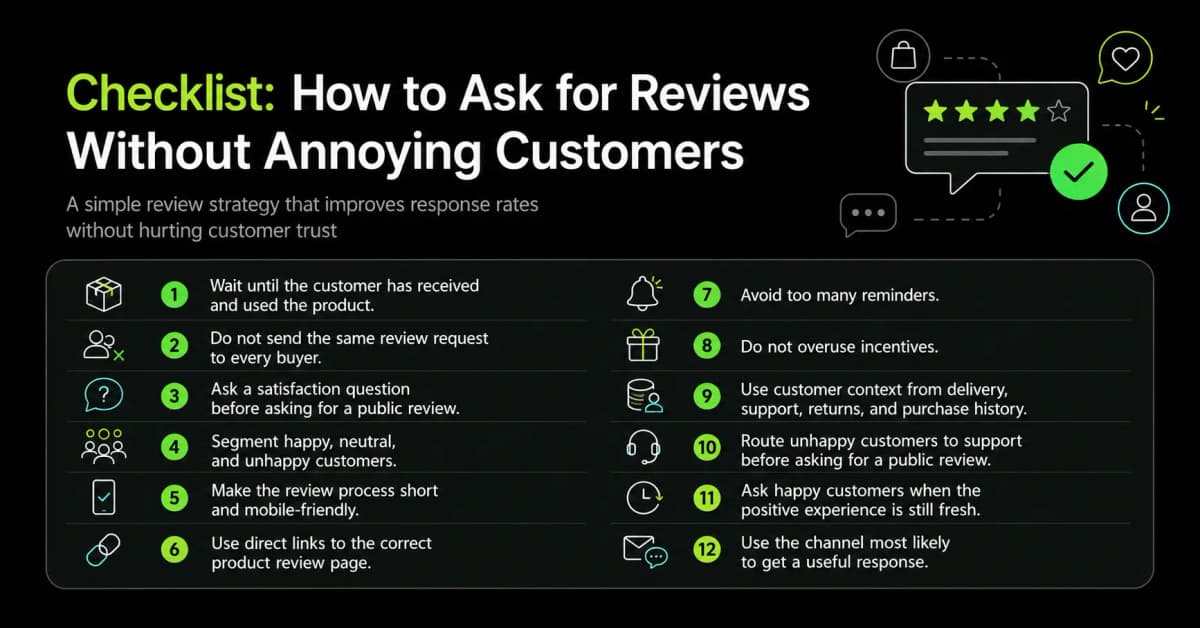
The best way to get more customer reviews is not to pressure customers with more emails. It is to build a review workflow around timing, satisfaction, context, and ease.
Ecommerce brands get better reviews when they ask after customers have actually experienced the product, listen before requesting public feedback, and guide happy customers toward the right review moment. At the same time, unhappy customers should be routed into recovery workflows before frustration turns into a negative public review.
More reviews should not come at the cost of customer trust. A feedback-first approach helps brands collect more useful ecommerce reviews while protecting the post-purchase experience.

Get $5 free credit on signup — no credit card required. Set up your AI voice agent in minutes and start converting more leads today.