Order-Confirmation
How AI Voice Agents Improve Ecommerce Order Confirmation



Premium Humanoid AI Voice Agents for your business.
Order confirmation sounds simple. It simply looks like A customer places an order, someone calls to verify it, and the warehouse ships it.
For many ecommerce brands, order confirmation can be a problem. This is especially true for those who focus on COD and high volumes. It often becomes an operational bottleneck.
Orders can have wrong phone numbers. They might have missing addresses or incorrect details. Sometimes, there’s low buyer intent. You may encounter duplicate entries or customers who are unsure after completing their checkout.
When manual teams manage all confirmation calls, dispatch is delayed. Verification quality changes, and reporting gets tricky.
That is where ecommerce order confirmation automation becomes valuable. AI voice agents for ecommerce can make customer calls easier. They turn manual calls into a simple pre-dispatch workflow.
Ecommerce teams should go beyond just asking, “Did we call the customer?” They can focus on a bigger question: “Is this order ready to ship, hold, correct, cancel, retry, or escalate?”
In this post, you’ll discover how AI voice agents enhance ecommerce order confirmation. You’ll see where manual calling falls short and learn what to seek in an AI calling system. Additionally, discover how Salesix streamlines order confirmation workflows efficiently.
A placed order is not always a clean order or a real order.
In ecommerce, especially in cash-on-delivery markets, checking out doesn’t always mean a buyer is serious.
Many people browse. Some customers order impulsively and change their minds later. Some enter incomplete addresses. Some places duplicate orders. Some do not answer delivery calls. Others may not remember the exact product, COD amount, or delivery date.
After confirmation, brands can also improve the post-dispatch experience with ecommerce delivery update automation that keeps customers informed until the order arrives.
Order confirmation helps ecommerce teams catch these issues before fulfillment costs are wasted.
Common order risks include:
Wrong or unreachable phone numbers
Missing address details or landmarks
Low-intent COD orders
Fake or suspicious orders
Duplicate orders from the same customer
First-time buyer hesitation
Customer uncertainty after checkout
Delivery availability issues
High-risk pincodes or regions
Past cancellation or RTO behavior
For additional context on ecommerce order risk signals, Shopify’s guide to fraud prevention and fraud analysis explains how merchants can review suspicious orders before fulfillment.
Without confirmation, these orders move into packing, dispatch, courier allocation, and last-mile delivery.
By the time the issue shows up, the brand might have paid for shipping. They could have blocked inventory, too. Plus, there may be extra work in the warehouse.
If fake or suspicious orders are a recurring problem, this guide on how to reduce fake orders in ecommerce before they reach fulfillment explains how pre-dispatch verification can help stop bad orders earlier.
The primary goal of order confirmation is not only to make a customer call. The goal is to decide the next course of action.
A good order confirmation workflow should help the team decide whether an order should be:
Shipped immediately
Held for address correction
Cancelled before dispatch
Retried later
Escalated to a human agent
Marked as risky
Updated with corrected delivery details
This is why order confirmation should be treated as a pre-dispatch quality-control step. The call is only one part of the workflow. The outcome is what matters.
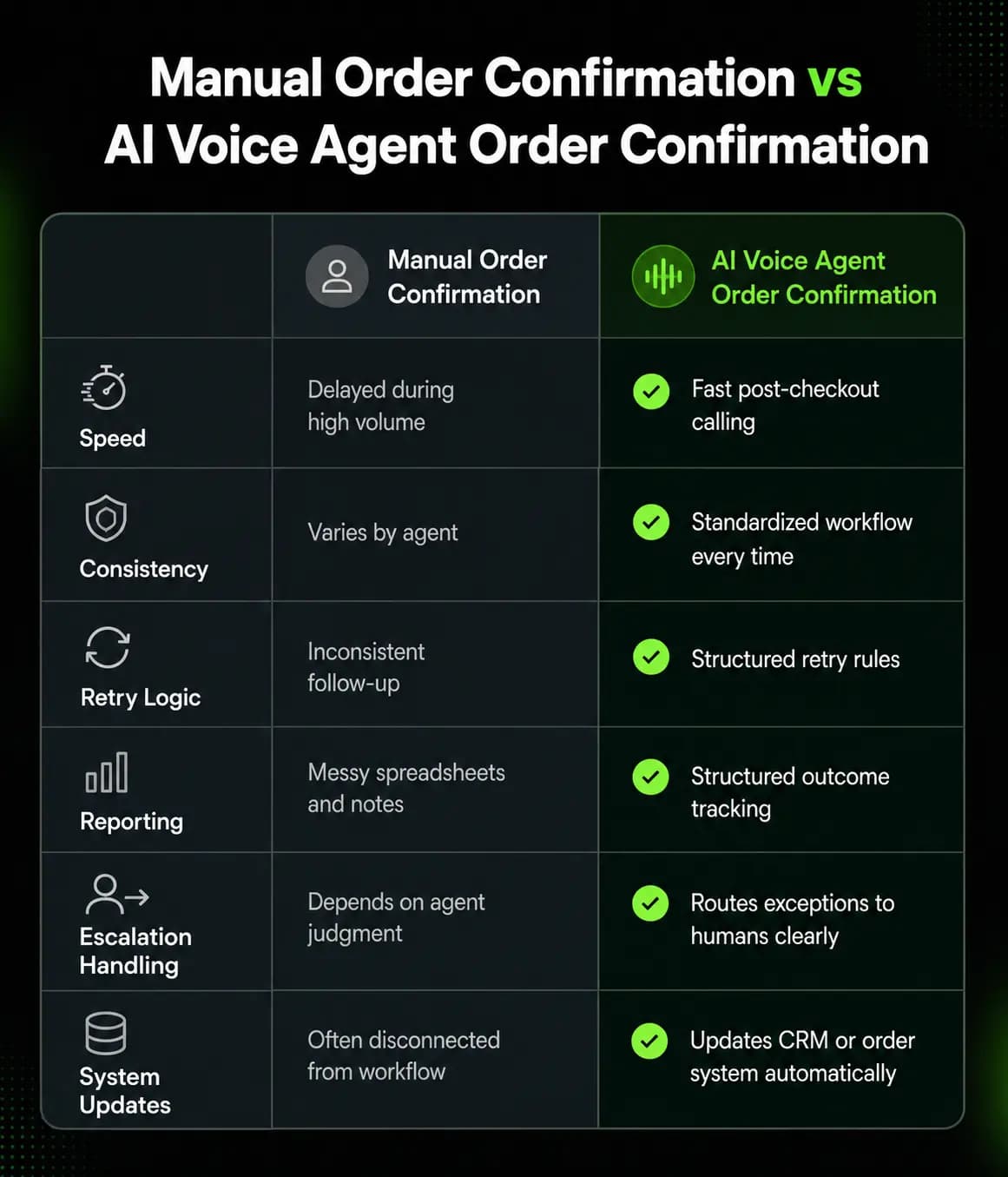
Manual confirmation can work when order volume is low. But as ecommerce brands scale, manual calling becomes slower, less consistent, and harder to measure.
For a deeper breakdown of this operational problem, read Why Manual Order Confirmation Breaks at Scale in Ecommerce.
Order confirmation works best soon after checkout, while the buyer's intent is still fresh. If a customer placed a COD order 10 minutes ago, they are more likely to remember the purchase, confirm details, and correct mistakes.
But during sale periods, product drops, festive seasons, or ad campaign spikes, manual teams often cannot call fast enough.
Orders pile up in queues. Some customers contacted too late. Dispatch waits for confirmation. Operations teams are forced to choose between shipping unverified orders or delaying fulfillment.
Both options create risk.
Manual calling depends heavily on the agent. One agent may verify the customer’s name, address, COD amount, product, and delivery availability. Another may only ask, “Do you want this order?”
Over time, this creates inconsistent confirmation quality.
Common manual calling issues include:
Skipped questions
Incomplete notes
Different handling styles
Weak cancellation reason capture
No standard retry logic
Unclear escalation rules
Poor follow-through after address correction
When each agent handles calls differently, then controlling order verification becomes challenging.
Warehouse and dispatch teams often wait. They need confirmation of outcomes before moving orders ahead. If the calling team is delayed, fulfillment slows down too.
This creates a chain reaction. Confirmed orders may sit idle. Risky orders may get shipped accidentally. Cancelled orders may still enter packing. Address correction cases may get lost between support, operations, and warehouse teams.
Manual confirmation not only affects the call center workload. It affects the entire fulfillment flow.
Many ecommerce teams track confirmation outcomes. They use spreadsheets, call logs, CRM notes, or other separate systems. This makes reporting unreliable.
Teams may struggle to answer basic questions such as:
What percentage of orders were confirmed?
How many customers were unreachable?
How many orders were cancelled before dispatch?
Which regions have higher confirmation failure?
How many addresses were corrected?
How many risky orders were still shipped?
How many exceptions needed human support?
Without clear reporting, order confirmation stays reactive. It doesn't turn into a measurable workflow.
An AI voice agent for order confirmation is a system that calls customers after a customer places an order. It can check the order details, understand what the customer wants, and update the next step in the process.
Unlike basic robocalls or one-way alerts, AI voice agents can hold two-way conversations. They can ask questions and understand customer responses. They capture structured outcomes and route exceptions to human teams when needed.
For ecommerce brands, automated confirmation calls can now be part of the order workflow. They won’t just sit outside it anymore.
A basic IVR usually follows a rigid flow. It may ask the customer to press 1 to confirm or press 2 to cancel. That can work for very simple cases, but it breaks when customers respond in different ways.
For example, a customer may say:
“I want the order, but change the address.”
“Can you deliver after Friday?”
“I ordered by mistake.”
“I don’t remember placing this order.”
“The amount sounds wrong.”
“Please connect me to someone.”
A basic IVR is not built for flexible conversations like these.
An AI voice agent can support natural responses, understand varied customer intent, capture structured outcomes, and route complex cases to humans. That makes it more useful for order verification for ecommerce, where the customer’s response is not always a simple yes or no.
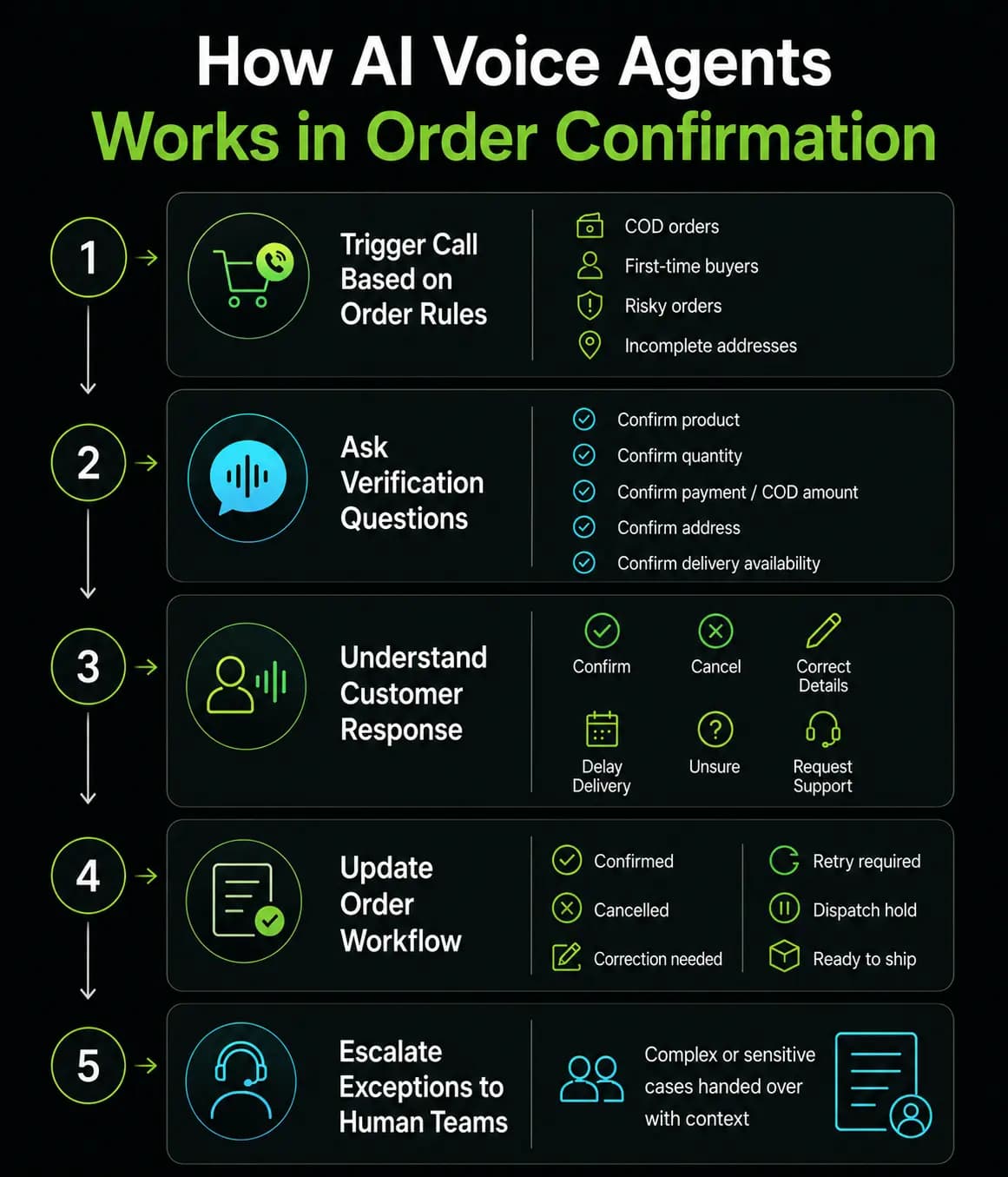
AI voice order confirmation works best when it connects to:
Order rules
Customer data
Fulfillment logic
Human escalation paths
Let's discuss the step-by-step workflow:
Not every order needs a confirmation call. Calling every customer can increase cost and create unnecessary friction.
A stronger workflow uses rules to decide which orders should be confirmed. For example, an AI calling for order confirmation workflow may trigger calls for:
COD orders
First-time buyers
High-value orders
Suspicious addresses
High-risk pincodes
Repeat cancellation history
Manual review flags
Orders with incomplete address fields
Customers with a failed delivery history
This keeps the workflow focused on orders where confirmation can reduce risk.
The call should be short, clear, and useful. A good voice order confirmation flow verifies the details that affect dispatch quality.
The AI voice agent may confirm:
Customer identity
Product ordered
Quantity
COD amount or payment status
Delivery address
Landmark
Phone number validity
Delivery availability
Final confirmation to ship
The goal is not to make the call long. The goal is to collect the minimum information needed to make a better dispatch decision.
Customers do not always answer in neat categories. An AI voice agent should detect whether the customer:
Confirms the order
Cancels the order
Wants to change the address
Requests delayed delivery
Sounds unsure
Does not answer
Has a payment or product question
Needs human support
This is where AI voice agents are more useful than rigid scripts. They can understand intent and move the order into the right next step.
The confirmation outcome should not stay trapped in a call log. It should update the order system or CRM so operations teams can act on it.
Possible order statuses include:
Confirmed
Cancelled
Address correction required
Retry required
Human escalation needed
Dispatch hold
Ready to ship
This is the point where ecommerce order confirmation automation becomes operationally valuable. The call result directly informs fulfillment.
AI voice agents should not replace human judgment in every situation.
Humans should deal with complex cases. They handle sensitive customers, product issues, refund worries, payment disputes, and unusual requests.
Automation should manage repetitive confirmations at scale. Meanwhile, human teams can focus on exceptions that need care and judgment.
Ecommerce order confirmation automation improves more than calling speed. It improves buyer intent verification, dispatch quality, team workload, and reporting.
AI voice agents can call customers quickly after checkout, when the order is still fresh in the customer’s mind.
This helps ecommerce teams verify buyer intent before the order enters fulfillment. For COD-heavy brands, quick confirmation helps identify serious buyers. This way, you can spot low-intent or accidental orders sooner.
You can also read how to lower ecommerce RTO rates without expanding your call centre if your main goal is reducing avoidable returns while keeping manual workload under control.
Manual agents often spend hours repeating the same questions:
Did you place this order?
Is this your address?
Can we ship this today?
Will you be available for delivery?
AI voice agents can handle these repetitive calls. This lets human agents focus on exceptions, escalations, and important customer conversations.
AI follows the same workflow logic every time. It does not forget questions, skip fields, or use different confirmation standards across agents.
This creates a more consistent order verification process across teams, regions, and order types.
Many delivery failures begin before dispatch. Missing landmarks and wrong phone numbers can cause problems. Unclear addresses and unavailable customers also lead to failed deliveries.
For teams improving address quality, Google’s Address Validation overview explains why validating and correcting address details can improve operational accuracy.
Automated confirmation calls help catch these problems earlier. The AI voice agent can
Ask customers to confirm the address
Request any missing details
Ask for corrections before the order proceeds
The warehouse should not have to guess which orders are safe to ship.
With automated confirmation outcomes, fulfillment teams can:
Ship confirmed orders.
Hold risky orders.
Cancel invalid orders.
Escalate unclear cases.
This helps reduce confusion between support, operations, and warehouse teams.
AI voice agents can create structured reporting around confirmation outcomes.
Useful metrics include:
Confirmation rate
Cancellation rate
Unreachable rate
Retry success rate
Address correction rate
Escalation rate
Dispatch hold rate
Ready-to-ship rate
These metrics help ecommerce teams check order quality. They do this before fulfillment, not just after delivery fails.
AI voice order confirmation is especially useful for ecommerce brands where order risk, volume, or manual workload is high.
Let's discuss some of them:
COD orders need stronger buyer-intent verification because payment is collected at delivery. If the customer changes their mind, refuses the package, or is unavailable, the brand may absorb shipping and return costs.
AI voice agents can help confirm the COD intent before dispatch.
As order volume grows, manual calling becomes harder to manage. More orders mean more calls, more queues, more agent variation, and more reporting gaps.
AI voice agents help busy teams standardise confirmations. They do this without needing to expand call centre capacity all the time.
Some ecommerce brands deal with fake orders, prank orders, duplicate orders, or buyers who place COD orders without a strong intent.
Voice verification helps spot bad-fit orders before dispatch. This works even better with order risk rules.
As brands expand into new regions, language and accent handling become important. Customers might feel more at ease confirming orders in their preferred language or local style.
Multilingual and localized AI voice agents can help standardize order confirmation across markets.
Small operations teams often cannot afford to add more callers every time order volume increases.
AI voice agents help lean teams manage a structured confirmation workflow. They allow scaling without relying solely on manual headcount.
Not every AI calling tool is suitable for ecommerce order confirmation. The system should support real operational workflows, not just outbound call volume.
Avoid systems that sound like robotic scripts. Customers can respond naturally. They can ask simple questions, correct details, and show uncertainty.
Different orders need different workflows. A prepaid repeat customer may not need the same flow as a high-value COD order from a first-time buyer.
The system must allow custom rules for:
Order type
Customer risk
Region
Payment method
Operational priority
Customers do not always answer the first call. A good system should support retry windows for missed, rejected, or unanswered calls.
Retry logic should be structured, not random.
Call outcomes should update the order system, CRM, helpdesk, or operations dashboard. If the outcome sits separately, the fulfillment team still has to chase information manually.
Complex cases should move to support or operations teams with context. Human agents should know what the customer said, what was verified, and why the case needs attention.
The system should track:
Confirmation rates
Cancellation rates
Unreachable customers
Address corrections
Retry outcomes
Dispatch decisions
Call volume alone is not enough. Business impact matters more.
Automation improves order confirmation only when it is designed around the workflow. Poor implementation can create friction instead of reducing it.
Calling every customer may look thorough, but it can increase cost and annoy low-risk buyers. Use confirmation rules to prioritize orders that actually need verification.
Order confirmation should be quick and focused. Long scripts increase drop-offs and customer frustration.
Ask only what is needed to make a dispatch decision.
Customers should not feel like they are listening to a one-way recording. AI voice agents should support conversation, clarification, and exception handling.
If the call outcome does not update the order workflow, automation loses much of its value.
This should be look like this:
A confirmed order should move forward.
A risky order should be held.
An address issue should trigger a correction.
A complex case should go to a human team.
The goal is not to make more calls. The goal is to improve order quality before dispatch.
Track outcomes such as:
confirmed orders
cancellations before dispatch
address corrections
unreachable customers
escalations
Salesix is a humanoid AI voice agent platform. It helps e-commerce brands automate order confirmation calls. It verifies order details and supports natural customer conversations.
Salesix syncs outcomes with business systems and scales calling workflows. This means you don't need more manual call centre staff.
Salesix supports:
Automated order confirmation calls
Proactive AI voice calls
Natural, human-like conversations
Buyer intent and order detail verification
CRM and business tool synchronization
High-volume call scalability
Multilingual and regional language support
Post-call outcome tracking
Human handoff for exceptions
Here is how a Salesix ecommerce order confirmation workflow can work:
Customer places an order.
Order enters confirmation rules.
Salesix AI voice agent calls the customer.
Customer confirms, corrects, cancels, or requests help.
Outcome syncs with the CRM or order system.
Warehouse receives a clear next step.
The human team handles only exceptions.
This helps ecommerce teams. They can move from manual calling queues. Now, they use a clear pre-dispatch verification workflow.
Explore Salesix’s ecommerce order confirmation automation use case to see how AI voice agents can help verify buyer intent, confirm order details, and update dispatch workflows before fulfillment.
Order confirmation is not only a call center task. It is a pre-dispatch quality-control workflow.
Manual calling can work at low volume, but it becomes slow, inconsistent, and difficult to measure as ecommerce brands scale.
High order volume, COD risk, fake orders, address issues, and unreachable customers all make manual confirmation tough to handle.
AI voice agents boost ecommerce order confirmation automation. They confirm buyer intent, check key order details, update workflows, and handle exceptions before orders go into fulfillment.
The result is a faster and more structured way to decide which orders are ready to ship, which need correction, and which should be held or cancelled.
For a more implementation-focused next step, read the Ecommerce Order Confirmations Playbook to see how to structure confirmation rules, call flows, outcomes, and handoffs.
An AI voice agent for order confirmation is a calling system. It automatically calls customers after they check out. It verifies order details, captures buyer intent, and updates the next step in the workflow.
Ecommerce order confirmation automation triggers calls based on order rules. It asks verification questions and understands customer responses. Then, it updates the order status and sends exceptions to human teams.
Yes, for flexible ecommerce workflows. IVR often relies on strict button flows. In contrast, AI voice agents can have natural conversations. They understand different responses and handle complex cases.
Yes, AI voice agents can:
Verify COD buyer intent
Confirm the payable amount
Check delivery availability
Identify cancellations before dispatch
Automated confirmation calls can find fake orders. They also catch low-intent, duplicate, or suspicious ones. This happens before fulfillment. They are most effective when combined with order risk rules.
An order confirmation call should:
Verify the customer’s identity
Confirm the product ordered and quantity
Check the payment or COD amount
Validate the delivery address and landmark
Ensure phone number is valid
Ask for final permission to ship
No, AI voice agents do not need to replace manual teams. They can take care of repetitive confirmation calls. Meanwhile, human agents handle exceptions, complex requests, and sensitive customer cases.
Salesix AI helps ecommerce brands by automating confirmation calls. It verifies buyer intent and captures structured outcomes. Then, it syncs call results with business systems and escalates exceptions to human teams.

Get $5 free credit on signup — no credit card required. Set up your AI voice agent in minutes and start converting more leads today.