Order-Confirmation
How to Reduce Fake Orders in Ecommerce Before They Reach Fulfillment



Premium Humanoid AI Voice Agents for your business.
Fake orders often look normal at checkout. A customer enters a name, phone number, address, product selection, and payment preference. The order enters the system like any other order.
The cost appears later because the inventory gets reserved, and warehouse teams start picking and packing.
If the courier fails to deliver, the brand loses time, money, and resources. This includes wasted shipping costs, returns, blocked inventory, and inaccurate data.
That is why learning how to reduce fake orders in ecommerce is not only about fraud detection at checkout. It is about pre-fulfillment verification.
Ecommerce brands must check risky orders. They need to confirm if the orders are real, reachable, deliverable, and worth sending. This should happen before they face any fulfillment costs.
In this post, you’ll discover how to cut down on fake orders in ecommerce. You’ll learn to:
Spot risky orders early.
Verify buyer intent.
Check phone and address quality.
Confirm COD commitment.
Stop bad orders before they reach fulfillment.
Fake orders in e-commerce are those made without real buying intent. They often lack correct customer details and have little chance of successful delivery.
They can include:
Fake names
Invalid phone numbers
Wrong or incomplete addresses
Bot-generated orders
Prank orders
Duplicate orders
Fake COD orders
Low-intent cash-on-delivery orders
Orders placed by customers who do not intend to accept delivery
Some fake orders are clearly fraudulent. Some are tougher to spot. They seem like real orders at checkout, but fail during confirmation, fulfillment, or delivery.
Payment fraud is only one type of ecommerce risk.
A payment fraud order often involves stolen cards. It may include unauthorised payments, chargeback risks, or unusual payment behaviour. Fake orders can be different. They may not involve online payment at all.
Many fake COD orders pass checkout because there is no upfront payment to validate commitment. The customer may enter a reachable number, but later refuse delivery. Or they may provide an incomplete address, etc. There can be many reasons.
That means fake order prevention cannot rely only on payment fraud tools. Brands also need to answer a more operational question: Is this order ready to move forward?
Fake orders become expensive when they move from the website into operations.
Before fulfilment begins, the system records a risky order. After fulfillment starts, it creates real cost across many teams.
A fake order can lead to:
Reserved inventory that could have gone to a real customer
Picking and packing effort
Packaging waste
Forward shipping cost
Failed delivery attempts
Return-to-origin cost
Support workload
Courier coordination
Distorted demand forecasting
Poor campaign performance data
The biggest issue is timing. If a brand discovers the order is fake after dispatch, the damage has already started. The business is no longer preventing costs. It is recovering from it.
To understand how these failed delivery and return costs build up, read What Is RTO in Ecommerce? Causes & How to Reduce It.
The strongest fake order prevention workflows do not only ask, “Is this order fraudulent?”
They ask, “Should this order move forward to fulfillment?”
That shift matters. A suspicious order may not look like payment fraud, but it may still be risky for dispatch.
For example, a COD order might need verification. This is true if it has an incomplete address, an unreachable customer, or a first-time buyer profile. The warehouse needs to verify before it starts work.
We should treat fake order prevention as a dispatch-readiness decision.
Fake COD orders are risky because the customer has not paid up front.
Cash on delivery makes it easier for real buyers, especially in places where people like to pay after getting their product.
But it also reduces purchase commitment. Prank buyers, low-intent shoppers, and unsure customers can place orders. This is because the system collects no money at checkout. They don’t face any immediate consequences.
Fake COD orders often happen when:
A customer places an order without serious intent
A prank order is placed using someone else’s details
The phone number is incorrect or unreachable
The address is incomplete or inaccurate
The customer changes their mind before delivery
The buyer refuses to pay at the doorstep
The customer does not understand the final COD amount
Removing COD entirely may reduce fake COD orders, but it can also hurt genuine buyers who prefer or need COD.
For many ecommerce brands, the better approach is not a blanket restriction. It is smarter to have COD order verification before fulfillment.
If fake COD orders are already increasing delivery failures, this guide explains how to lower e-commerce RTO rates fast without expanding your call centre.
Fake orders usually happen because ecommerce checkout is designed for conversion, not operational certainty.
Most ecommerce stores reduce friction at checkout because every extra field or step can affect conversion. That is understandable.
However, fast checkout can also allow weak orders to slip through. Some of them are:
A customer may enter incomplete details, a fake name, or a wrong phone number.
A bot may submit orders.
A low-intent buyer may place an order without considering the delivery or payment details.
The checkout process captures order details. It does not always confirm operational readiness.
COD allows customers to place orders without paying immediately. This can help conversion, but it also creates risk.
Some of the risks can be:
A prepaid customer has already taken a financial action.
A COD customer may still be deciding.
Some are genuine.
Some are uncertain.
Some are fake.
Without verification, all of them may enter the same fulfillment process.
Fake orders are not always malicious. Sometimes customers enter careless or incomplete details.
Common issues include:
Invalid phone numbers
Missing house numbers
No landmark
Wrong pincode
Placeholder addresses
Unclear delivery instructions
Duplicate orders from the same customer
Even when the customer is real, poor details can create failed delivery and RTO risk.
For teams improving address quality at checkout, Google’s guide to address validation for ecommerce checkout explains how better address capture can reduce delivery issues.
CAPTCHA, OTP, email verification, and fraud scoring can help. But they do not always prove that the customer is ready to receive and pay for the order.
An OTP can confirm access to a phone number. It does not confirm that the customer wants the product.
CAPTCHA can reduce bot orders. It does not confirm address quality.
Fraud scoring can detect suspicious patterns. It may still miss low-intent COD behavior.
Passive checks are useful, but they are not the same as buyer intent verification.
In many ecommerce workflows, once an order is placed, fulfillment starts automatically.
That is efficient for trusted orders. But it’s risky for COD orders, first-time buyers, suspicious baskets, incomplete addresses, or areas with high RTO.
Without a pre-fulfillment checkpoint, risky orders rush into the warehouse. They move too quickly into shipping processes.
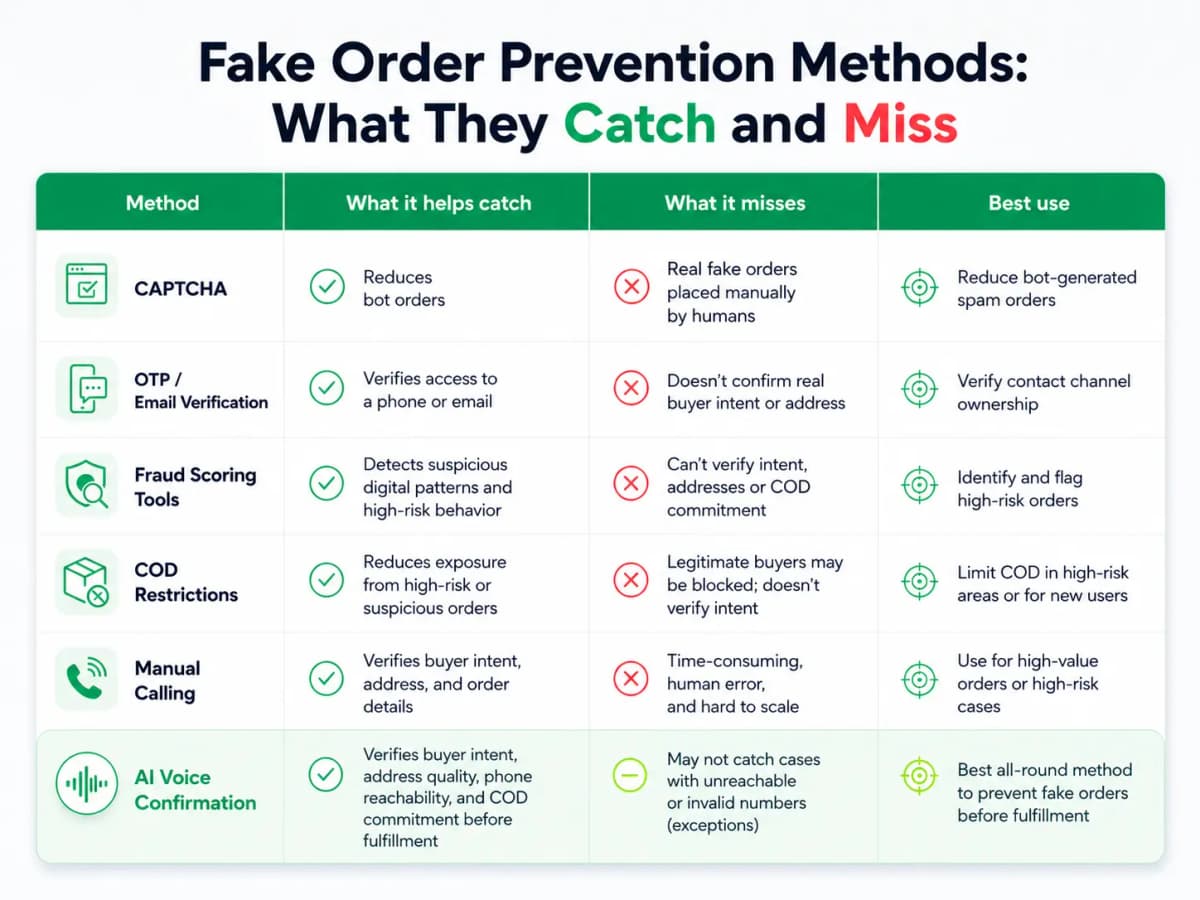
There is no single method that catches every fake order. Each method helps with one part of the problem.
CAPTCHA can reduce bot-generated orders and automated spam activity.
But CAPTCHA does not confirm whether a real customer intends to accept delivery. It also does not verify address quality, COD commitment, or phone reachability.
OTP and email verification confirm that the customer has access to a phone number or email address.
That is useful, but it has limits. A customer can complete OTP and still refuse delivery later. OTP does not confirm that the address is complete, the order is intentional, or the buyer understands the COD amount.
Fraud scoring tools can spot unusual patterns and look for strange order behaviour. They also check risky locations and device signals. Plus, they track repeated suspicious activity.
They are valuable for ecommerce fraud prevention. But they may miss operational risk, especially fake COD orders that look normal digitally but fail during delivery.
COD restrictions can cut down on fake orders. They do this by limiting access in risky areas, for high-value purchases, first-time buyers, or unusual order patterns.
The risk is overcorrection. If restrictions are too broad, genuine customers may abandon checkout. COD restrictions work best when paired with smarter verification rather than applied as a blanket rule.
Manual calling is one of the most direct ways to verify buyer intent.
A human agent can call the customer, confirm order details, check address quality, and decide whether the order should proceed. But manual calling is slow and hard to scale.
Agents might ask various questions. Notes can be inconsistent. Risky orders may be fulfilled before the team finishes verification.
An AI voice agent for order confirmation helps brands quickly and efficiently verify orders before fulfilment. It’s fast, structured, and scalable. Some of the benefits are mentioned below:
An AI voice agent can call risky customers shortly after checkout.
Confirm intent.
Validate key details.
Capture outcomes.
Route exceptions before warehouse and shipping costs begin.
The best way to reduce fake orders in ecommerce is to verify risky orders before fulfillment begins.
Pre-fulfillment verification is a checkpoint between checkout and dispatch. Its goal is to confirm whether the order is real, reachable, complete, and ready to ship.
A strong pre-fulfillment verification process should confirm:
Whether the customer is reachable
Whether the customer actually placed the order
Whether they still want the product
Whether the phone number is valid
Whether the address is complete
Whether a landmark or delivery instruction is needed
Whether the customer understands the COD amount
Whether the order should be shipped, held, corrected, or cancelled
This process helps ecommerce teams stop bad orders early and move good orders forward with more confidence.
Explore how an AI voice agent for ecommerce can support order confirmation, delivery updates, support calls, returns, and other customer communication workflows.
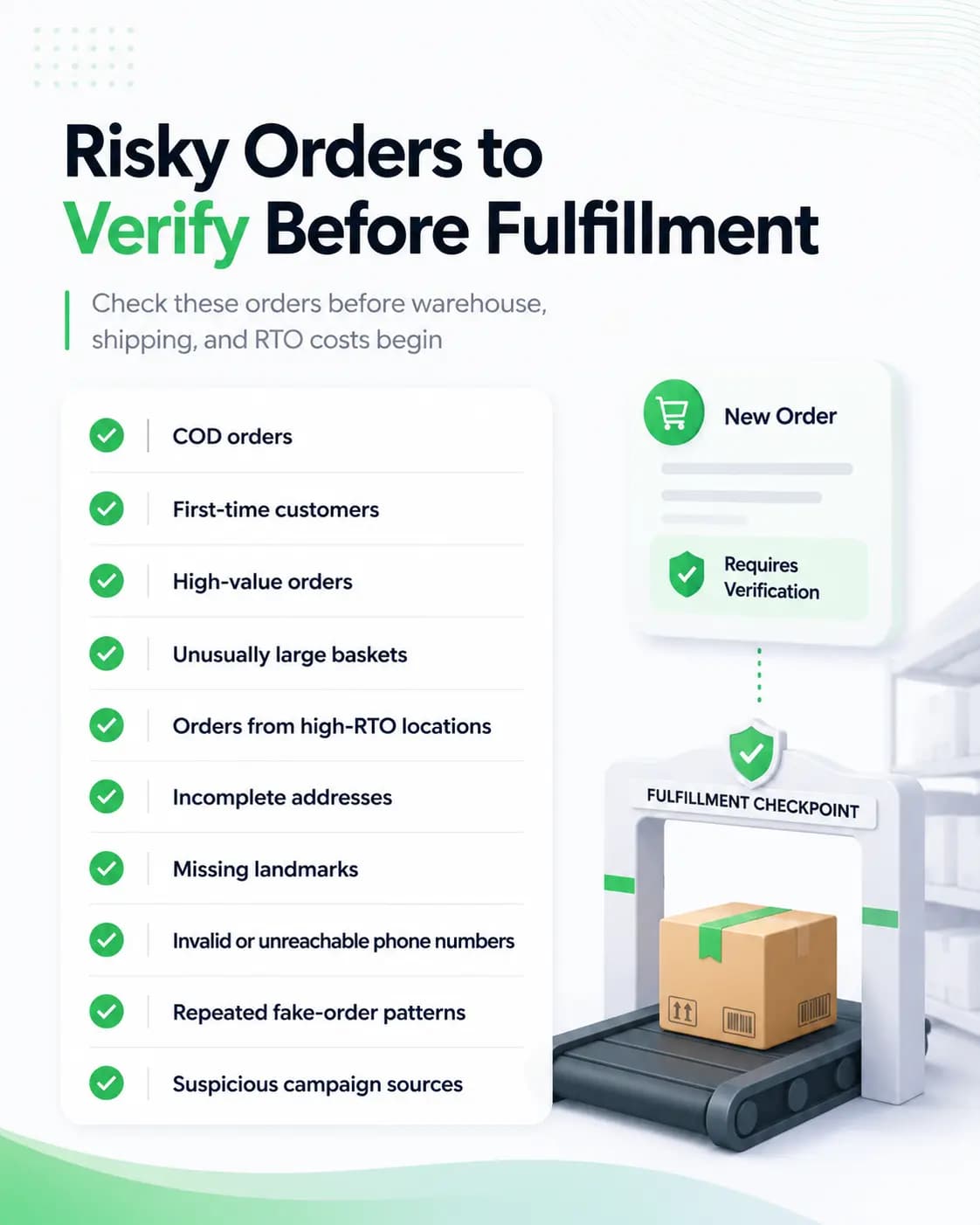
Not every order needs the same level of verification. Verifying every order manually can slow down operations and create unnecessary costs.
Instead, ecommerce brands should prioritize high-risk orders.
Orders worth verifying before fulfillment include:
COD orders
First-time customers
High-value orders
Unusually large baskets
Orders from high-RTO locations
Orders with incomplete addresses
Orders with missing landmarks
Orders linked to repeated fake-order patterns
Orders with invalid or unreachable phone numbers
Orders from suspicious campaign sources
This keeps verification focused where it has the highest operational impact.
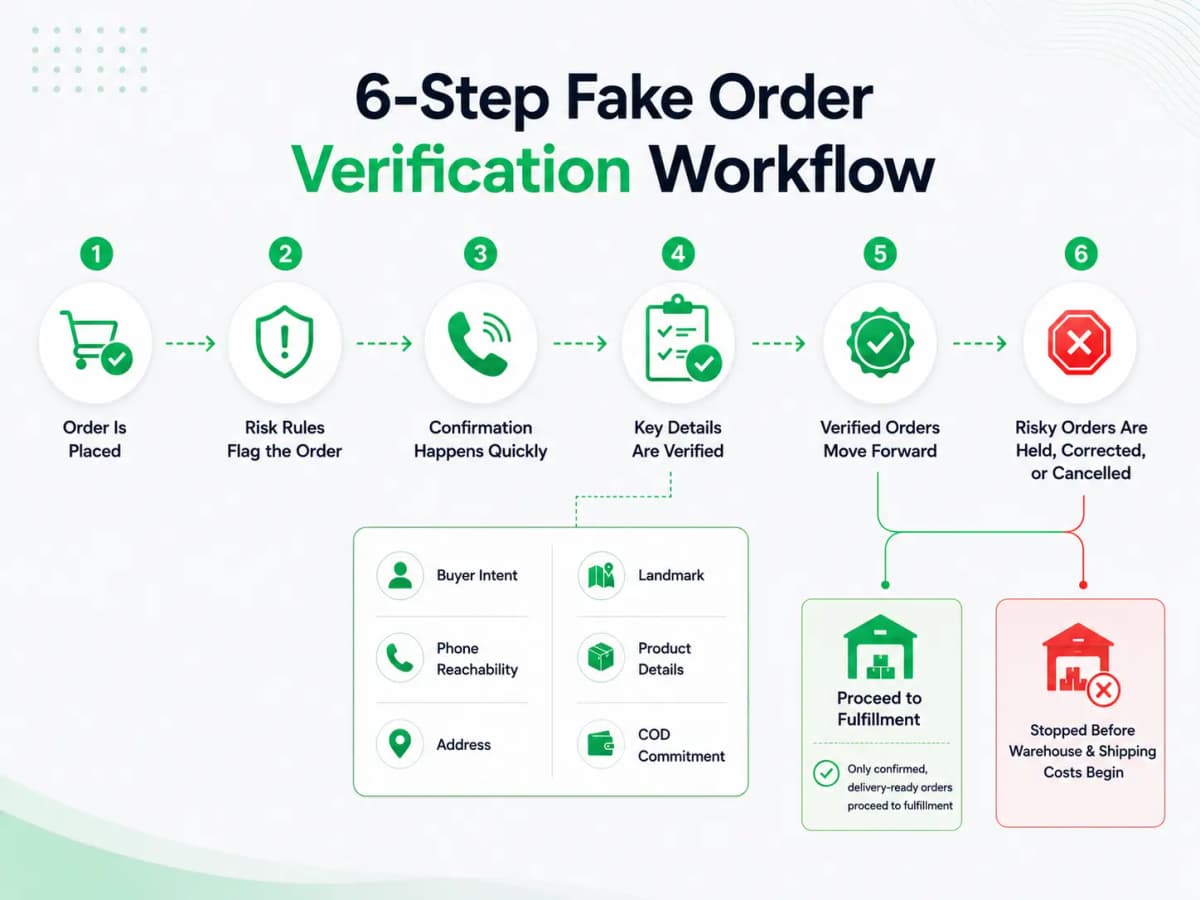
A fake order verification workflow should be quick. It must be organised and tied to fulfilment choices.
The customer places an order through the ecommerce store. The order enters the system after checkout.
The system flags orders based on risk rules.
These may include:
COD payment
Suspicious details
Risky locations
First-time customers
Large orders
Known fake-order patterns
The customer is contacted before the order moves too far into fulfillment.
Speed matters. The longer verification takes, the more likely warehouse teams are to start processing the order.
The verification step checks several things. It confirms buyer intent. It verifies phone reachability, address, and landmark. It also looks at product details, delivery availability, and COD commitment.
The goal is not only to ask, “Did you place this order?” It is to confirm whether the order is ready to ship.
If the customer confirms the order and the details are complete, the order continues to fulfillment.
If the customer cancels, doesn't reply, gives unclear details, or can't confirm the order, we will hold, correct, or cancel it. This helps avoid wasting fulfillment costs.
Following these steps ensures that only confirmed, delivery-ready orders proceed to the warehouse, directly protecting your operations from unnecessary costs.
Manual verification can work when order volume is small. It becomes harder as the business grows.
Support or operations teams cannot always call every risky order fast enough. Agents may ask different questions. Some may verify only intent, while others check address and COD amount. Outcomes may be written in notes that are difficult to report on. Follow-ups may be missed.
As volume grows, manual verification creates new bottlenecks:
More risky orders require more agents
Verification gets delayed during sales spikes
Warehouse teams may process orders before calls are completed
Call notes become inconsistent
Reporting becomes difficult
Managers cannot easily track how many fake orders were stopped
The result is a verification process that exists, but does not reliably protect fulfillment.
For a deeper look at this bottleneck, read why manual order confirmation breaks at scale in ecommerce.
An AI voice agent for order confirmation helps ecommerce brands cut down on fake orders. It automates structured customer calls before fulfillment.
An AI voice agent like Salesix AI can quickly contact customers after purchase. This way, it verifies the details needed for dispatch readiness, instead of relying on slow manual calls or passive checks.
Salesix AI voice agent order confirmation can help teams:
Confirm buyer intent
Verify phone reachability
Confirm the address and landmark
Confirm product details
Confirm the COD amount
Detect cancellation or low intent
Capture customer responses
Route exceptions to humans
Update CRM, OMS, or order systems
Stop risky orders before dispatch
This is super helpful for brands. It tackles fake COD orders, high RTO risk, delays in manual checks, and bad confirmation quality.
To see the full workflow, read how AI voice agents improve ecommerce order confirmation.
Here is what a Salesix-powered order confirmation workflow can look like:
A customer places a COD or high-risk order.
The order is flagged for confirmation.
The Salesix AI voice agent calls the customer.
The AI confirms buyer intent, order details, COD amount, and address.
The customer confirms, corrects, cancels, or does not answer.
The outcome syncs with the order workflow.
Verified orders move forward.
Risky orders are held before the fulfillment cost is wasted.
This changes the order confirmation. It turns a manual call task into a structured workflow for checking before fulfillment.
If fake orders are creating fulfillment losses, start with the workflow before adding more manual review.
Use this checklist:
Identify fake-order patterns by payment mode, region, SKU, campaign, and customer type.
Separate fake COD orders from payment fraud.
Define which orders need pre-fulfillment verification.
Shorten the time between checkout and confirmation.
Improve address and phone validation.
Use confirmation calls for high-risk orders.
Track fake orders stopped before dispatch.
Route exceptions to humans instead of manually reviewing everything.
Measure RTO and cancellation impact after verification.
Link verification outcomes directly to fulfillment decisions.
The goal is not to block every risky order. The goal is to verify the right orders early enough to avoid unnecessary warehouse, shipping, and RTO costs.
Use the Ecommerce Order Confirmations playbook to plan confirmation rules, verification questions, exception routing, and fulfillment decisions.
Fake orders are not only a checkout problem. They become expensive when they enter fulfillment.
The best way to reduce fake orders is to check risky ones first. Do this before starting warehouse work, shipping costs, failed deliveries, or returns.
This means checking buyer intent, phone reachability, address quality, and COD commitment early. This helps in making a fulfillment decision.
Salesix Order Confirmation helps ecommerce teams tackle fake COD orders and low-intent customers. It automates pre-fulfillment calls, checks buyer intent sooner, and manages risky orders. This prevents costs from piling up later.
Fake orders in e-commerce are those made without real buyer intent. They lack accurate customer details and have little chance of successful delivery. They can include:
Prank orders
Bot orders
Orders with wrong phone numbers
Orders with incomplete addresses
Duplicate orders
Fake cash-on-delivery orders
Ecommerce brands can cut down on fake orders by:
Using risk rules
Validating phone numbers and addresses
Verifying cash on delivery orders
Making confirmation calls
Conducting pre-fulfillment checks
These steps help ensure that risky orders don’t get to the warehouse and shipping processes.
Fake COD orders are common because customers do not pay up front. This lowers purchase commitment. It helps prank buyers and low-intent shoppers. Uncertain customers can also order without immediate costs.
Pre-fulfillment verification checks risky orders. It happens before the warehouse works or ships. It confirms buyer intent, phone reachability, address quality, delivery readiness, and COD commitment.
CAPTCHA and OTP help reduce some fake orders, but they do not stop all of them. CAPTCHA helps cut down bot activity, and OTP verifies access to a phone number. But neither truly confirms buyer intent or delivery commitment.
Yes. Order confirmation calls help cut down on fake orders. They check if the customer really placed the order, wants the product, has given a valid address, and understands the COD amount before shipping.
An AI voice agent can quickly contact risky customers. It asks structured verification questions and captures outcomes. Then, it routes exceptions and updates order workflows before any fulfillment costs arise.
Before shipping a risky order, brands should check:
Buyer intent
Phone reachability
Address completeness
Landmark
Product details
Delivery availability
COD amount
They should also decide if the order should proceed, be corrected, or be cancelled.

Get $5 free credit on signup — no credit card required. Set up your AI voice agent in minutes and start converting more leads today.