Order-Confirmation
What Is RTO in Ecommerce? Causes, Costs, and How to Reduce Them



Premium Humanoid AI Voice Agents for your business.
RTO in ecommerce is one of the most misleading losses for an online brand.
At first, the order looks successful. A customer places the order, the product is packed, the shipment is handed to the courier, and revenue looks likely.
But when the package isn’t delivered and returns to the seller, it creates extra costs. This includes shipping fees, blocked inventory, warehouse tasks, support work, and lost profit.
That is why high order volume does not always mean healthy revenue. If too many packages return to the origin, growth can quietly become expensive.
RTO is not only a courier problem. It is often caused by weak buyer intent, poor address quality, COD risk, failed delivery communication, and slow NDR recovery.
Top ecommerce brands lower avoidable RTO. They do this before dispatch, during delivery, and right after a failed delivery attempt.
In this post, you'll discover what RTO means in ecommerce. You'll see why it happens, how to calculate the RTO rate, and ways to reduce it.
This includes:
Improving order verification
Checking addresses
Enhancing delivery communication
Managing NDRs
Using automated order confirmation workflows
RTO stands for Return to Origin.
In ecommerce, RTO means a shipped order can't be delivered. It gets sent back to the seller, warehouse, or origin.
The customer never gets the package. Still, the brand pays for forward shipping, return shipping, handling, packaging, and follow-up.
Common RTO triggers include:
The customer refuses the delivery
Customer is unavailable
The delivery address is wrong or incomplete
The customer's phone number is invalid or unreachable
Delivery attempts fail
COD customer changes their mind
The customer is unaware of the delivery
Delivery is delayed, and the buyer loses interest
In simple terms, return to origin ecommerce losses occur when an order travels far enough to incur costs but fails to generate any revenue.
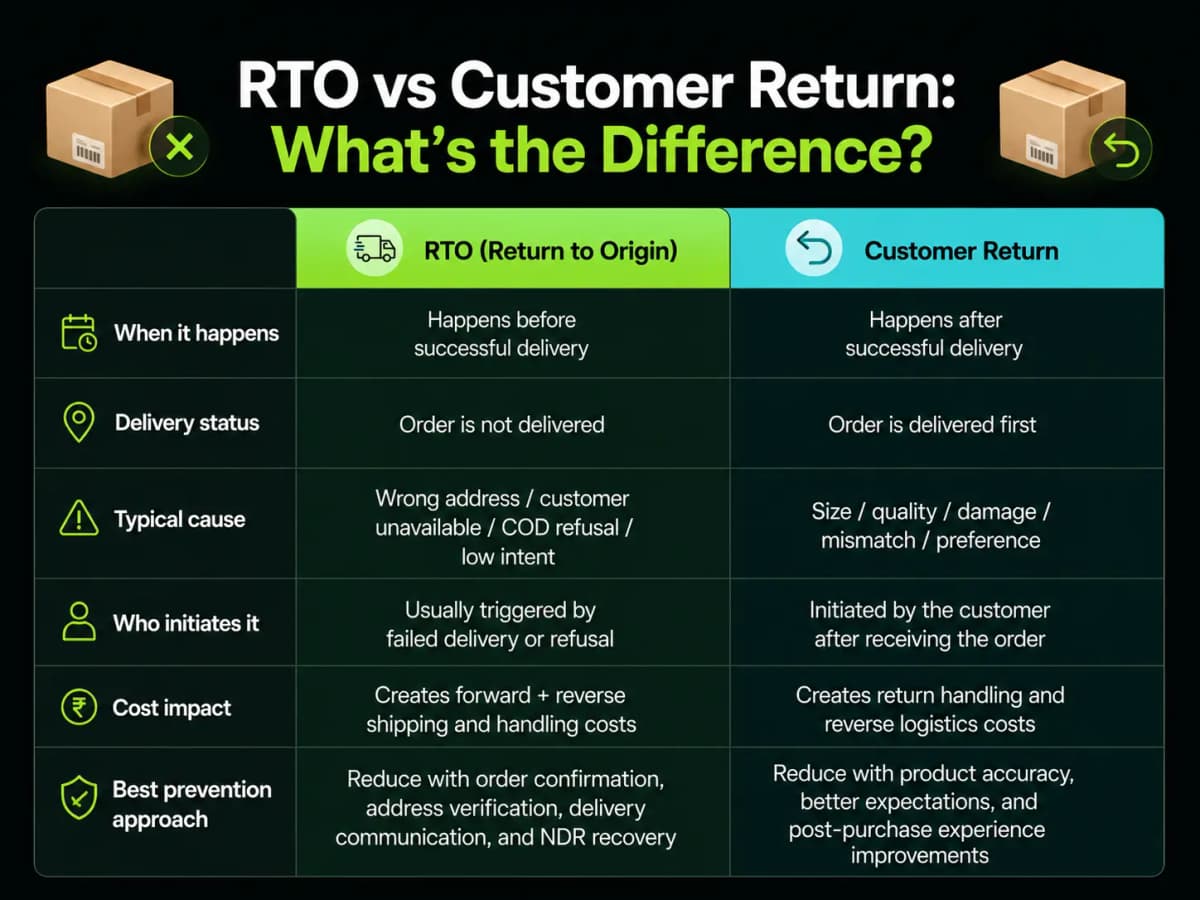
RTO and customer returns are not the same.
RTO means the order was never successfully delivered. The package comes back because delivery failed, the customer refused it, or the shipment could not be completed.
A customer return happens after delivery. The customer gets the product. Then, they return it because of size, quality, damage, mismatch, preference, or another reason after delivery.
This difference matters because RTO is often more preventable.
Many RTO issues can be spotted before dispatch. You can do this by confirming orders. Check COD. Confirm phone numbers. Fix addresses. Understand customer intent.
Customer returns usually need product, policy, or post-purchase experience improvements.
RTO matters because it turns expected revenue into operating costs.
When an order returns to origin, the brand does not just lose the sale. It also pays for the processes that happened around that failed sale.
The impact usually includes:
Forward shipping cost
Reverse logistics cost
Packaging loss
Warehouse handling
Inventory blocked in transit
Product damage risk
COD cash flow delay
More support tickets and calls
More operations team follow-up
Lower contribution margin
Poorer customer experience
RTO charges hit hard for low-margin products, brands focused on COD, busy sales periods, and categories where fresh inventory is key.
For example, if a COD order is shipped but refused at the doorstep, the brand may pay for shipping both ways without receiving payment.
The product might come back days later. It may need inspection, repackaging, and could be unavailable for other buyers during that time.
This is why RTO reduction is not only a logistics project. It is a revenue protection project.
RTO comes from several factors. These include customer behaviour, address quality, payment method, courier performance, and communication gaps.
Here are the most common causes.
Bad address quality is one of the most common reasons for RTO.
Customers can enter missing landmarks. They might also enter wrong pin codes, missing house numbers, unclear building names, or vague areas.
In some cases, the phone number is invalid or unreachable, making it harder for the delivery partner to clarify the address.
Address-related RTO often starts at checkout, long before the courier attempts delivery.
Not every failed delivery comes from a fake order. Genuine customers might miss their delivery because they are at work, travelling, or unaware of the package's arrival.
If the customer doesn’t get a delivery-day reminder or can’t connect with the delivery agent, the order might fail, even if they want the product.
COD can help ecommerce brands get more sales. This is important in markets where customers prefer to pay on delivery. But COD RTO is usually higher because the buyer has not paid up front.
The customer can place an order with little commitment. They can compare options later, change their mind, or refuse delivery when the package arrives.
The goal is not always to remove COD. For many brands, COD is commercially important. Verify risky COD orders before dispatch. Use stronger confirmation workflows when necessary.
Some RTO cases arise from fake orders, prank orders, duplicate orders, wrong phone numbers, odd order patterns, or impulse buys.
These orders may look valid at checkout but fail during delivery because the customer never intended to accept the package.
High-value COD baskets and frequent cancellations show risks. Odd addresses and invalid contact details also raise flags. High-RTO pincodes help brands find problems before shipping.
You can also reduce this risk earlier by learning how to reduce fake orders in ecommerce before they reach fulfillment.
Delivery delays reduce buyer urgency.
A customer might really want to place an order. But if delivery takes too long, they could buy from another store, lose interest, or refuse the shipment when it arrives.
Delays are especially risky for COD orders because there is no prepaid commitment holding the customer to the purchase.
NDR stands for Non-Delivery Report.
An NDR is created when a courier fails to deliver a shipment. This does not always mean the order is lost. It may still be recoverable if the brand responds quickly.
For example, the customer might need to:
correct an address
confirm availability
provide a landmark
Ask for another delivery attempt
If the brand reacts too slowly, a recoverable failed delivery can become a confirmed RTO.
Good NDR management helps ecommerce brands get back more failed deliveries before they return.
Customers are more likely to accept an order when they know what is happening.
Order confirmations and dispatch alerts help reduce uncertainty. Delivery reminders, delay updates, and follow-ups on failed deliveries also do this.
When communication is weak, customers may forget the order, miss the delivery, ignore the courier call, or refuse the package.
Poor communication not only creates support tickets. It can directly increase RTO.
Strong ecommerce delivery updates can reduce missed deliveries by keeping customers informed before the package reaches their doorstep.
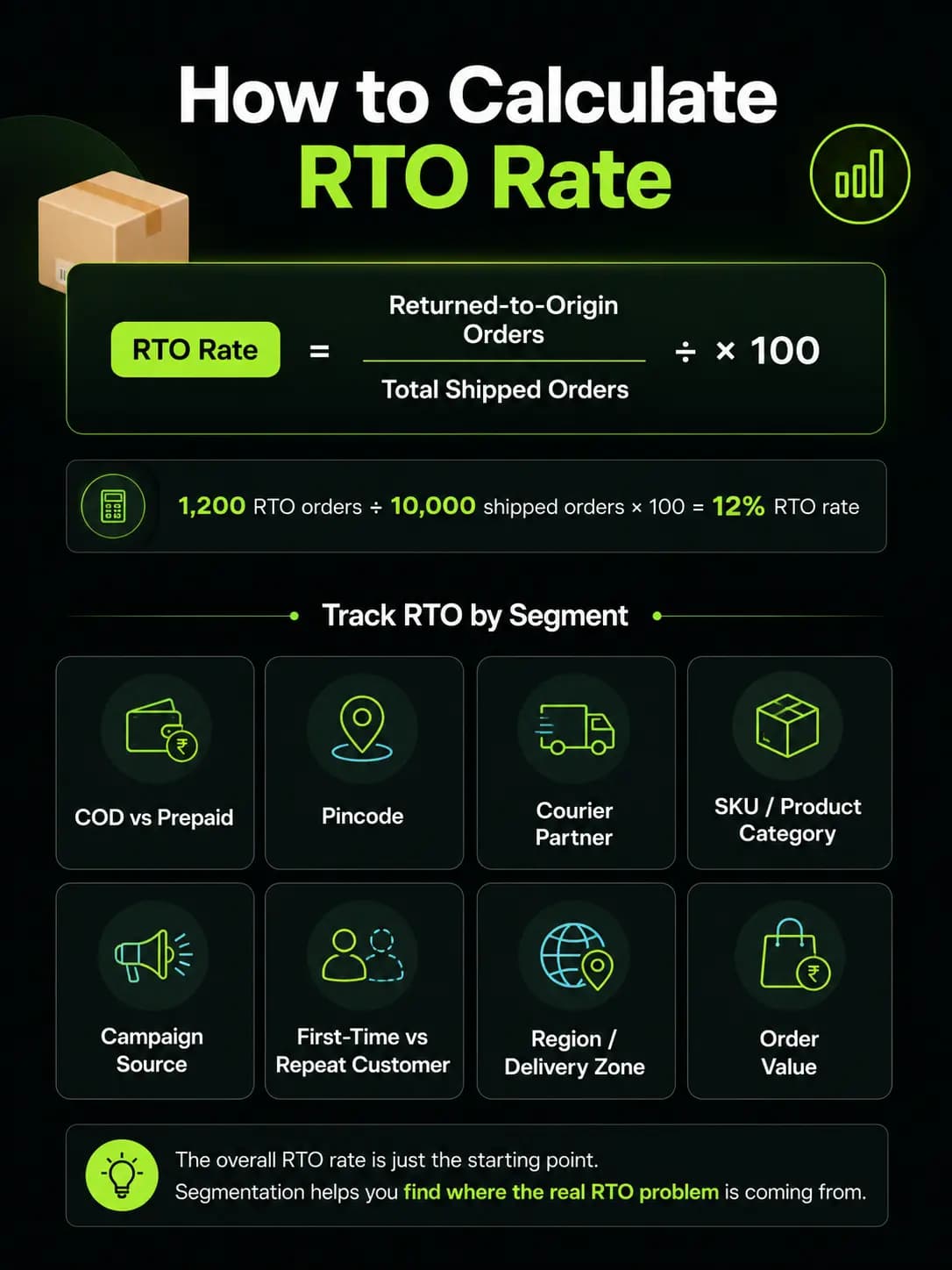
RTO rate shows what percentage of shipped orders return to origin.
Use this formula:
RTO Rate = Returned-to-Origin Orders / Total Shipped Orders × 100
For example, if you shipped 10,000 orders and 1,200 returned to origin, your RTO rate is:
1,200 / 10,000 × 100 = 12%
But overall RTO rate is only the starting point. Ecommerce brands should also track:
COD RTO rate
Prepaid RTO rate
RTO by pincode
RTO by courier partner
RTO by SKU or product category
RTO by campaign source
RTO by first-time vs repeat customer
RTO by region or delivery zone
RTO by order value
This segmentation matters because RTO is rarely evenly distributed. A few pincodes, couriers, products, campaigns, or customer segments may create a large share of the problem.
To reduce RTO in ecommerce, brands need to stop treating every order the same.
The best way is to spot risks early. Check customer intent, improve address quality, communicate clearly, and resolve failed deliveries promptly.
Many preventable RTO cases begin before the product leaves the warehouse.
Brands should verify high-risk orders such as:
COD orders
First-time customer orders
High-value orders
Orders from high-RTO pincodes
Orders with incomplete addresses
Orders with suspicious phone numbers
Duplicate orders
Orders from risky campaign sources
Verification helps answer a simple question. Should we ship, correct, hold, convert to prepaid, or cancel this order? We want to prevent wasting shipping costs.
Address quality should be improved before fulfillment begins.
Useful checks are:
Pincode validation
Structured address fields
Landmark prompts
Mobile number verification
Clearer checkout forms
Address formatting rules
A small improvement at checkout can prevent a much higher cost later in the delivery journey.
For India-focused ecommerce operations, teams can use the official India Post pincode lookup as a reference point when validating delivery pincodes and serviceability.
COD verification should not create unnecessary friction for every customer.
Instead of blocking COD completely, brands can apply smarter checks to risky COD orders.
A repeat customer with a good delivery history may not need the same checks. This is different from a first-time customer. That customer is placing a high-value COD order from a high-RTO area.
Smart COD verification helps preserve conversion while reducing avoidable COD RTO.
Customers should not have to guess where their order is.
Useful communication touchpoints include:
Order confirmation message
Dispatch alert
Out-for-delivery reminder
Delivery-day call or notification
Delay update
Failed-delivery follow-up
The purpose is not to send more messages. It is to send the right message at the moment when customer action can prevent delivery failure.
NDR recovery is time-sensitive.
When a delivery fails, brands should quickly reach out to the customer. They need to find out what went wrong, fix the details, and decide on the next steps.
They may include:
Reattempting delivery
Updating the address
Adding a landmark
Confirming availability
Cancelling before additional costs arise
Slow NDR response allows recoverable orders to become RTO.
RTO reduction improves when brands know where the risk is coming from.
Useful segments include:
Payment mode
Region
Pincode
Courier
Product category
Customer type
Order value
Campaign source
First-time vs repeat customer
This helps teams avoid blanket rules. Instead of making every order harder to place, brands can focus effort where RTO risk is highest.
Courier performance can vary by pincode, route, product type, and delivery zone.
A courier that performs well in one region may have higher failed delivery rates in another. Brands should check courier-level RTO patterns. They should look at service areas and delivery speed. Also, review fake attempt complaints. Finally, note zones with repeated failures.
Better courier allocation can reduce failed deliveries without changing the customer experience.
For a deeper execution guide, read how to lower e-commerce RTO rates fast without expanding your call centre.
Order confirmation is key to reducing RTO. Many avoidable RTO cases begin before dispatch.
The customer may not have intended to buy.
The address may be incomplete.
The phone number may be wrong.
The COD amount may be misunderstood.
The customer may want to cancel.
The delivery location may need a landmark.
The customer may only be available on certain days.
A strong order confirmation workflow catches these issues early.
Ecommerce brands can improve shipping by confirming buyer intent. They should check address issues, verify COD commitment, and hold risky orders.
In this way, they avoid unnecessary forward and reverse shipping costs.
To build this workflow at scale, explore how ecommerce order confirmation automation helps verify buyer intent, COD commitment, address accuracy, and delivery readiness before dispatch.
An effective order confirmation call should verify:
Customer identity
Product ordered
Quantity
COD amount or payment status
Full delivery address
Landmark
Pincode and locality
Delivery availability
Phone number validity
Final confirmation to ship
The goal is not to make the customer repeat everything unnecessarily. The goal is to confirm the details that most often cause RTO.
An effective order confirmation call should verify:
Customer identity
Product ordered
Quantity
COD amount or payment status
Full delivery address
Landmark
Pincode and locality
Delivery availability
Phone number validity
Final confirmation to ship
The goal is not to make the customer repeat everything unnecessarily. The goal is to confirm the details that most often cause RTO.
Manual order confirmation works when the order volume is low. As an ecommerce brand grows, manual calling gets inconsistent, costly, and hard to handle.
This is why many growing brands need to understand why manual order confirmation breaks at scale in ecommerce.
Agents may skip calls during high-volume periods. Call quality may vary. Outcomes may not be logged properly. Risky orders may get shipped without verification because the team cannot keep up.
AI voice agent for ecommerce can help brands automate phone-based RTO reduction workflows at scale.
For order confirmation,
An AI voice agent can call customers.
Verify COD intent.
Confirm address details.
Capture landmarks.
Remind customers about delivery.
Recover NDR cases.
Update CRM or order systems.
Record call outcomes for operations teams.
Salesix AI handles automated order confirmation calls. It also verifies COD, checks addresses, and sends delivery reminders. The platform makes NDR recovery calls and provides post-call analytics. This helps teams lower preventable RTO. They can do this without expanding the call centre.
For a closer look at this workflow, read how AI voice agents improve ecommerce order confirmation.
Here is how an automated RTO reduction workflow can work:
Customer places a COD order.
The order is flagged as high risk.
An AI voice agent calls the customer.
The customer confirms, corrects, or cancels the order.
The order system is updated automatically.
The warehouse ships only confirmed orders.
Risky orders are held before shipping costs are wasted.
This workflow helps ecommerce teams. It shifts them from reacting to RTO issues. Now, they can prevent problems with order verification.
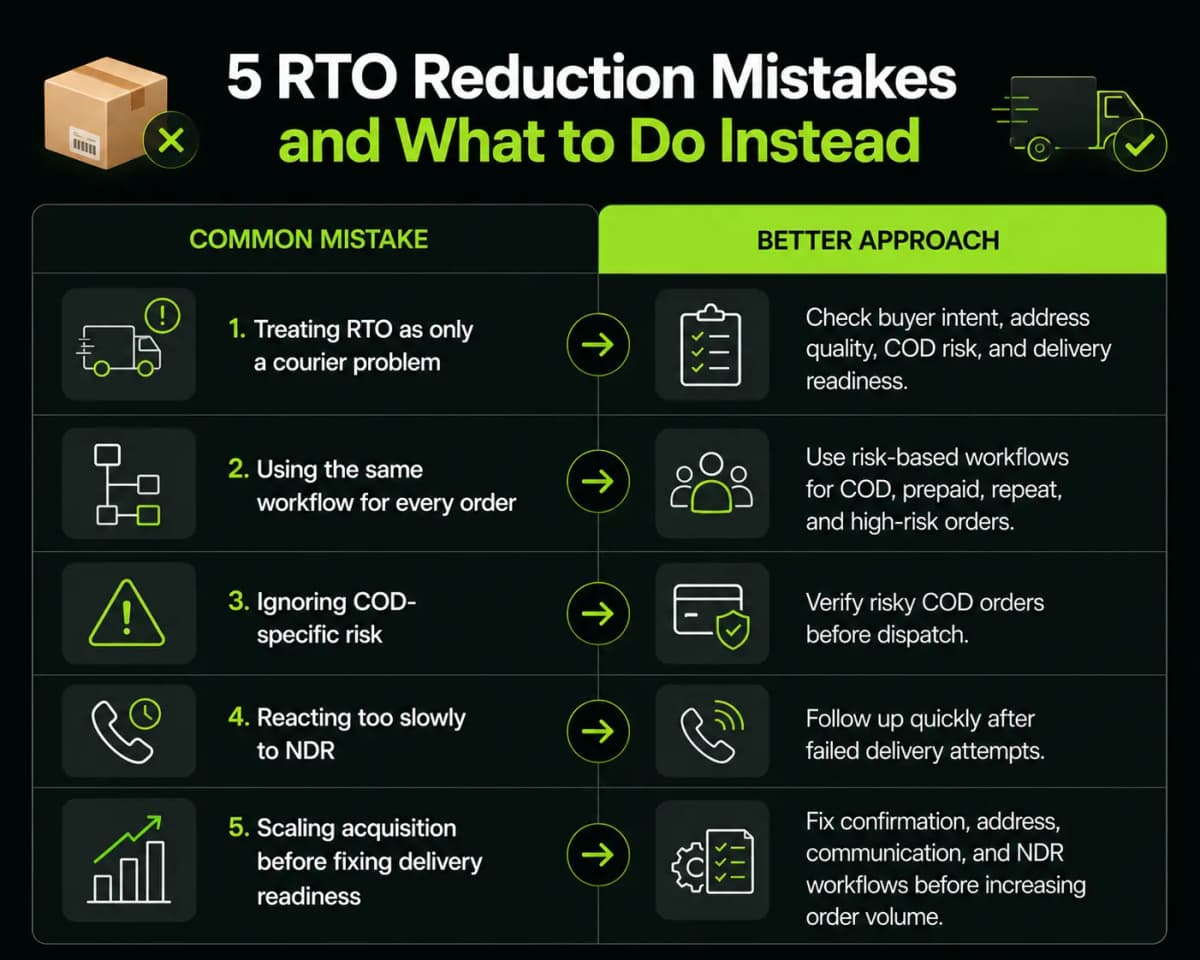
Many ecommerce brands try to reduce RTO, but their approach stays too broad or too late in the journey.
Courier performance matters, but many RTO causes start before pickup.
If the customer has low intent, the address is incomplete. The phone number may be wrong, or the COD amount could be misunderstood. Changing the courier might not fix the main issue.
Not every order has the same risk.
Orders need different workflows. COD, prepaid, repeat customers, and first-time customers are all different. High-value and low-value orders are not the same. Metro, non-metro, and high-RTO pincode orders also need unique workflows.
Risk-based workflows help reduce RTO without adding unnecessary friction to good orders.
COD needs its own verification logic.
A COD order has a different risk than a prepaid order because the customer has not paid up front. Brands that treat COD and prepaid orders the same often miss preventable RTO signals.
A failed delivery attempt is not always final.
But if the brand waits too long to act on NDR events, the chance of successful delivery drops. Fast recovery can turn a failed attempt into a delivered order.
More orders do not help if more of them come back.
Before scaling ads or influencer campaigns, brands need to check a few things:
Can their confirmation process handle more volume?
Is address capture working effectively?
How is delivery communication?
Are NDR workflows prepared for the extra load?
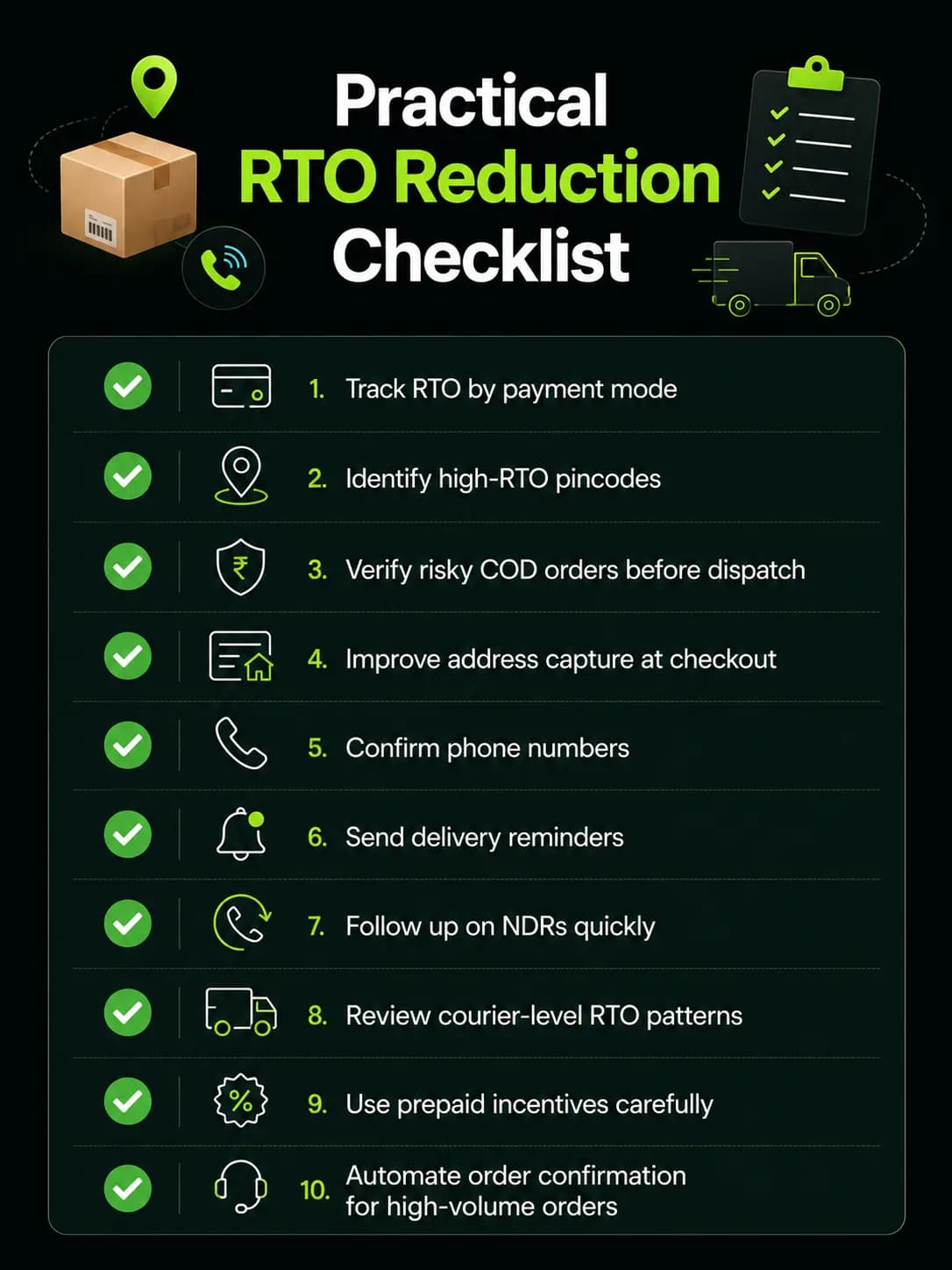
Use this checklist to start reducing preventable RTO:
Track RTO by payment mode.
Identify high-RTO pincodes.
Verify risky COD orders before dispatch.
Improve address capture at checkout.
Confirm phone numbers.
Send delivery reminders.
Follow up on NDRs quickly.
Review courier-level RTO patterns.
Use prepaid incentives carefully.
Automate order confirmation where order volume is high.
Use the Ecommerce Order Confirmations playbook to create a practical workflow for verifying risky orders before fulfillment costs are wasted.
The most effective RTO reduction programs combine prevention, communication, and recovery. No single tactic fixes every problem.
However, when used together, they lower the number of orders that shouldn’t have shipped. They also help recover orders before they return to the origin.
RTO in ecommerce is not just a delivery failure. It’s a loss we can prevent. It impacts revenue, logistics costs, inventory, support workload, and customer experience.
Top ecommerce brands lower RTO in three steps. First, they act before dispatch. Next, they focus on delivery. Finally, they address failed delivery attempts.
They check risky orders early. They improve address quality. They communicate proactively and recover NDRs quickly. They also use data to find where RTO risk is highest.
Order confirmation is crucial. It helps catch weak buyer intent, COD risks, wrong phone numbers, incomplete addresses, and cancellation requests. This way, we avoid wasting shipping costs.
If your team is handling order confirmation manually, Salesix AI can help automate high-volume confirmation calls, COD verification, address checks, delivery reminders, and NDR recovery workflows with AI voice agents.
The RTO full form in ecommerce is Return to Origin. It means a shipped order could not be delivered to the customer and was returned to the seller, warehouse, or fulfillment origin.
RTO in ecommerce often happens for several reasons:
Incorrect addresses
Customer unavailability
COD refusal
Fake or low-intent orders
Delivery delays
Weak NDR management
Poor delivery communication
Invalid phone numbers
Ecommerce brands can cut RTO by:
Verifying risky orders before dispatch.
Improving address quality.
Confirming phone numbers.
Sending delivery reminders.
Quickly responding to NDR events.
Segmenting RTO by risk.
Automating order confirmation workflows.
COD orders often have higher RTO because customers have not paid upfront. This makes it easier for buyers to change their mind, refuse delivery, ignore calls, or place low-commitment orders.
RTO happens when an order is not delivered and returns to the seller. A return happens after the customer receives the product and sends it back.
NDR management reduces RTO by helping brands act quickly after a failed delivery attempt. Teams can reach out to the customer. They can fix the address, check availability, and ask for another delivery attempt before the shipment goes back to the origin.
Yes, Order confirmation calls can reduce preventable RTO by verifying customer intent, COD commitment, address accuracy, phone number validity, and delivery availability before the order is shipped.
AI voice agents can automate several tasks, including:
Order confirmation calls
COD verification
Address confirmation
Delivery reminders
NDR recovery calls
CRM updates
Call outcome tracking
This automation works well at scale.
This helps ecommerce brands reduce preventable RTO without adding more manual calling workload.

Get $5 free credit on signup — no credit card required. Set up your AI voice agent in minutes and start converting more leads today.