Order-Confirmation
How to Reduce RTO in Ecommerce Without Expanding Your Call Centre



Premium Humanoid AI Voice Agents for your business.
RTO is not a delivery issue. For ecommerce brands, revenue can shift. It might turn into shipping costs, blocked inventory, extra warehouse work, or lost margins.
For example
For example, the typical RTO cycle begins when a customer places an order that enters the system. The warehouse then packs it, and the courier picks it up for delivery.
The process fails, and the shipment goes back to the seller if the customer:
refuses the package,
is unreachable,
gives an incomplete address, or
no longer wants the product.
That is where the real cost begins.
Many brands try to solve this by hiring more call centre agents, restricting COD, or reacting after a non-delivery report.
These methods can help in some cases, but they do not solve the core problem fast enough. If you want to learn how to reduce RTO in ecommerce, the better approach is to confirm buyer intent before dispatch.
In this post, you’ll learn how to lower RTO in ecommerce. You can do this by:
Verifying COD orders before dispatch
Confirming buyer intent
Checking address accuracy
Filtering out fake COD orders
Using automated calls to confirm orders
These steps can help prevent returns and save on shipping costs.
RTO in ecommerce means Return to Origin. It happens when a shipped order is not delivered to the customer and is sent back to the seller, warehouse, or fulfilment centre.
This usually happens because:
The customer refuses the order.
The customer is unavailable during delivery.
The customer provides incorrect details.
The customer gives a fake phone number.
The customer no longer wants the product by the time it arrives.
For COD-heavy ecommerce brands, RTO is especially costly because the customer has not paid upfront. The brand pays to ship the order forward, then often pays again when the product comes back. The sale disappears, but the operational cost remains.
RTO affects more than logistics:
It blocks sellable inventory.
It increases warehouse workload.
It delays restocking.
It adds pressure on customer support.
It skews campaign performance until delivery results are reviewed.
For a deeper explanation of the causes, costs, and prevention methods, read this guide on what RTO in ecommerce means and how to reduce it.
RTO and customer returns are not the same.
An RTO order is never successfully delivered. The customer does not receive the product, and the order comes back before completion.
A customer return happens after delivery. The customer gets the product. Then, they return it. Reasons include size, fit, quality, damage, expectation mismatch, or other issues after delivery.
This difference matters because the prevention strategy is different.
Customer returns need clearer product pages. They also need better return policies. Sizing tips should be more helpful. Strong post-purchase support is important too.
To reduce RTO, we need stronger order confirmation. We also need address checks, COD verification, delivery updates, and risk filtering. All this should happen before dispatch.
High RTO rates often happen due to several reasons. They can include:
Low buyer commitment
Poor order quality
Wrong delivery details
Weak communication
Slow responses
The problem gets worse when order volume grows because weak processes that were manageable at 100 orders per day start breaking at 1,000 orders per day.
COD orders are easier for customers to place because there is no upfront payment. This boosts conversions in markets where customers like to pay after delivery. However, it also raises the risk of refusals.
A prepaid customer has already made a financial commitment. A COD customer can change their mind later with less friction.
This does not mean ecommerce brands should remove COD completely. In many categories and regions, COD supports trust, first-time purchases, and conversion. But COD orders should not be treated exactly like prepaid orders. They need an extra layer of confirmation before dispatch.
Fake COD orders are one of the clearest causes of preventable RTO.
These can include
Prank orders
Invalid phone numbers
Duplicate orders
Wrong customer details
Low-intent purchases
Orders made without real buying intent
The problem is that fake COD orders often look valid inside the order system until the brand tries to deliver them. By then, the brand has already paid for fulfilment, shipping, packaging, and courier handling.
A simple confirmation step before dispatch can filter many of these orders early.
If fake orders are a major source of failed deliveries, this guide explains how to reduce fake orders in ecommerce before they reach fulfillment.
Address quality has a direct impact on delivery success, such as:
A missing landmark can slow delivery.
An incorrect PIN code may cause delays.
An incomplete house number can hinder the process.
An unclear locality can lead to setbacks.
An unreachable phone number can also cause delays.
Because of the following, the delivery agent often fails to complete the order, even if the customer truly wants the product.
This type of RTO is frustrating because it is preventable. The order did not fail because demand was weak. It failed because the brand shipped before confirming whether the delivery details were usable.
Customer intent is strongest near checkout. The longer the delivery takes, the more that intent can weaken.
The customer may buy from another brand, lose interest, travel, forget the order, or decide the purchase is no longer needed.
This often happens with impulse-led categories. It also includes low-consideration products. Festive shopping and urgent-use items fall in this group too. Influencer-driven campaigns are also common.
When delivery delays happen, proactive communication becomes important. But for high-risk COD orders, communication after dispatch may not be enough. Brands need to confirm intent before shipping and re-engage quickly if delivery gets delayed.
Not every RTO comes from fake or low-intent buyers. Genuine customers can also miss a delivery.
They may be at work, travelling, unavailable at home, unable to answer the delivery call, or unaware that the order is arriving that day. If the delivery attempt fails and follow-up is slow, the order can move into NDR and eventually become RTO.
This is why RTO reduction should not only focus on blocking bad orders. It should also help good customers receive the orders they actually want.
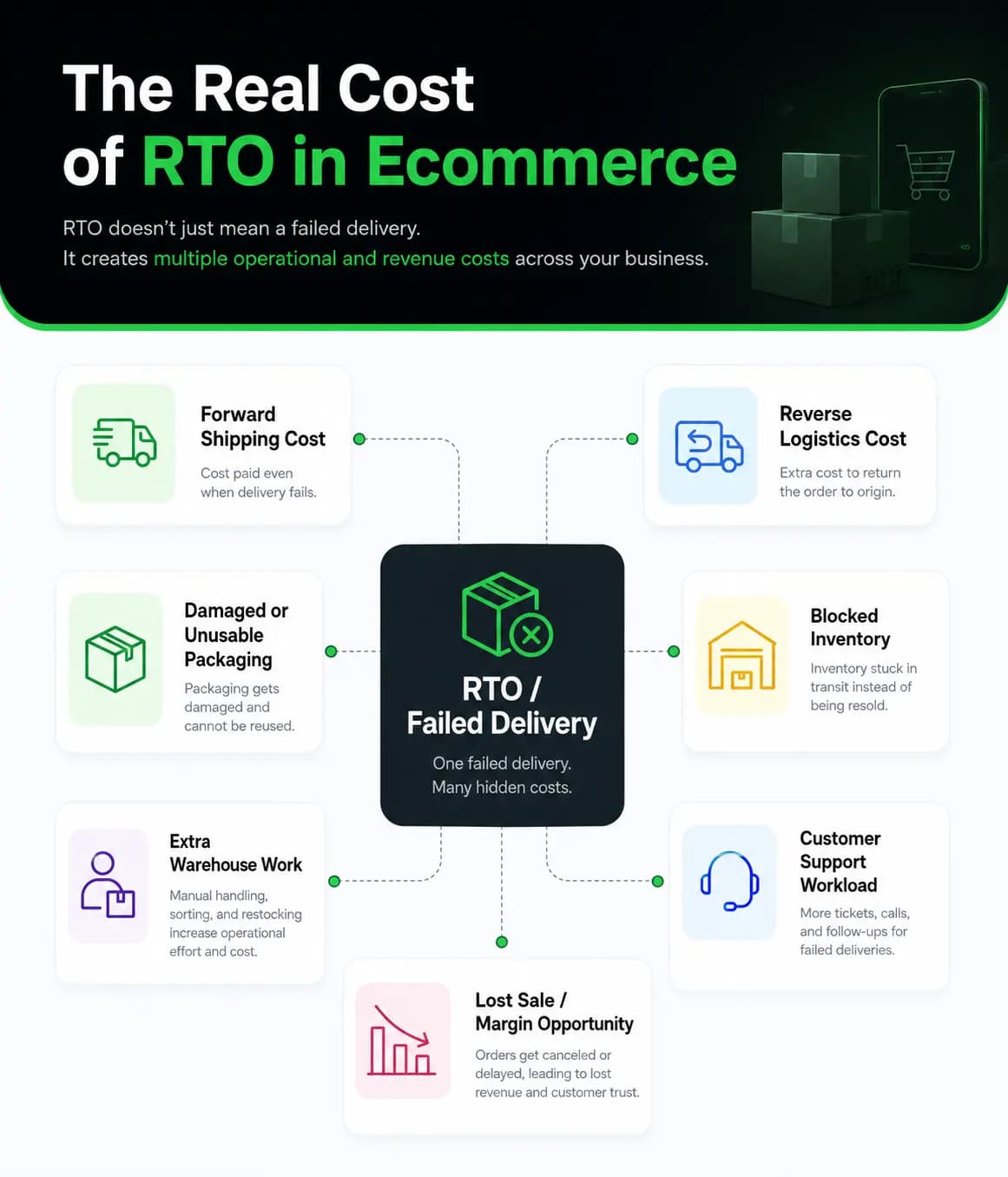
RTO charges are not limited to one courier fee. The real cost includes several layers:
The brand pays for forward shipping even though the delivery failed.
It may also pay reverse logistics costs when the product is returned.
Packaging may be damaged or unusable.
The warehouse team must inspect, restock, and update the product.
Inventory stays blocked while the shipment is in transit.
Support teams may need to handle customer questions, delivery complaints, refund confusion, or order status issues.
There is also an opportunity cost. The product could have been sold to a genuine customer during the time it was stuck in a failed delivery cycle.
For low-margin ecommerce brands, repeated RTO can erase profits. This happens even with successful marketing campaigns.
For example, A campaign might bring in a lot of orders. However, if many COD orders fail to arrive, the delivered revenue can end up much lower than expected.
RTO becomes harder to control when order volume increases quickly.
During flash sales, festive campaigns, influencer drops, and paid ad spikes, teams often focus on processing orders fast.
Higher order volume means more COD orders. It also brings more incomplete addresses. There are more duplicate orders and unverified phone numbers. This results in delivery coordination gaps.
Manual confirmation may work when the team has a small number of orders to verify. It breaks when thousands of orders need attention within a few hours.
If the confirmation process cannot keep up, the warehouse ships before the risk is checked. That is when preventable RTO becomes a scale problem.
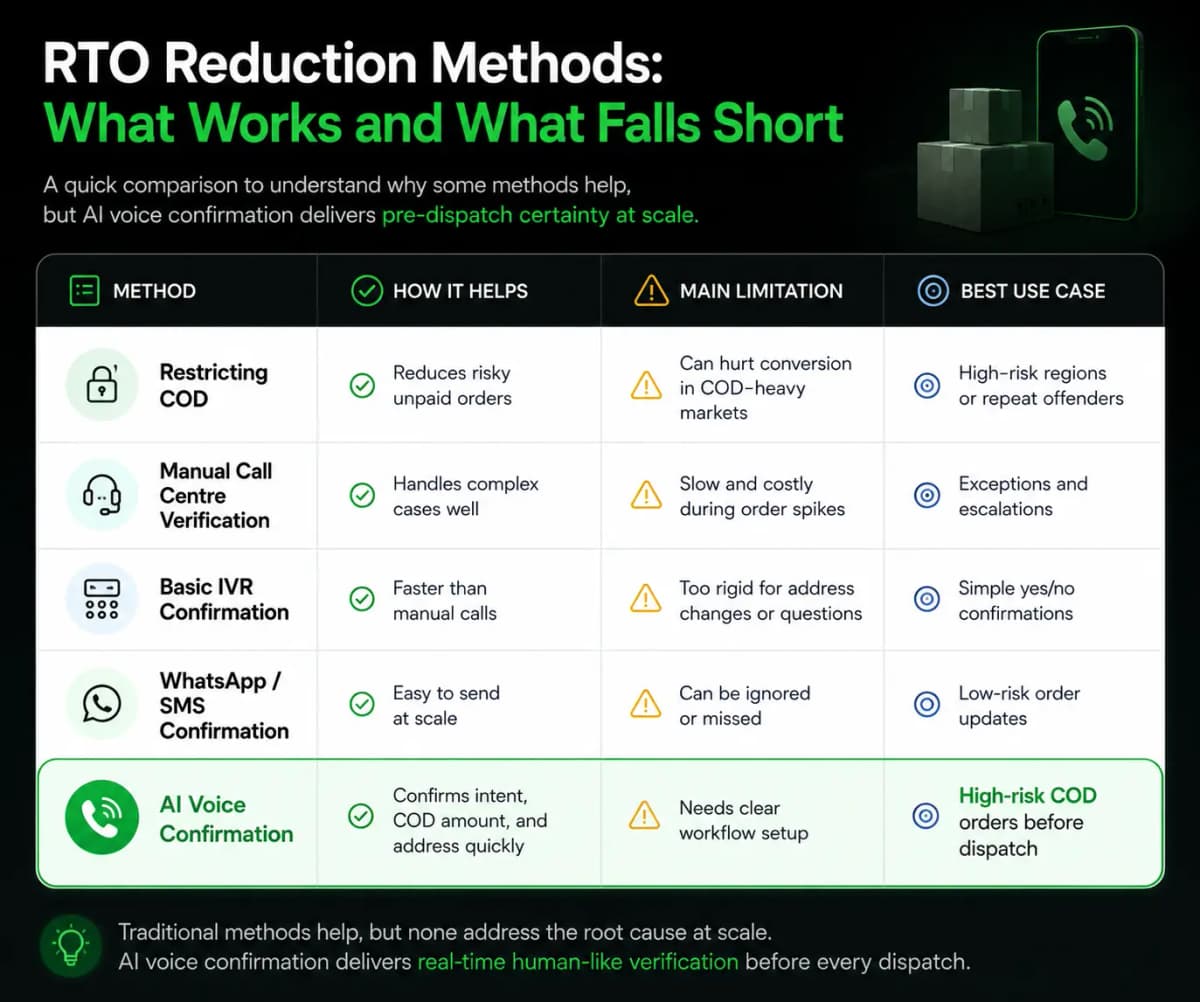
Traditional methods can reduce some RTO, but they often create new trade-offs.
The issue is not that these methods are useless. The issue is that they are incomplete when used alone.
Removing COD can lower RTO risk, but it can also hurt conversion in COD-preferred markets.
Many first-time buyers use COD because they do not fully trust the brand yet. If COD disappears completely, some customers may abandon the purchase instead of switching to prepaid.
A better approach is selective COD control. Brands can promote prepaid orders. They can limit COD for high-risk PIN codes or repeat offenders. Also, they should verify risky COD orders before shipping.
This reduces exposure without damaging genuine customer demand.
Manual call centre verification can work, but it does not scale well.
Human agents can only make a limited number of calls per hour. During sales peaks, they may not reach every customer fast enough. Some orders get delayed. Some are shipped without confirmation. Some customers are called too late, after the buyer's intent has already dropped.
Expanding the call centre means more costs. You’ll need to hire staff, train them, and ensure quality. Scheduling and management also add to the expenses.
For brands trying to reduce RTO fast, adding more agents is usually not the most efficient first move.
This is why many growing brands need to understand why manual order confirmation breaks at scale in ecommerce.
Basic IVR confirmation is faster than manual calling, but it is often too rigid.
A “press 1 to confirm” workflow can capture simple responses, but it cannot handle messy real-world conversations well. Customers may want to correct an address, ask about the COD amount, confirm delivery timing, or clarify what they ordered.
If the system cannot understand nuance, the order may still need manual follow-up. That reduces the value of automation.
WhatsApp and SMS are useful for routine updates, tracking links, and delivery reminders. But for high-risk COD confirmation, passive messages are often not enough.
Customers may miss the message, ignore it, delay responding, or fail to understand the urgency.
A non-response doesn’t always show if the customer wants the order, forgot it, entered the wrong number, or lost interest.
For high-risk orders, brands need active confirmation. Voice is often better suited for that moment.
The most effective RTO reduction starts before dispatch.
Ecommerce brands should check risky orders right away. This way, they won’t have to wait for failed delivery attempts. It’s best to act while the buyer's intent is still fresh.
This helps the team check four things.
Is the order real?
Does the customer know the COD amount?
Can we deliver to the address?
Does the customer still want the product?
This creates a cleaner fulfilment pipeline.
Confirmed orders can proceed with confidence.
Incorrect addresses may be corrected before printing shipping labels.
Cancelled or fraudulent orders can be paused to avoid wasting shipping costs.
Risky orders can be sent for review instead of proceeding directly to fulfilment.
This is where COD verification becomes a practical operational layer, not just a support task.
A strong COD verification call should confirm:
Customer name
Product ordered
COD amount
Full delivery address
Landmark or PIN code
Delivery availability
Final confirmation to ship
The call should answer one core question: Is this order worth dispatching?
A good confirmation workflow should not only ask, “Did you place this order?” It should also check whether the order details are accurate enough for successful delivery.
For example, if the customer confirms the product but corrects the address, the order can still be saved. If the customer says they did not place the order, the brand can stop the shipment before the cost is wasted. If the number is unreachable, the order can be flagged for review.
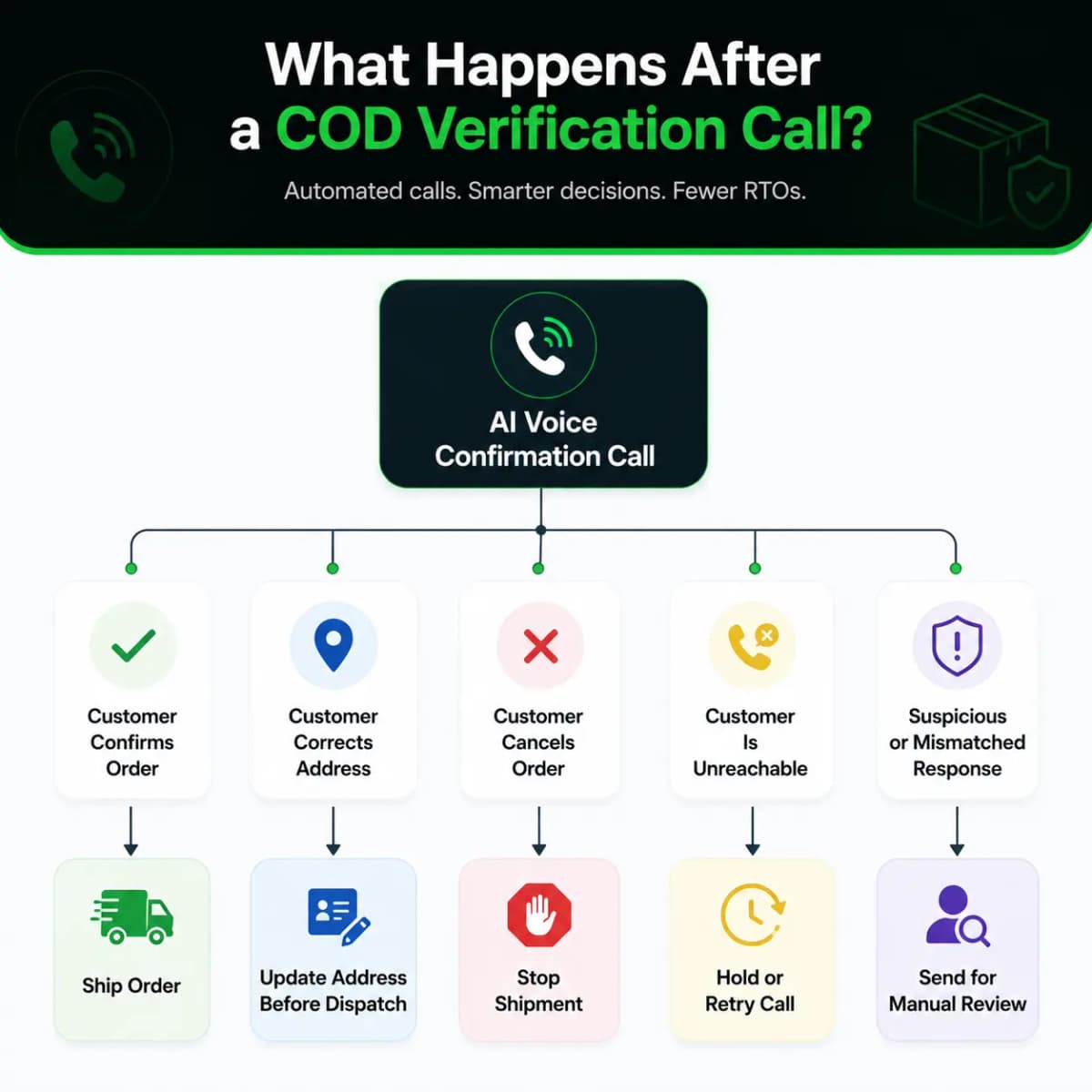
Automated order confirmation calls help reduce RTO. They check buyer intent before the warehouse ships the order.
Ecommerce brands can use automated calls to reach customers just minutes after checkout. This approach is faster than relying solely on manual agents.
The system can confirm the product, COD amount, address, landmark, and willingness to accept delivery. It can then update the order system based on the call outcome.
This helps teams act before the order enters the logistics network:
If the customer confirms, the order can move to dispatch.
If the address is wrong, it can be corrected.
If the customer cancels, the order can be stopped.
If the customer is unreachable, the order can be held or routed for another attempt.
This is useful for high-risk COD orders. It helps first-time buyers, too. It works well for high-RTO PIN codes and costly products. It flags odd order patterns and spikes from campaigns.
For a more detailed breakdown of this workflow, read how AI voice agents improve ecommerce order confirmation.
Voice creates active confirmation.
A call can quickly show if the phone number is valid. It can also reveal if the customer remembers the order, understands the COD amount, and confirms the delivery address is correct.
Voice also handles nuance better than SMS, WhatsApp, or basic IVR. For example:
A customer can say, “The address is correct, but add the office landmark.”
“I ordered this, but I will not be available tomorrow.”
“I want to cancel because the delivery is too late.”
These responses give the brand useful operational data before dispatch.
For high-risk COD orders, that difference matters. The goal is not just to send a message. The goal is to get a clear decision that the fulfilment team can act on.
Peak sales create a timing problem.
During flash sales, festive campaigns, and influencer drops, the confirmation workload can rise fast. Sudden COD spikes can also add to this.
This often overwhelms the call centre. If the team cannot verify orders quickly, dispatch decisions become weaker.
AI voice agents for ecommerce help by making high-volume confirmation calls at scale. They can call customers right after checkout.
They ask structured questions, capture responses, and update business systems. This all happens without waiting for an agent to be available.
This helps ecommerce teams keep the order flow moving while still filtering risky shipments before they become RTO.
Salesix AI helps ecommerce brands automate order confirmation calls. It uses humanoid AI voice agents.
For teams facing high COD volume and RTO losses, Salesix can help. It can call customers after checkout to confirm their intent.
It also checks order details, records address changes, and updates the CRM or order management systems with the call results.
This supports a faster and more scalable RTO reduction workflow.
Ecommerce teams don’t need to expand the call centre when order volume rises. They can use Salesix to automate routine confirmation calls. This way, human teams can focus on exceptions, escalations, and complex customer conversations.
Salesix AI is designed to call like a human. It can:
Automates workflows
Supports multilingual chats
Offers localised conversations
Can handle multiple calls simultaneously
Updates CRM and business tools
Provides analytics after calls
That makes it useful for brands that need to confirm more COD orders without slowing fulfilment or adding manual workload.
You can explore how Salesix supports this workflow on the ecommerce order confirmation automation use case page.
Here is how a Salesix-powered order confirmation workflow can work:
Customer places a COD order.
Salesix triggers an automated confirmation call.
The AI voice agent confirms the product, COD amount, and address.
The customer confirms, corrects, or cancels the order.
The CRM or order system is updated.
The warehouse ships only confirmed orders.
Risky orders are held before shipping cost is wasted.
This workflow helps ecommerce teams act before the cost of fulfilment is already locked in.
It also creates better visibility. The team can now see more than just “confirmed order.” They can check if the customer actively confirmed, changed details, cancelled, or didn’t respond.
That data can improve fulfilment decisions, logistics planning, COD policy, and future RTO reduction strategy.
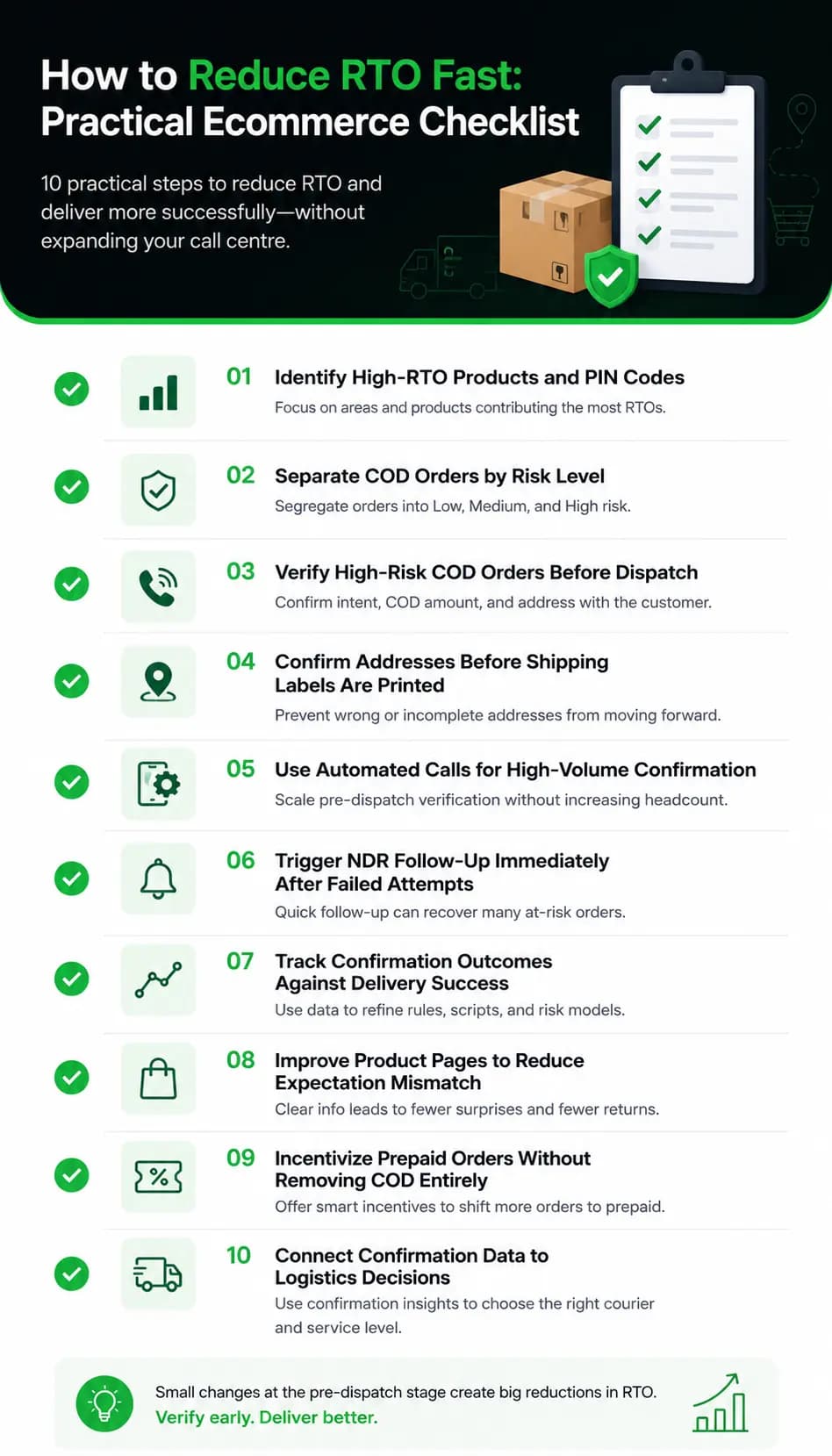
To reduce RTO quickly, ecommerce teams should focus on the orders most likely to fail before dispatch.
Here is a practical checklist
Start by finding where RTO is concentrated.
Look at product categories, SKUs, regions, PIN codes, courier partners, campaign sources, and customer segments. This helps the team avoid treating every order as equally risky.
Not all COD orders need the same intervention.
Set risk levels using these factors:
Customer history
Order value
PIN code
Product type
Duplicate attempts
Phone number quality
Past delivery success
High-risk COD orders should be confirmed before they enter fulfilment.
This helps reduce fake COD orders, wrong addresses, low-intent orders, and avoidable cancellations.
Address correction should happen before shipping labels are generated.
Once the label is printed and the shipment is handed to the courier, fixing address issues becomes harder, slower, and more expensive.
Automated order confirmation calls let teams check more orders. This works without needing to hire more call centre staff.
This is really helpful during flash sales, festive campaigns, influencer drops, and sudden increases in COD orders.
RTO prevention does not end at dispatch.
If a delivery attempt fails, the team should trigger immediate follow-up. The faster the customer is contacted, the higher the chance of saving the delivery before it becomes RTO.
This also connects closely with automated delivery updates for ecommerce, especially when brands need to follow up after failed delivery attempts.
Track confirmed orders that the delivery partner delivered.
Note unconfirmed orders that turned into RTO.
Identify the most common cancellation reasons.
This turns order confirmation from a calling task into a decision system.
Some RTO happens because customers lose confidence before delivery.
So, providing clear product descriptions and accurate images is important. Sizing details and delivery times matter too. COD expectations help reduce confusion. This can prevent unnecessary refusals.
The Nielsen Norman Group’s guide to ecommerce product page UX is also useful for understanding how clearer product information can help shoppers make more confident purchase decisions.
Offer prepaid incentives where useful, but avoid removing COD too aggressively if your audience relies on it.
A balanced strategy can reduce risk while preserving conversion.
Use confirmation outcomes to guide fulfilment.
Confirmed orders can move faster. Risky orders can be held. Address-corrected orders can be updated before shipping. Repeated fake attempts can be blocked or reviewed.
That is how ecommerce brands reduce RTO without slowing every order.
Learning how to reduce RTO in ecommerce starts with one important shift: do not wait until delivery fails to find out whether the order was risky.
RTO reduction starts before dispatch.
Manual call centres can help, but they are hard to scale during high-volume periods.
Restricting COD can lower failed deliveries. However, it might hurt conversion if customers like paying after delivery.
Passive messages can help with communication. However, they might not give enough confirmation for high-risk COD orders.
Automated order confirmation calls give ecommerce teams a faster way to verify buyer intent while the order is still fresh. They check the customer’s details. This includes the COD amount, phone number, address, and whether they will accept delivery. They do this before shipping costs begin.
For COD-heavy ecommerce brands, this can be a practical way to reduce preventable RTO without expanding the call centre.
To turn this into a repeatable workflow, use the ecommerce order confirmations playbook.
COD orders are more likely to become RTO because the customer has not paid up front. This reduces commitment and raises the risk of refusals, cancellations, fake orders, or delivery issues.
Ecommerce brands can lower RTO without eliminating COD. They can do this by:
Verifying high-risk COD orders before dispatch.
Confirming addresses.
Checking buyer intent.
Incentivising prepaid orders.
Improving delivery communication.
Using automated order confirmation calls.
A COD verification call is made before dispatch. It checks if the customer placed the order, understands the COD amount, provided the right address, and is ready to accept delivery.
Yes. Automated order confirmation calls can cut down on fake COD orders. They check if the phone number is valid, if the customer knows about the order, and if the customer confirms shipment before it goes out.
A COD order should be verified soon after checkout and before dispatch. This gives the brand enough time to confirm intent, correct address issues, or hold risky orders before shipping cost is wasted.
Salesix AI helps ecommerce brands automate order confirmation calls. It uses humanoid AI voice agents. It confirms COD orders. It checks addresses. It collects customer responses. It updates business systems. It helps teams ship only confirmed orders.

Get $5 free credit on signup — no credit card required. Set up your AI voice agent in minutes and start converting more leads today.