Order-Confirmation
Why Manual Order Confirmation Breaks at Scale in Ecommerce



Premium Humanoid AI Voice Agents for your business.
Manual order confirmation can be a good option when order volume is low. Because a small team can call customers, verify key details, and flag questionable orders before they move to fulfillment.
The problem starts when the ecommerce brand starts scaling, and the manual order confirmation fails.
As more orders come in, managing the manual order confirmation workflow becomes increasingly challenging. Teams must call faster, verify more orders, manage more exceptions, and keep dispatch moving simultaneously. What once felt like a practical quality-control step turns into a hidden operational bottleneck.
That bottleneck creates real business risks, like:
Orders wait longer to be processed.
Verification quality becomes uneven.
Labor costs rise.
And risky or low-intent orders still make it into fulfillment because the team cannot keep up.
In this post, you'll learn why manual order confirmation breaks at ecommerce scale. How do they slow down dispatch and increase verification risks?
You’ll also find out how ecommerce teams can confirm orders before shipping, all without adding extra manual work.
For a deeper look at how this workflow can be automated, explore Salesix’s ecommerce order confirmations solution.
In most cases, the ecommerce order confirmation process begins after a customer places an order. A team member checks the order for issues. Then, they contact the buyer to confirm details before shipping.
That often includes:
confirming the customer’s intent to receive the order
verifying address, contact number, or delivery details
checking for suspicious patterns or incomplete information
confirming COD acceptance where relevant
updating internal systems after the call
flagging approved, failed, or hold-status orders for the next workflow step
At low volume, this manual order confirmation process can feel manageable. Teams can work from a queue, call customers one by one, and update spreadsheets or order systems as they go.
But the process depends on human availability, speed, and consistency. As soon as volume rises, those limits become hard to ignore.
Manual order confirmation struggles with growth. As a business expands, the workload rises more quickly than teams can manage.
Every new order adds more follow-up work, calls, retries, statuses to track, and edge cases to handle.
The problem is that headcount does not scale with the same ease as order volume. A team that handled 100 confirmations daily might find it hard at 500. This is true, especially when many orders need several attempts.
This is where scaling order confirmation becomes difficult in ecommerce. The workflow relies on people doing repetitive tasks quickly, but this pace often becomes unrealistic.
Order confirmation is not something teams can leave for later. If the business wants to confirm orders before shipping, outreach needs to happen quickly.
The longer the delay, the more likely the customer will ignore the call. They might change their mind, become unreachable, or think the order will move on its own.
Late confirmation creates tension between speed and control. Teams either hold dispatch to verify orders or proceed with orders without confirmation.
Neither option is good.
Manual calling introduces variation into a process that we should standardise.
Aspects of Inconsistent Manual Verification
Some agents conduct a comprehensive verification; others rush to complete the process.
Some log outcomes are clear; others leave partial notes.
Some ask the right follow-up questions; others only confirm the basics.
That inconsistency weakens ecommerce order verification. It means that similar orders may be treated differently depending on who handles them, how busy the team is, or when the call occurs.
Busy periods make the problem worse.
Promotions, holidays, launch windows, and seasonal spikes create sudden jumps in order volume. Those are the times when verification is crucial. Risky orders and operational pressure rise then.
Human teams usually respond in one of two ways:
The backlog builds up, or verification standards drop. Sometimes both happen at once.
That is why many brands only realise that the process is broken when they face high demand. The workflow seems acceptable in normal weeks, but it fails when the business needs it most.
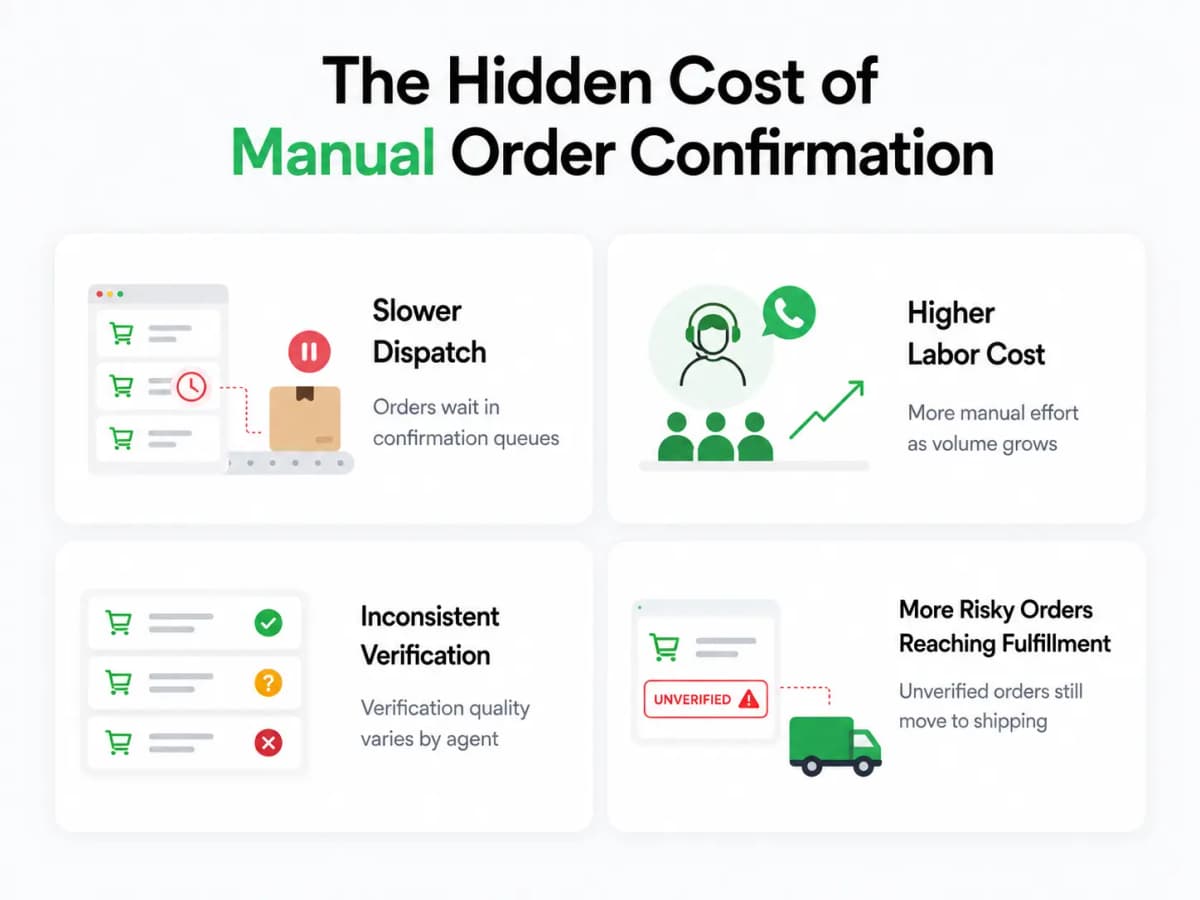
The cost of manual confirmation is not only the time spent making calls. It affects areas like fulfilment, labour, risk, and customer experience.
When orders sit in a confirmation queue, fulfilment slows down.
This affects delivery timelines, warehouse flow, and customer expectations. It also builds internal pressure to rush orders before verification is done. This undermines the process's purpose.
Once orders move into fulfillment, proactive ecommerce delivery updates can help reduce customer anxiety and support tickets.
Manual calling is expensive to sustain.
As order volume grows, brands often add callers, supervisors, QA checks, and tracking overhead just to keep the process running. The work is repetitive, but it still consumes skilled team time.
What looks like a control layer can become a growing operational burden.
A manual workflow makes it harder to maintain the same verification standard across all orders.
This means some risky orders get caught, but others slip through. This can happen if someone hurried through the call, missed it, or recorded it in a bad way. Over time, this creates a weak and uneven confirmation system rather than a reliable safeguard.
When teams fall behind, risky orders still move ahead.
That might mean low-intent buyers. It could also mean unreachable customers or wrong addresses. Some orders may need further review. Once those orders are picked, packed, and shipped, the business begins to absorb unnecessary costs.
Stripe’s fraud prevention documentation also recommends identifying false information, inconsistent details, unusual orders, and suspicious shipping requests before fulfilling orders.
You can also read how to reduce fake orders in ecommerce before they reach fulfillment to understand how better pre-shipping checks protect operations.
Customers also feel the weakness of a manual process.
Customer Experience Issues
Some receive quick and clear calls.
Others get repeated calls at odd times.
Some are asked the same questions multiple times.
Others receive no useful follow-up at all.
A weak order confirmation process after a sale creates friction. This isn’t the experience most brands want to provide.
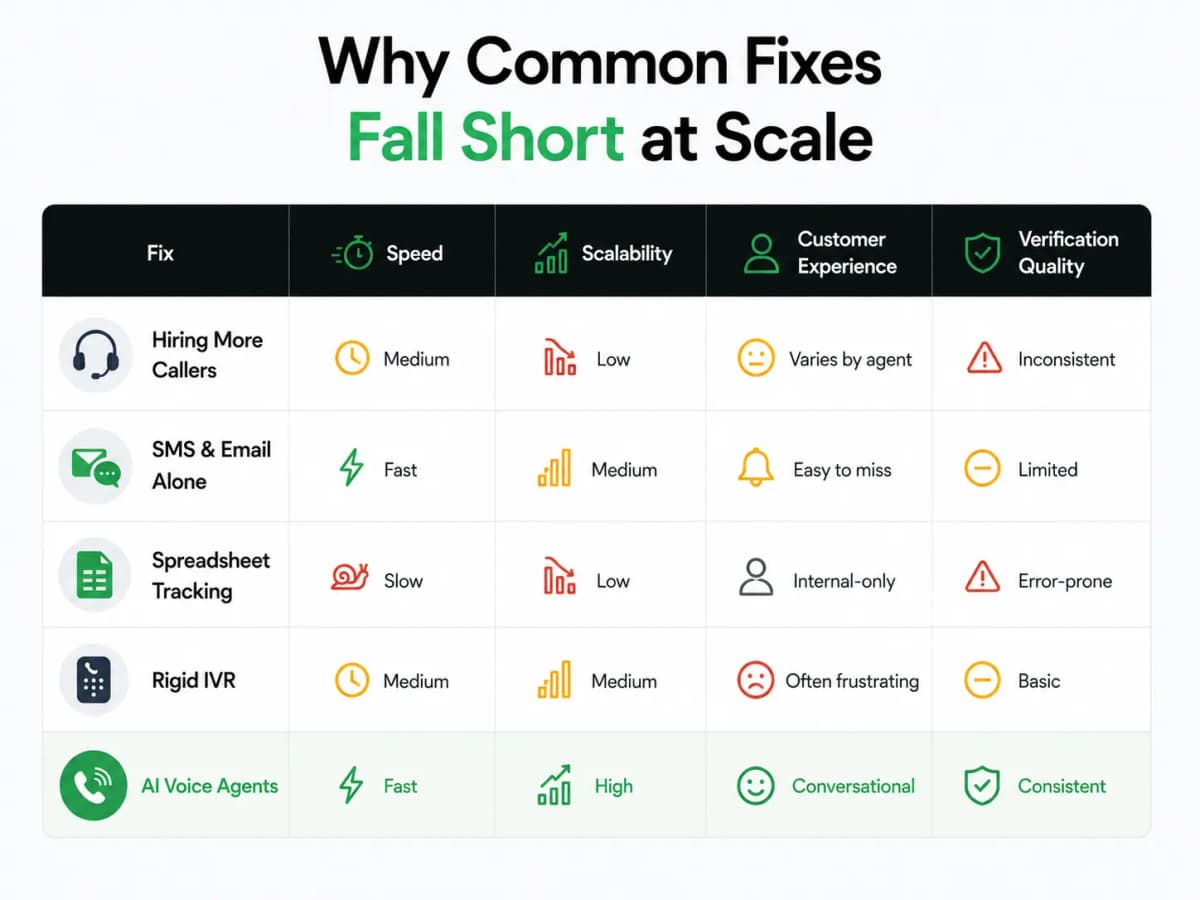
When manual confirmation starts to fail, ecommerce teams often try to fix it instead of redesigning it.
Adding more staff can boost capacity, but it won't fix the core process issue.
It raises cost, requires training, and still leaves the workflow dependent on human speed and consistency. During peak periods, the same issues often recur.
SMS and email are useful, but they are not enough on their own for many confirmation scenarios.
They can be ignored, misunderstood, or missed entirely. They can’t always manage clarification, objections, or conversational checks as well as voice.
Brands using order confirmation calls in ecommerce need to be cautious. Switching to text-based outreach can significantly reduce control. It might not make things better.
Spreadsheets are often used to manage call queues, outcomes, retries, and exceptions.
They may help organise work for a while, but they add more manual handling to an already manual process. They also create visibility problems, slower updates, and more room for error.
Basic robocalls and rigid IVR systems often fail. They lead to bad customer interactions.
Customers do not want confusing menus or robotic flows when confirming an order. If automation reduces clarity, it won't help. If it cuts the completion rate, it doesn't fix the problem.
That is why many ecommerce teams hesitate to automate order confirmation at all. They are not rejecting automation itself. They are rejecting bad automation.
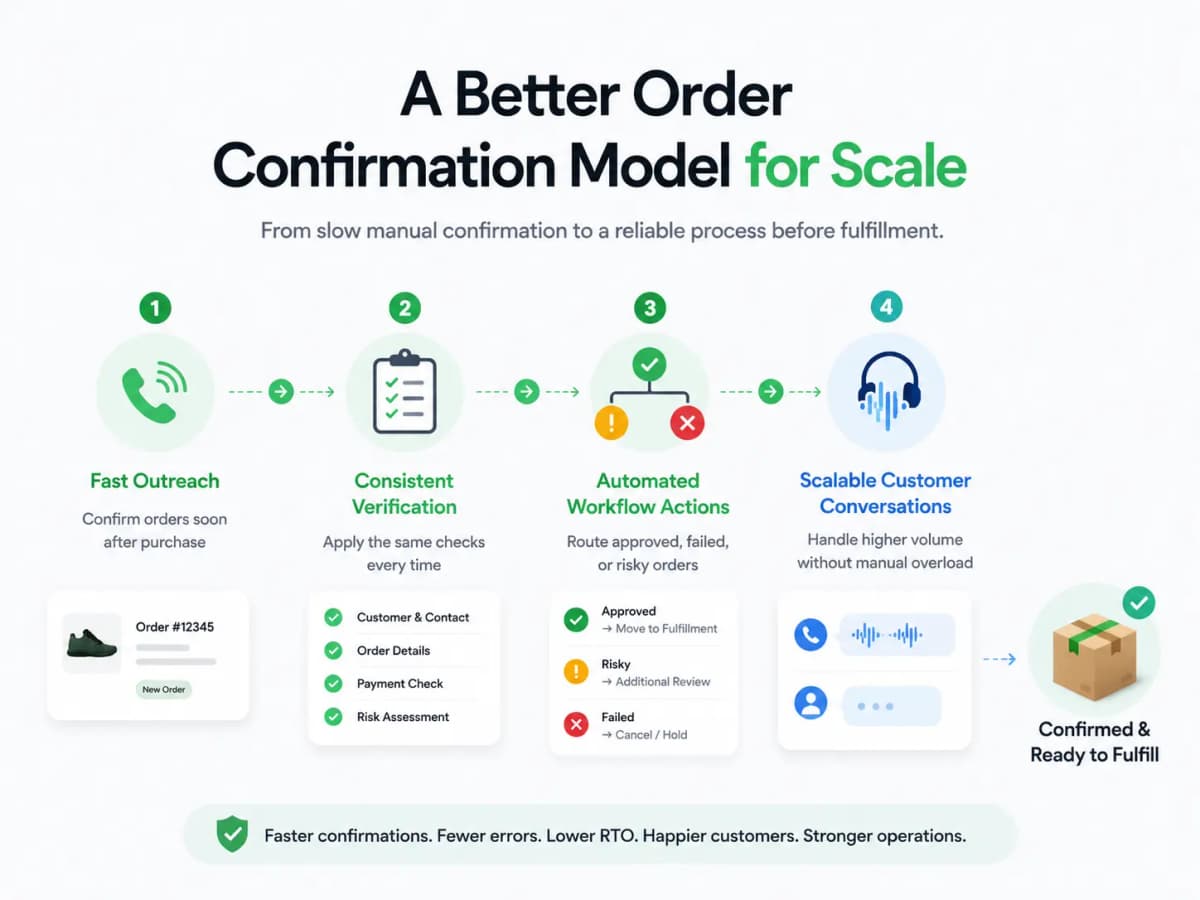
A better model keeps the business goal of confirmation while removing the operational drag of manual work.
The system should confirm the order right after the customer places it. This keeps intent high. It also helps to control dispatch decisions better.
Every order should follow the same verification logic, with clear checks, outcomes, and escalation rules.
Confirmation is only useful if the result moves the order forward. Approved orders should trigger the next step. Hold, flag, or route risky or failed confirmations automatically.
The process must manage increasing order volume without needing to hire more staff at the same rate.
This is where many brands start to automate order confirmation ecommerce more practically.
For implementation steps, use the ecommerce order confirmations playbook to plan the workflow, call logic, and fulfillment handoff.
An AI voice agent for ecommerce works well. It mixes fast automation with the friendly conversation needed for confirmation.
A human-like AI voice agent can chat naturally with customers. It verifies key details, responds to simple changes, and wraps up conversations in real time. This is better than static messages or rigid call trees.
That makes it well-suited to:
fast outbound confirmation after purchase
consistent verification across large order volumes
handling retries without adding team workload
capturing structured outcomes from every conversation
triggering workflow actions based on confirmed status
For ecommerce brands, this changes the role of order confirmation. Instead of being a manual queue that slows the business down, it becomes a scalable operational checkpoint.
In other words, AI voice does not just replace calls. It improves the reliability of the ecommerce order confirmation process itself.
Salesix AI helps ecommerce teams manage order confirmations using AI voice agents. These agents sound human and are built for real customer conversations.
It can help brands in:
Confirm orders before fulfillment resources are committed
Reduce manual calling overhead
improve consistency in order verification
handle higher volumes without growing confirmation teams at the same pace
maintain a smoother customer experience during the post-purchase stage
For brands dealing with dispatch delays, verification inconsistency, or rising confirmation workload, the next step is not just adding more people. It is moving to a model built for scale.
You can explore how that works on the Order Confirmation use case page, or go deeper with the ecommerce order confirmations playbook.
Manual confirmation is not a bad idea. The problem is that it doesn’t work well when ecommerce growth rises. This increase leads to more volume, time pressure, and complex workflows.
That is why manual order confirmation ecommerce becomes a bottleneck at scale. It slows dispatch, increases labor cost, weakens verification consistency, and allows more risky orders to reach fulfillment.
A better approach is to keep the control benefit of confirmation while removing the manual constraint. Human-like AI voice gives ecommerce teams a more scalable way to verify orders, trigger actions, and protect fulfillment operations without adding more overhead.

Get $5 free credit on signup — no credit card required. Set up your AI voice agent in minutes and start converting more leads today.