Customer-Feedback
Negative Reviews in E-commerce: How to Handle Them Before They Hurt Customer Trust



Premium Humanoid AI Voice Agents for your business.
Negative reviews in e-commerce are not public complaints. They are often the visible result of an earlier customer experience failure.
A negative review may come from a customer whose expectations weren't met. They might say the product was late, damaged, or that the return process was confusing. By the time they post their review, they usually feel ignored.
That is why handling negative reviews is not only about reputation management. It is about customer recovery, feedback collection, support improvement, and operational visibility.
The right approach is easy. Respond in a public manner, and recover in private. Build a feedback loop. This catches problems before they lead to repeated complaints.
In this post, we’ll discuss how to manage negative reviews in e-commerce. We’ll also look at ways to keep customer trust strong.
Negative reviews in e-commerce damage customer trust. They create doubt right when a buyer is deciding to buy.
Shoppers often use reviews to answer questions they cannot confirm from product pages alone:
Will the product look like the images?
Will the size, fit, or quality match expectations?
Will delivery be reliable?
Will the brand help if something goes wrong?
Are other customers satisfied after buying?
A single negative product review does not always damage trust permanently. In fact, a mix of positive and negative reviews can make a brand look more real. The bigger problem is repeated negative reviews that point to the same unresolved issue.
For example, one review that says “delivery was late” may be seen as an exception. But if ten reviews say, “delivery was late, and no one responded,” show a bigger problem with customer experience.
That is why e-commerce teams need to look beyond the review itself. The review is the symptom. The real problem is the experience that caused it.
Negative reviews usually happen when there is a gap between what the customer expected and what the brand delivered.
Some of the common causes are:
Customers leave negative product reviews when the item does not match the description, images, size guide, quality promise, or use case they expected. This is common in categories like fashion, beauty, electronics, home goods, and accessories.
Delivery delays do not always create negative reviews on their own. The frustration usually increases when customers do not know what is happening, when the order will arrive, or who to contact for help.
Receiving the wrong item, missing items, or damaged products creates immediate disappointment. If resolution is slow, that disappointment often becomes a public complaint.
A confusing return process can turn a fixable issue into a negative review. Customers may complain about unclear policies, difficult pickup scheduling, eligibility confusion, or poor return instructions.
Refund-related complaints are especially sensitive because customers feel their money is stuck. Slow or unclear refund communication can quickly damage trust.
If customers have to repeat their problem, wait too long, or receive generic replies, they may use reviews as a last resort to get attention.
Many negative reviews are not caused by one single failure. They are caused by silence after the failure. When a brand does not follow up after delivery, returns, complaints, or support tickets, unhappy customers may feel the review is the only place where they will be heard.
Responding to negative reviews matters, but it is not enough.
A public response shows future shoppers that the brand is listening. It can soften the impact of a bad review and show accountability. However, public review replies are reactive. By the time the review exists, the customer has already had a poor experience.
This is where many ecommerce brands fall short. They monitor reviews, reply with polite templates, and consider the job done. But the customer may still be unhappy. The issue may still be unresolved. The same problem may still be affecting other buyers.
A review response can help brands protect their reputation. However, it doesn't ensure the customer will return or fix the problem behind the complaint.
Ecommerce brands need a bigger feedback loop that connects reviews to support, operations, delivery, returns, product quality, and customer follow-up.
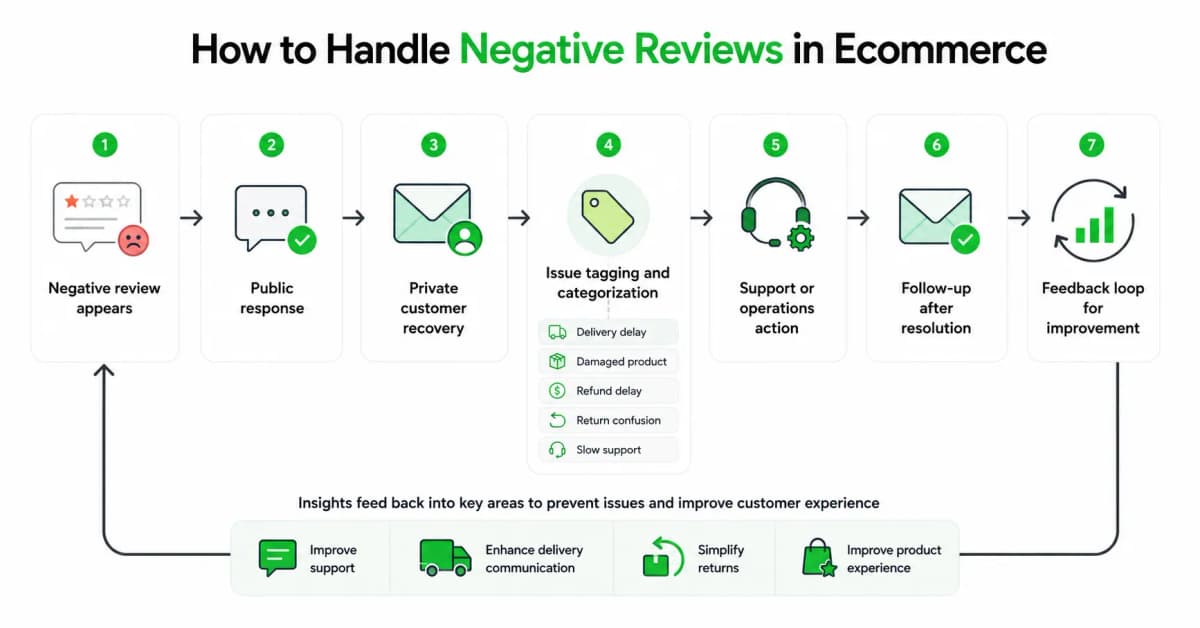
To handle negative reviews in ecommerce effectively, brands need a response process that is fast, specific, calm, and resolution-focused.
Here is a practical framework.
A delayed response makes the brand look inattentive. Quick replies show that the customer’s concern matters and that the brand is actively monitoring feedback.
Speed is especially important for reviews about delivery, refunds, damaged products, or support failures because these issues may still be unresolved.
Avoid generic replies like “We are sorry for the inconvenience.” They sound automated and dismissive.
A better response names the issue clearly:
“We’re sorry your order arrived damaged and that the replacement process took longer than expected.”
Specific acknowledgment shows the customer and future shoppers that the brand understood the complaint.
A good apology does not argue with the customer. It does not blame logistics partners, policies, warehouse teams, or the customer.
Even when the issue needs investigation, the first response should show ownership:
“We’re sorry this experience did not meet the standard we want for our customers.”
Customers need to know what happens next. A good response should show a clear way to resolve the issue. This could include contacting support, checking order details, arranging a replacement, confirming refund status, or escalating the matter.
Public review replies should not expose personal order information. After acknowledging the issue publicly, move the detailed resolution to a private support channel.
For example:
“We’d like to look into this and help resolve it. Please contact our support team with your order number, or reply to the message we’ve sent you directly.”
Many brands stop after the first reply. Stronger brands follow up after the issue is resolved.
This matters because customer recovery is not complete when support sends one reply. It is complete when the customer feels the issue was handled.
The real recovery happens privately.
A public response may protect brand perception, but a private conversation can repair the customer relationship. The goal is not to pressure the customer to remove the review. The goal is to understand what went wrong and resolve the issue properly.
A recovery workflow should include:
If order details are available, reach out through the customer’s preferred channel. This could be phone, email, SMS, WhatsApp, or support chat.
For high-friction complaints, a direct conversation can work better than another email because it allows the customer to explain the issue in their own words.
Do not assume the review contains the full story. Ask what happened, what the customer expected, and where the experience broke down.
For example, A customer who wrote “bad service” may actually mean the return pickup failed twice. A customer who wrote “poor product” may mean the sizing guide was misleading.
Customer recovery improves when the brand understands the desired resolution. Some customers want a refund. Others want a replacement, exchange, apology, store credit, delivery clarification, or simply a real response.
Do not ask customers to edit or remove a negative review before the problem is fixed. That can feel manipulative and may create more frustration.
First, resolve the issue. Then, after the customer confirms satisfaction, it is fair to say they are welcome to update their review if they feel the experience has changed.
The best way to prevent negative reviews is to identify dissatisfaction before it reaches public channels.
This starts with treating reviews as operational data, not just reputation data.
Ecommerce teams should track patterns by:
Product
SKU or variant
Delivery partner
Region
Return reason
Refund issue
Support category
Customer segment
Campaign or promotion
Warehouse or fulfillment location
For example, if several negative reviews mention “wrong size,” the issue may be the size guide, product description, photography, or quality control. Or, if reviews mention “late delivery” in one region, the issue may be a delivery partner or local fulfillment delay.
Early post-delivery feedback collection is especially useful here. Instead of waiting for customers to leave a public review, brands can ask about the experience soon after delivery.
A simple post-delivery feedback flow can ask:
Did the product arrive as expected?
Was delivery smooth?
Are you satisfied with the product?
Do you need help with anything?
Would you like to share feedback?
Happy customers can be encouraged to leave reviews. Unhappy customers can be routed to support before frustration becomes public.
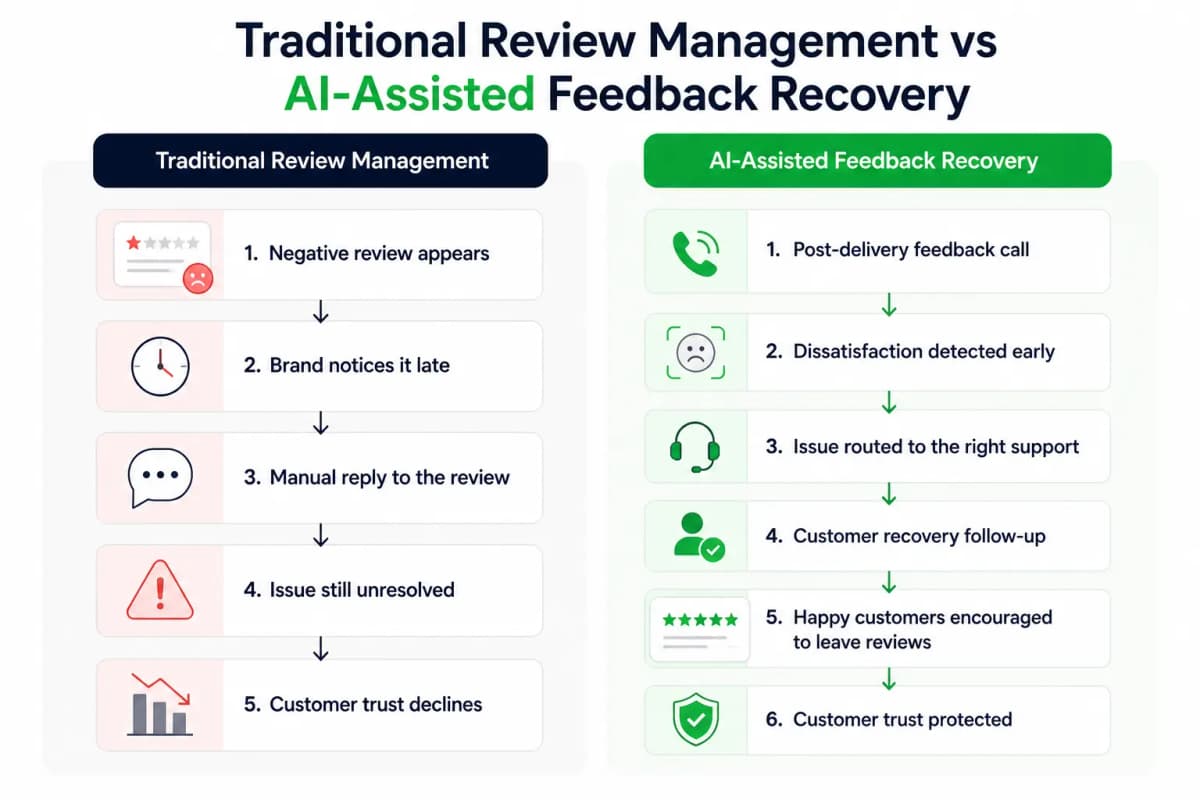
Traditional online review management often fails within ecommerce brands because it is too reactive, too manual, or disconnected from customer workflows.
Many brands rely on post-purchase feedback, like email flows, to collect reviews. These can work for some customers, but they are easy to miss, ignore, or delay.
Unhappy customers may not respond to a survey. They may go straight to a public review platform instead.
Calling unhappy customers can be effective, but manual calling becomes difficult as order volume grows. Support teams often do not have enough time to call every recent buyer, detect dissatisfaction, and follow up properly.
Monitoring tools help brands find negative reviews after they are published. They do not always help brands identify unhappy customers before the review appears.
When support teams are already handling tickets about orders, returns, refunds, delivery delays, and product issues, review recovery often becomes inconsistent.
Survey responses, support tickets, reviews, return reasons, and delivery complaints often live in separate systems. This makes it harder to understand the complete customer experience.
That is why ecommerce brands need complete customer feedback more than review replies.
A better approach is to treat negative reviews as part of a larger feedback system.
Instead of asking, “How do we reply to this bad review?”, ecommerce brands should ask:
What customer experience caused this review?
Could we have detected dissatisfaction earlier?
Is this issue happening repeatedly?
Which team needs to act on this feedback?
How do we recover this customer?
How do we prevent similar reviews from future customers?
This shifts review management from damage control to customer experience improvement.
For ecommerce brands, the strongest system connects three workflows:
Collect customer feedback after delivery, returns, refunds, support interactions, and repeat purchases.
Route the unhappy customers to the right team quickly, especially when the issue involves damaged products, delayed delivery, failed returns, or refund confusion.
Use automation to identify low satisfaction, trigger follow-ups, assign support tasks, and encourage satisfied customers to leave reviews.
This is where AI voice agents for ecommerce can virtually support ecommerce review workflows.
AI voice agents help ecommerce brands catch negative feedback earlier by proactively calling customers after important post-purchase moments and turning those conversations into structured feedback.
If the customer is satisfied, the workflow can encourage them to leave a review.
If the customer is unhappy, the workflow can collect the reason, detect dissatisfaction, trigger a support follow-up, and route the issue to the right team.
For ecommerce brands, this is useful because many dissatisfied customers do not fill out surveys. But they may explain the issue in a short conversation when contacted at the right time.
Salesix AI supports this kind of feedback and review collection workflow by helping ecommerce teams automate phone-based customer conversations, collect post-call insights, trigger next actions, and scale proactive outreach without relying only on manual support calls.
This makes AI voice agents especially relevant for:
Post-delivery feedback calls
Negative sentiment detection
Review request workflows
Customer satisfaction follow-ups
Return and refund feedback
Support recovery escalation
Repeat complaint tracking
The goal is not to replace every review platform or support process. The goal is to create an earlier feedback layer so unhappy customers are heard before they turn frustration into public complaints.
Negative Review Handling Checklist for Ecommerce Brands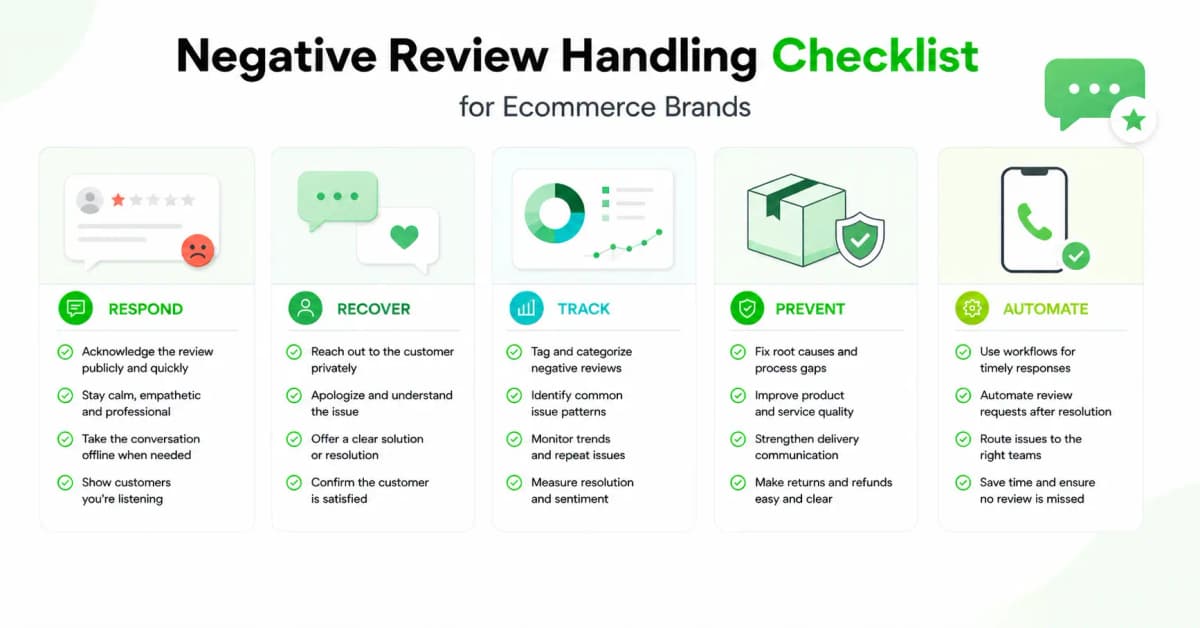
Use this checklist to improve how your ecommerce brand handles and prevents negative reviews:
Monitor reviews across key platforms regularly.
Reply quickly to negative reviews.
Acknowledge the customer’s specific issue.
Apologize without sounding defensive.
Offer a clear next step.
Move detailed resolution to a private channel.
Follow up after the issue is resolved.
Track recurring complaint patterns.
Categorize issues by product, delivery, return, refund, and support reason.
Collect post-delivery feedback before customers complain publicly.
Route unhappy customers to support quickly.
Ask satisfied customers to leave reviews.
Use feedback to improve product pages, delivery communication, returns, and support workflows.
Connect review handling with customer feedback collection and operational reporting.
Negative reviews in ecommerce do not have to become long-term trust damage.
The brands that handle them best do not only reply publicly. They recover the customer privately, investigate what caused the poor experience, and build feedback loops that catch dissatisfaction earlier.
A negative review is a warning sign. It may point to product mismatch, delivery communication gaps, return friction, refund delays, or weak support follow-up.
When ecommerce teams treat negative reviews as customer feedback signals, they can protect trust, improve customer recovery, and prevent the same complaints from repeating.

Get $5 free credit on signup — no credit card required. Set up your AI voice agent in minutes and start converting more leads today.