Customer-Feedback
Why Customer Feedback Is Important for Ecommerce Growth



Premium Humanoid AI Voice Agents for your business.
For Growth almost every ecommerce brands look at areas like more ads, better discounts, higher website traffic, improved product pages, and stronger conversion tactics. They rely on these strategies to drive sales and gain a competitive edge in the market.
Those things matter. But many ecommerce growth problems begin after the customer buys.
A customer may receive the wrong product. Delivery may be confusing. Packaging may feel poor. Support may respond late. A return may feel difficult. The customer may not complain directly, but they may never buy again.
That is why customer feedback is important for ecommerce growth. It helps brands understand what customers actually experience, not just what analytics dashboards show.
In this post, you’ll discover why customer feedback is important for ecommerce growth. And see how it uncovers hidden issues in customer experience. Plus, learn how brands can use feedback to improve products, boost reviews, and increase retention and repeat purchases.
Customer feedback in ecommerce is the information customers share about their experience with a brand, product, order, delivery, support interaction, return, or overall shopping journey.
It can include feedback about:
Product quality
Size, fit, color, or variant accuracy
Delivery speed and communication
Packaging condition
Website and checkout experience
Customer support quality
Return or exchange experience
Refund updates
Overall satisfaction
Reasons for repeat purchase or churn
Customer feedback is broader than customer reviews.
A review is usually public and often appears on a product page, marketplace, Google profile, or review platform.
Customer feedback includes all of these, but it also includes private conversations, post-purchase responses, survey answers, phone call insights, return reasons, social comments, and direct customer conversations.
In ecommerce, the most useful feedback explains not only what happened, but why it happened and what the brand should do next.
Customer feedback is important because it connects customer experience to business growth.
It helps ecommerce brands understand why customers buy again, why they leave, why they complain, and why they recommend a product to others.
Without feedback, teams often rely on surface-level metrics such as conversion rate, return rate, support volume, repeat purchase rate, and star ratings. Those metrics show that something is happening, but they do not always explain why.
For example, a brand may see repeat purchases falling. Analytics can show the drop, but customer feedback may reveal that customers liked the product but felt ignored after delivery. Another brand may see returns rising. Feedback may show that the product page created the wrong expectation about sizing, material, or usage.
This is where customer feedback for business growth becomes valuable. It turns customer opinions into product, support, delivery, and retention insights.
The benefits of customer feedback include:
Finding hidden friction in the customer journey
Improving customer satisfaction
Reducing repeated complaints
Improving product pages and product quality
Increasing review volume and trust
Identifying unhappy customers before they churn
Understanding why first-time buyers do not return
Creating better follow-up and retention campaigns
Ecommerce customer feedback helps teams stop guessing and start improving the experience customers are having.
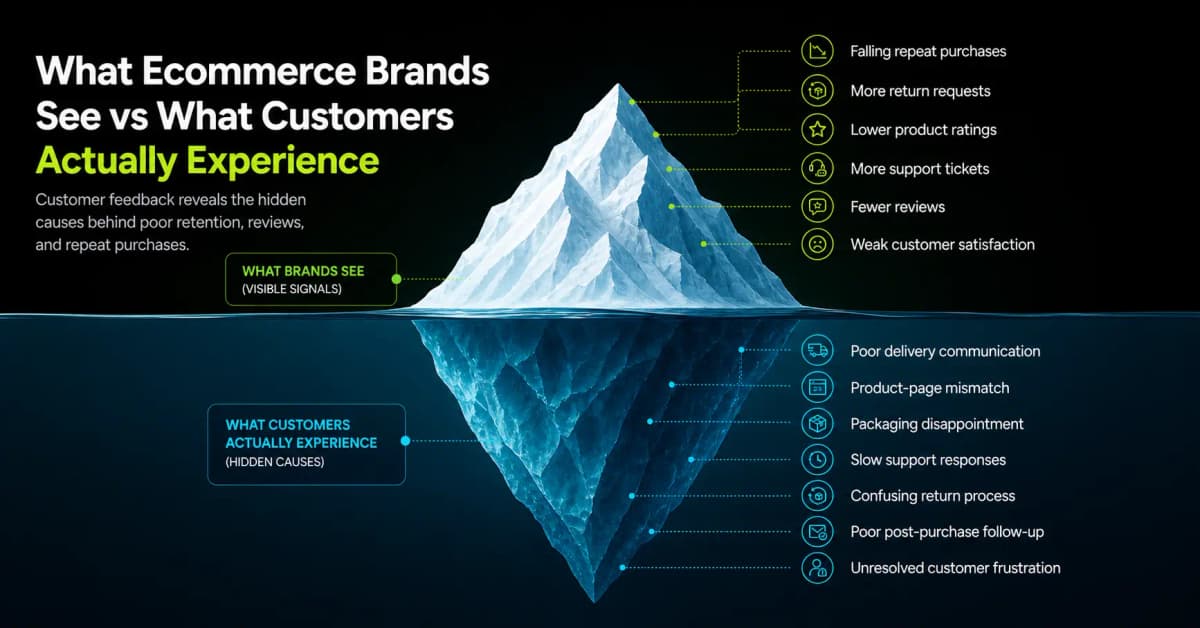
Many ecommerce brands are surrounded by signals, but still lack clarity.
They may see:
Falling repeat purchases
More return requests
Lower product ratings
More support tickets
Fewer reviews
More delivery complaints
Poor post-purchase engagement
Weak customer satisfaction
But these signals often appear after the problem has already affected growth.
A customer who does not buy again may not explain why, A shopper who receives a late delivery may complain privately but never leave feedback, or a buyer who had a confusing return experience may simply choose a competitor next time.
This creates a dangerous gap. The brand sees the outcome, but not the customer’s experience.
That is why collecting customer feedback in ecommerce should not be treated as a passive reporting activity. It should be built into the post-purchase journey. The goal is not only to collect feedback after something goes wrong. The goal is to understand customer experience early enough to improve it.
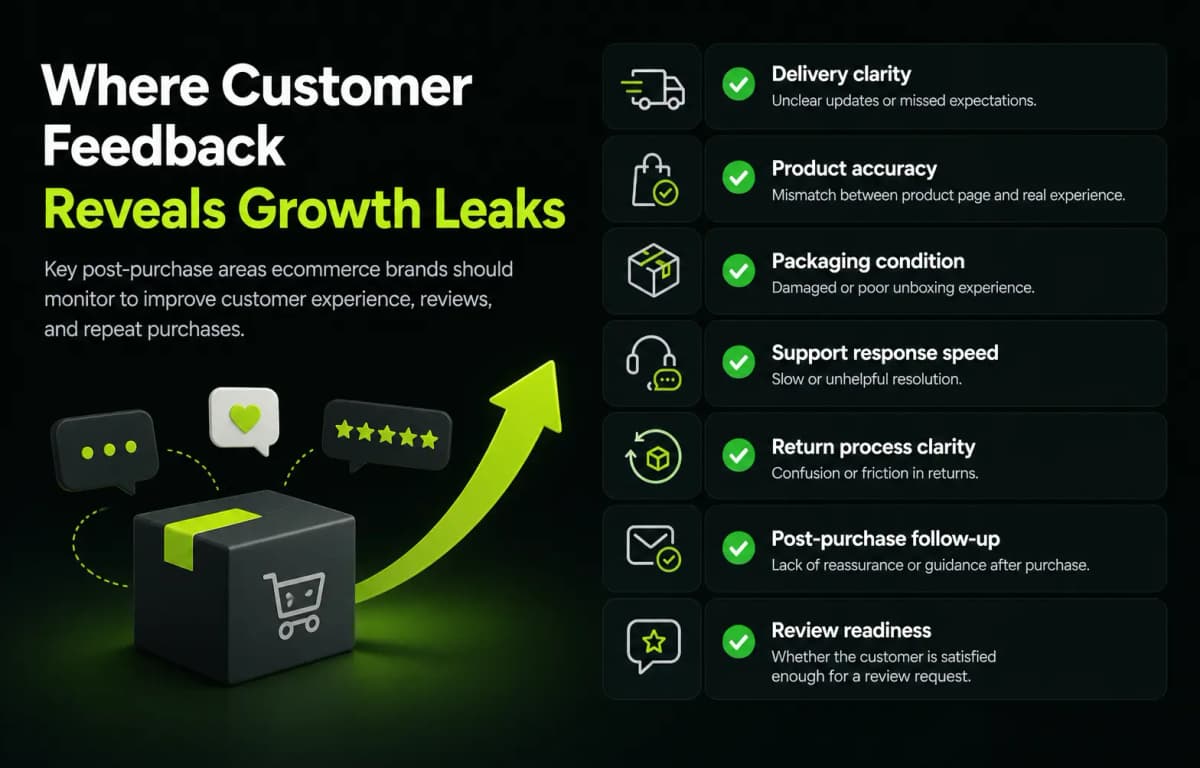
Customer feedback improves customer experience by showing where the buying journey feels confusing, slow, unreliable, or frustrating.
In ecommerce, the customer experience does not end at checkout. It continues through payment confirmation, delivery updates, product arrival, usage, support, returns, exchanges, reviews, and future purchases.
Feedback can reveal issues such as:
Customers may struggle to compare products, understand sizing, choose the right variant, or find key information before buying.
If this confusion is not captured, the brand may see high returns without understanding that the problem started before checkout.
Customers often become anxious when they do not know where their order is, when it will arrive, or what to do if delivery fails.
Feedback can show whether customers feel informed or ignored during the delivery window.
Support delays can turn small issues into trust problems. Customer feedback helps teams understand whether response time, tone, resolution quality, or follow-up is hurting customer satisfaction.
A return policy may look clear internally, but feel confusing to customers. Feedback can show where customers get stuck, which steps create frustration, and where support tickets are being created unnecessarily.
Many brands send order confirmations and delivery emails but miss the moments when customers need reassurance, guidance, or follow-up. Feedback helps identify where communication should be more proactive.
This is how customer feedback and customer satisfaction are connected. Feedback shows what customers feel. Satisfaction improves when the brand acts on those signals.
Customer feedback is one of the clearest ways ecommerce brands can improve products.
Product analytics may show sales volume, return rate, or margin. But feedback explains what customers experienced after using the product.
For example, customer feedback can reveal:
Repeated complaints about a specific SKU
Size or fit issues
Quality concerns
Packaging damage
Missing instructions
Poor product images
Inaccurate product descriptions
Mismatch between product page promises and real experience
Common reasons customers choose refunds instead of exchanges
This is especially important for ecommerce brands with large catalogs. A few scattered complaints may look minor when viewed individually. But when feedback is organized by product, order type, customer segment, or return reason, patterns become easier to spot.
Customer feedback helps business growth because it gives product, merchandising, support, and operations teams a shared view of what needs to improve.
Customer feedback helps ecommerce brands build trust because it shows customers that the brand is listening.
Trust is not created only through polished product pages or promotional messaging. It is created through the customer’s lived experience: what happens after they pay, whether the product meets expectations, whether support responds, and whether the brand follows through.
It also helps reduce repeated public complaints. When customers have a private channel to explain what went wrong, the brand has a chance to recover the experience before dissatisfaction becomes a negative review.
Strong feedback systems help ecommerce brands:
Understand what creates positive customer sentiment
Identify happy customers for review requests
Find unhappy customers before they complain publicly
Improve product pages with real customer language
Strengthen trust through better post-purchase follow-up
Customer reviews matter, but reviews are usually the visible result. Feedback is the system that helps brands understand and improve the experience behind those reviews.
Customer feedback supports retention by explaining why customers do or do not come back.
Many ecommerce brands focus heavily on acquisition. They bring customers in through ads, influencers, SEO, marketplaces, discounts, and email campaigns. But if the post-purchase experience is weak, the brand has to keep paying to replace customers who should have returned.
Feedback helps teams understand the reasons behind low repeat purchase behavior.
For example:
Did the product fail to meet expectations?
Was delivery too uncertain?
Did support feel slow or unhelpful?
Was the return process frustrating?
Did the customer like the product but not know what to buy next?
Was there no follow-up after the first purchase?
Did the customer have a minor issue that was never resolved?
This makes customer feedback useful for retention teams, not just support teams.
Feedback can help brands segment customers by satisfaction, product interest, issue type, and future intent. A happy customer may be ready for a review request, loyalty offer, or product recommendation. A dissatisfied customer may need a recovery workflow. A neutral customer may need education, onboarding, or a better follow-up sequence.
How customer feedback helps business growth is simple: it gives teams a clearer reason to act. Instead of sending generic campaigns to everyone, brands can create follow-ups based on what customers actually said.
Most ecommerce brands already collect some kind of feedback. The problem is that many methods are passive, delayed, shallow, or disconnected from action.
Customers may not want to complete a long survey after receiving an order. Even when they do respond, they may rush through the answers or provide limited detail.
Post-purchase emails often compete with promotions, shipping updates, and inbox noise. Many customers ignore them, especially if the request feels generic.
A star rating can show satisfaction level, but it may not explain the reason behind the rating. A three-star review could mean slow delivery, wrong expectations, average product quality, or weak support.
Many unhappy customers never open a support ticket. They simply leave, return the item, write a review, or choose another brand next time.
Customers may share feedback across Instagram, TikTok, Facebook, marketplaces, or review sites. Without a system to collect and organize those signals, insights stay fragmented.
Human follow-up calls can collect rich feedback, but they are difficult to scale across thousands of orders, especially for growing D2C and ecommerce teams.
The weakness is not feedback collection itself. The weakness is collecting feedback without enough timing, context, structure, or workflow action.
To explore practical ways to collect better feedback after delivery, read: How to Collect Customer Feedback After Purchase in Ecommerce
A Better Approach: Turn Feedback Into an Actionable Growth Loop
A strong ecommerce feedback loop does more than ask, “How was your experience?”
It connects feedback to action.
A useful feedback loop should:
Ask at the right moment
Capture more than a rating
Understand the reason behind the response
Connect feedback to product, support, delivery, and retention workflows
Identify happy customers for review requests
Escalate dissatisfied customers quickly
Track patterns across customers, products, orders, and teams
Timing matters. A customer may give better feedback after delivery, after support resolution, after a return is completed, or after they have had enough time to use the product.
Context matters too. Asking a customer “How was your experience?” is helpful, but asking “Was the delivery clear and on time?” or “Did the product match what you expected from the page?” produces more useful insight.
The strongest brands do not only collect ecommerce customer feedback. They operationalize it.
That means feedback should influence product pages, support scripts, delivery updates, return workflows, review requests, CRM tags, retention campaigns, and escalation processes.
When feedback becomes part of the operating system, it stops being a report. It becomes a growth loop.
AI voice agents for ecommerce fit naturally for feedback tasks because they help brands collect richer, more timely feedback through human-like conversations at scale.
Instead of relying only on passive surveys or generic review emails, an AI voice agent can call customers at important post-purchase moments, such as:
After delivery
After support resolution
After return or exchange completion
After a product usage window
After a delayed order is resolved
After a high-value purchase
Before asking for a public review
The value of voice is that it can capture context.
A customer may not type a detailed survey response, but they may explain in a short conversation that the product was good, the packaging was damaged, delivery updates were unclear, or the return process felt slow.
AI voice agents can ask follow-up questions, capture sentiment, identify satisfied customers, detect dissatisfaction, summarize responses, update CRM or support tools, and trigger workflows based on what the customer says.
For Salesix, this is where feedback and review collection become more actionable. Ecommerce brands do not just need more feedback. They need timely, conversational feedback that reveals customer intent and creates the next step automatically.
That next step could be:
Asking a happy customer for a review
Escalating an unhappy customer to support
Tagging a product issue in the CRM
Triggering a retention follow-up
Creating a support ticket
Updating customer satisfaction records
Summarizing feedback for CX and product teams
This makes AI voice agents a practical layer for ecommerce brands that want to move from passive feedback collection to proactive customer experience improvement.
Customer feedback matters because it shows ecommerce brands the real customer experience behind ratings, reviews, support tickets, returns, and repeat purchase behavior.
It explains why customers trust, complain, return, recommend, or leave. It helps teams improve products, fix customer experience gaps, build stronger review systems, and create better retention campaigns.
The key is not just collecting more feedback. The key is collecting feedback at the right moment, understanding the reason behind each response, and connecting that insight to real workflows.
For ecommerce growth, customer feedback should not be treated as a side activity. It should be treated as an early warning system for lost trust, lost retention, poor reviews, product issues, and post-purchase friction.

Get $5 free credit on signup — no credit card required. Set up your AI voice agent in minutes and start converting more leads today.