Delivery-Updates
Ecommerce Shipping Delays: Why Poor Communication Damages Customer Trust



Premium Humanoid AI Voice Agents for your business.
Ecommerce shipping delays are not always fully in your control. A courier may face a backlog, a warehouse may miss a dispatch window, or a delivery route may get disrupted. Even well-run ecommerce brands can face delays that are difficult to avoid.
But the communication experience is in your control. A late order is frustrating. Silence makes it worse.
When customers have to contact your support team just to understand where their order is, the delay is no longer only a logistics issue. It becomes a trust issue.
This is why growing ecommerce brands need more than operational delay reduction.
In this post, we’ll cover why ecommerce shipping delays damage customer trust, where communication often breaks down, and how proactive delivery updates can reduce complaints, support pressure, and post-purchase frustration.
What Are Ecommerce Shipping Delays?
Ecommerce shipping delays happen when an order arrives later than the promised, estimated, or expected delivery date.
A delay can happen at different stages of the order journey. It may begin before dispatch, it may happen during transit, or it may occur during last-mile delivery.
Shipping delays in ecommerce are different from failed deliveries or return-to-origin (RTO) cases. In a shipping delay, the order may still reach the customer. The issue is that it is late, uncertain, or poorly explained.
That distinction matters. A delayed delivery in ecommerce can still end with a successful delivery, but the customer experience may already be damaged by the time the package arrives.
Why Ecommerce Shipping Delays Happen
Shipping delays in ecommerce can come from many sources. Some are internal and preventable. Others are external and harder to control. The important point is that customers rarely separate these causes clearly. From their point of view, they ordered from your brand, so your brand is responsible for the experience.
Some ecommerce delivery delays begin before the order even leaves the warehouse.
Common causes include inaccurate stock counts, overselling, delayed picking and packing, warehouse staffing pressure, slow order processing, or delayed courier handoff.
During sales campaigns or seasonal peaks, these problems occur most often because order volume rises faster than the fulfillment team can process it.
For the customer, these internal delays are rarely obvious. They may only see that the order has not moved, the tracking link has not updated, or the promised dispatch date has passed.
Many ecommerce shipping delays happen after the package has been handed to a courier.
Carrier hubs may become overloaded.
Routes may be constrained.
Delivery capacity may be limited in certain locations.
Remote-area delivery can take longer than expected.
Peak-season pressure can also slow down first-mile, middle-mile, and last-mile movement.
Even when the carrier causes the delay, the customer usually expects the ecommerce brand to explain it. A brand that simply passes the customer to the courier tracking page often feels absent from its own post-purchase experience.
Incomplete or incorrect customer data can also create delayed delivery in ecommerce.
Wrong PINs or ZIP codes
Missing landmarks
Invalid phone numbers
Incomplete addresses or unclear delivery instructions can all slow down delivery.
This is where communication becomes operationally important. If the customer can be contacted early, the brand may be able to correct the issue before the delay becomes a failed delivery or return-to-origin problem.
Some delays happen because of factors outside the brand, warehouse, or courier.
Weather events, strikes, road disruptions, port congestion, supply chain issues, customs delays, and regional delivery restrictions can all delay orders. These disruptions are hard to prevent, but they still need to be communicated clearly.
Customers do not expect every brand to control the weather or customs process. They do expect the brand to tell them what changed, what it means for the delivery timeline, and when they will receive the next update.
Ecommerce shipping delays hurt customers’ trust. Then, Poor communication makes them feel worse.
A customer waiting for a late order usually has a few simple questions:
Is my order still coming?
Why is it delayed?
When will I receive it?
Do I need to do anything?
Will someone update me if the timeline changes again?
Most delivery communication does not answer these questions well enough.
A tracking page may show “in transit” for three days without context.
An SMS may say “your order is delayed” without explaining why.
An email may arrive after the customer has already contacted support.
A chatbot may repeat the same tracking status the customer already saw.
When communication fails, the customer starts filling in the gaps. They wonder whether the order is lost, question whether the brand is reliable, contact support, and they may cancel, leave a negative review, or decide not to buy again.
The delay may be unavoidable. The uncertainty is not.
How Poor Shipping Delay Communication Damages Customer Trust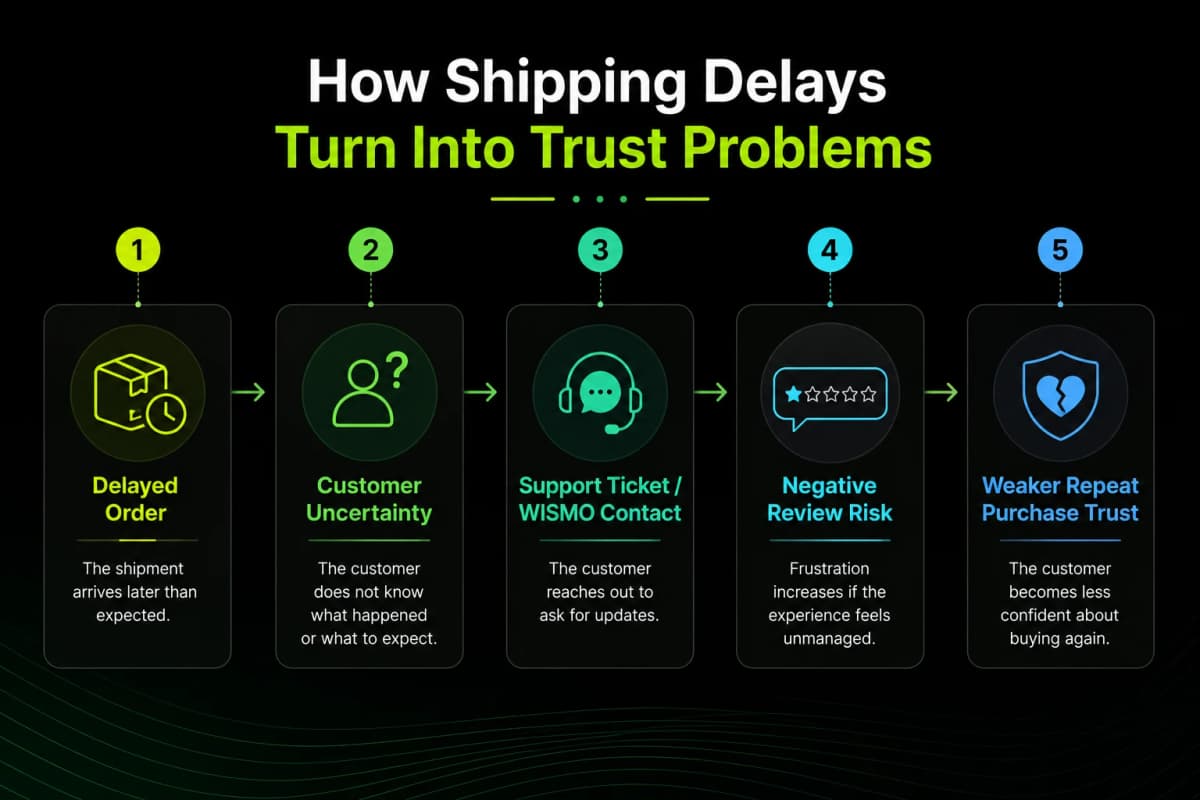
Customers usually do not think in terms of warehouse systems, carrier handoffs, or last-mile capacity. They think, “I ordered from this brand, and my order is late.”
That means even carrier-caused delays affect brand trust. If the brand does not communicate clearly, customers assume the business has lost visibility or control.
Silence makes the brand look unaware. Unclear updates make the brand look unprepared. Repeated generic messages make the brand look like it is avoiding responsibility.
Strong shipping delay customer communication does not need to pretend the brand controls every delivery variable. It needs to show that the brand is aware, accountable, and actively managing the customer experience.
Every ecommerce order includes a promise. Sometimes it is explicit, such as “delivered by Friday.” Sometimes it is implied through the checkout experience, product page, or shipping confirmation.
When that promise is missed without a clear explanation, customers begin to doubt future promises, too.
This is how shipping delays affect customer satisfaction beyond one order. A customer may still receive the package, but the next time they shop, they remember the uncertainty. They may choose a competitor, avoid time-sensitive purchases, or hesitate before buying from the same store again.
Customers contact support when self-service updates do not address their real concerns.
A tracking link may show movement, but not meaning. An automated message may confirm a delay, but not provide confidence. When customers do not know what to expect, they open tickets, call support, reply to emails, or message on social channels.
This creates a secondary cost. The brand is not only dealing with the delayed order. It is also dealing with support volume caused by unclear communication.
For CX and support teams, shipping delays in ecommerce quickly become repetitive conversations: “Where is my order?” “Why is it late?” “When will it arrive?” “Can you check with the courier?” “Should I cancel?”
Better communication can reduce many of these contacts before they happen. When updates are unclear, WISMO tickets can quickly overload the support team. To go deeper, read our guide on how to reduce WISMO tickets.
Customers review the full buying experience, not just the product.
A product can be good, but if delivery communication is poor, the review may still be negative. The customer may mention late delivery, no updates, lack of support response, or confusion around the tracking status.
This is especially risky for D2C brands and marketplaces where social proof influences purchase decisions. Delivery complaints can make future buyers question whether the brand is dependable, especially when they turn into public feedback.
To learn how to manage this risk, read our guide on negative reviews in ecommerce.
A delayed order can still arrive. The customer can still use the product. The transaction can still be technically complete.
But the chance of repeat purchase may be slightly less.
Customers buy again when they believe the brand will deliver reliably and communicate honestly when something goes wrong. If a delay feels ignored, unmanaged, or difficult to resolve, the customer may decide the brand is not worth the uncertainty.
For ecommerce teams, this is the hidden cost of poor delay communication. The order may not be lost, but future revenue may be.
Tracking links are useful, but they are not enough during ecommerce delivery delays.
A tracking page can show “delayed,” “in transit,” “exception,” or “arrived at hub.” But these statuses often do not explain what happened in customer-friendly language. They also do not always provide a realistic updated ETA or a clear next step.
Customers do not only want data. They want reassurance and want to know whether the order is safe, whether someone is monitoring the delay, and when they can expect a resolution.
That is why brands should think beyond carrier status pages and build an integrated order tracking experience that keeps customers informed throughout the ecommerce journey.
SMS and email are important channels for delivering updates, but they are passive.
Customers may miss them. They may ignore them or misunderstand them. During busy shopping periods, inboxes and message threads are crowded with promotional and transactional communication.
For minor delays, passive messages may be enough. For urgent, high-value, time-sensitive, or trust-sensitive orders, brands may need a more direct communication channel.
When tracking, SMS, and email do not provide enough clarity, support teams become the default explanation layer.
This is expensive and inefficient. Human agents end up repeating the same delay explanations across calls, tickets, and chats. During peak periods, this creates longer wait times and more frustrated customers.
Support should not be the first place customers learn about a delay. Ideally, support should handle exceptions, while proactive delivery updates handle predictable delay communication at scale.
“Your order is delayed” is technically an update. But it does not fully answer the customer’s concern.
The customer wants to know: Is my order safe? Why did this happen? When will it arrive? Is the brand doing anything? Do I need to take action?
Generic notifications feel like courier data being passed along without ownership. Better communication sounds like the brand is taking responsibility for the experience, even when the delay came from an external logistics partner.
The best time to communicate a delay is before the customer contacts support.
Once a meaningful delay is detected, the customer should receive a proactive update. This shows that the brand is aware of the issue and is not waiting for the customer to discover the problem alone.
Proactive communication helps reduce anxiety. It also lowers the chance of duplicate support tickets because the customer is not forced to chase basic information.
Do not only say “delayed.” Explain what changed in simple, customer-friendly language.
For example, the order may be delayed because of a courier backlog, a route issue, an address clarification problem, or a warehouse handoff delay. The message does not need to be overly detailed, but it should give enough context to make the delay feel real and understood.
A clear explanation builds credibility. Vague messaging creates suspicion.
A delayed order without a new expectation creates uncertainty.
Even if the ETA is approximate, customers need a realistic delivery window. A clear updated ETA is better than silence because it helps the customer plan and reduces the need to contact support.
For US ecommerce brands, clear delay communication can also support compliance expectations around shipping delay consent and refund rules, especially when an order cannot ship within the promised timeline.
If the ETA is still uncertain, say so clearly and explain when the next update will arrive.
Good shipping delay, customer communication should tell customers whether action is needed.
If no action is required, say that. If the customer needs to confirm an address, answer a call, provide a landmark, or choose a new delivery window, make that clear.
Every delay message should answer four questions:
What happened?
What is the updated ETA?
Does the customer need to do anything?
When will the next update come?
Not every delay needs the same communication channel.
Tracking pages are useful for visibility. SMS and email work well for standard updates. Support is needed for complex exceptions. Direct calls are useful for urgent, high-trust, high-value, or action-required moments.
For example, if a high-value order is delayed and the customer needs to confirm availability for a new delivery window, a phone call may be more effective than another passive notification.
The tone of delayed communication matters.
A cold, generic message can make the brand feel distant. A human, accountable message can make the same delay feel managed.
The goal is not to over-apologize or blame the courier. The goal is to show ownership: “We noticed your order is delayed. Here is what changed, here is the new expected delivery window, and we will update you again if anything changes.”
Most advice on how to handle shipping delays focuses on prevention.
That advice is useful. Ecommerce brands should improve inventory accuracy, warehouse processes, carrier selection, route planning, address validation, fulfillment technology, and delivery tracking.
But delay prevention is only one side of the problem.
The missing layer is what happens after a delay is already detected. At that point, the customer experience depends on communication. Does the brand update the customer early? Does it explain what changed? Does it provide a realistic ETA? Does it reduce the need for the customer to contact support? Does it make the delay feel managed instead of ignored?
This is where many ecommerce brands still rely on passive tracking links and overloaded support teams.
A stronger approach treats delivery communication as part of the post-purchase experience, not just a logistics notification.
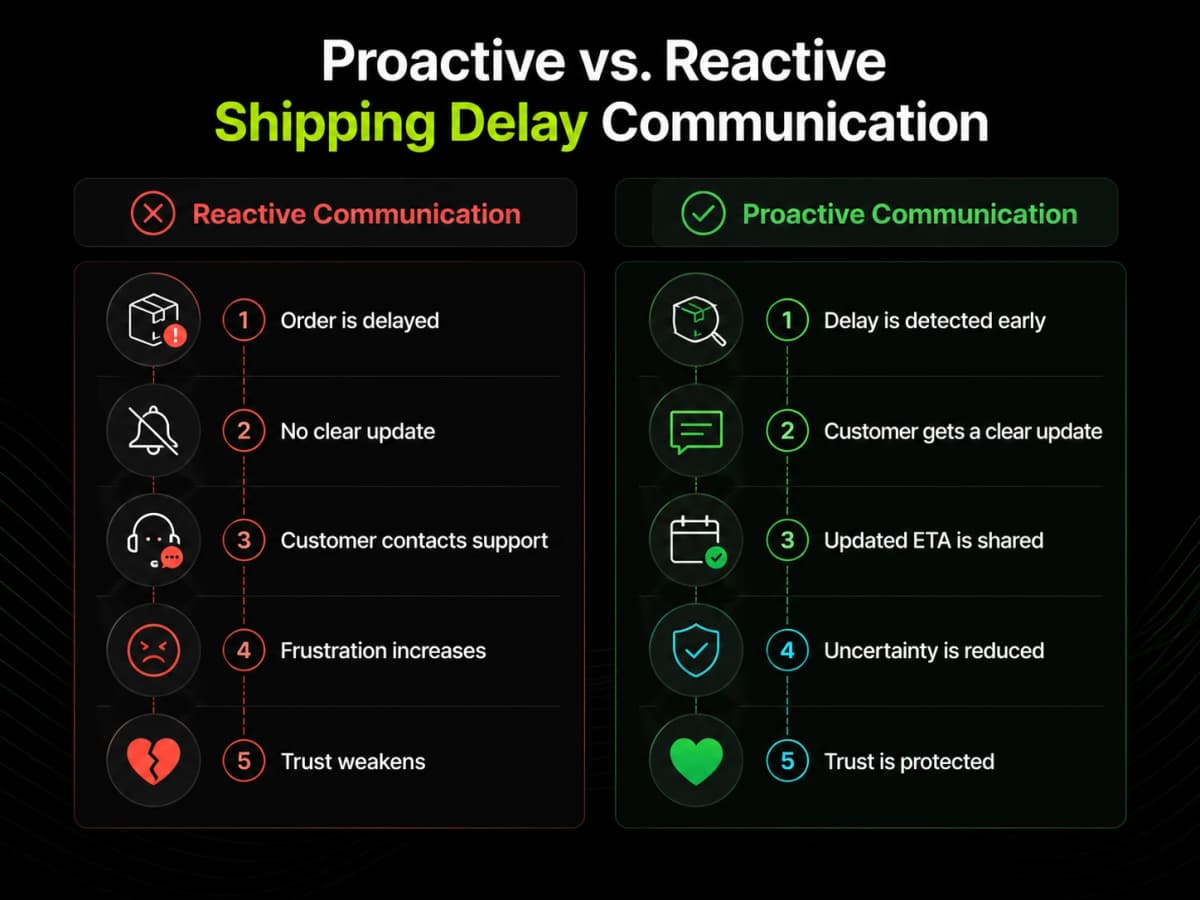
Proactive delivery updates protect customer trust by reducing uncertainty.
When a customer receives a clear update before they complain, the brand sends an important signal: we know what is happening, we are monitoring your order, and we will keep you informed.
This changes the emotional experience of the delay. Instead of feeling ignored, the customer feels guided.
For ecommerce teams, proactive delivery updates also reduce operational pressure. Fewer customers need to ask basic delivery questions.
Support teams spend less time repeating tracking information. Logistics and CX teams get a clearer system for managing risky orders before they become complaint-heavy issues.
That is the natural role of the Salesix Delivery Updates use case: helping ecommerce teams communicate delivery changes, shipment delays, updated ETAs, and delivery risks before customers lose trust.
AI voice agents for ecommerce are very useful when communication needs to be immediate, clear, human-like, and scalable.
During normal order volume, support teams may be able to manually call a small number of customers. But during peak season, courier disruption, warehouse backlog, or campaign spikes, delayed communication can quickly exceed human capacity.
AI voice agents can help ecommerce brands handle these moments more consistently.
They can call customers with real-time delay updates, can update ETAs in natural language, can reassure customers before they contact support, and can handle large notification volumes
They can also collect information when the delay requires customer action. For example, if an order is delayed because of an address issue, a Salesix AI voice agent can ask the customer to confirm delivery details. If the delivery window changes, you can confirm availability. If the order is time-sensitive, it can escalate to a human team.
This does not replace every support conversation. Complex, emotional, or exception-heavy cases may still need human agents. But AI voice agents can reduce repetitive delivery-related workload by handling predictable communication moments at scale.
For ecommerce brands, the goal is not simply to automate calls. The goal is to make sure customers hear from the brand at the moment trust is most at risk.
5 Step Practical Framework Your Brands Should Follow to Communicate Shipping Delays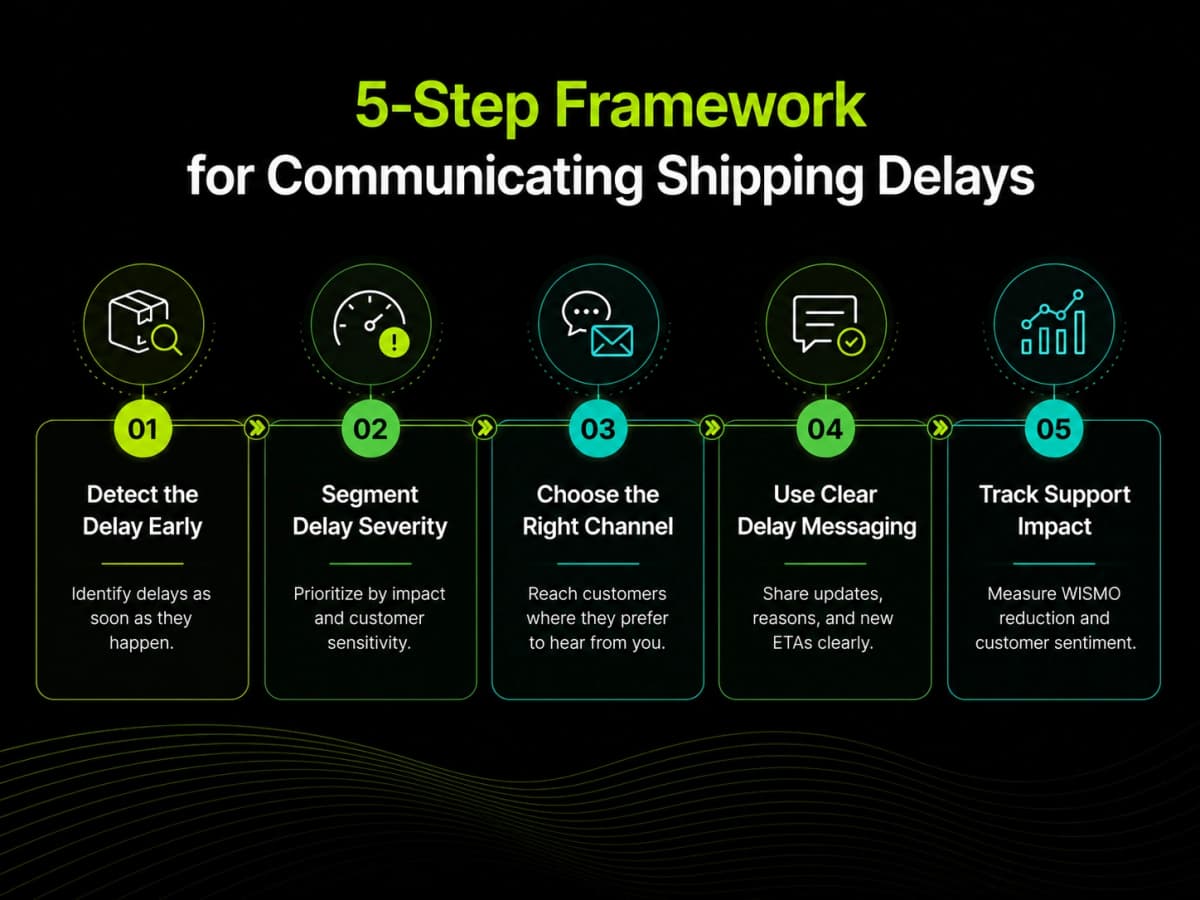
The first step is early detection.
Use courier data, order management data, warehouse status, and logistics rules to identify orders that are at risk of delay. Do not wait until the customer notices the problem.
A delay detected early can still be managed. A delay discovered through a frustrated customer complaint is already damaging the relationship.
Not all delays deserve the same response.
Segment delays by severity and customer impact. A minor one-day delay on a low-risk order may only need an SMS or email, and a delay on a high-value order, repeat customer order, gift purchase, urgent item, or address-risk order may need a more direct update.
Useful segments include:
Minor delays
High-value order delays
Time-sensitive order delays
Repeat customer delays
Delivery-window changes
Delays requiring customer action
Delays in high-risk locations
Delays after previous delivery complaints
Segmentation helps ecommerce teams communicate smarter instead of sending the same generic delay message to every customer.
Once the delay is segmented, choose the right channel.
Use tracking pages for ongoing visibility. Use SMS and email for basic status updates. Use human support for complex cases. Use AI voice agents for calling urgent, high-trust, high-value, or action-required segments.
The channel should match the risk level. If the delay is minor, passive communication may be fine. If the delay could trigger cancellation, complaint, failed delivery, or loss of trust, direct communication is usually stronger.
Every delay message should be specific enough to reduce uncertainty.
A strong delay update should answer:
What happened?
What is the new ETA?
Does the customer need to do anything?
When will the next update come?
For example, instead of saying, “Your order is delayed,” a better message would say:
“Your order is running behind because of a courier handoff delay. The updated delivery window is now tomorrow between 2 PM and 6 PM. You do not need to take any action. We will update you again if the delivery window changes.”
This type of communication is simple, but it feels more accountable.
Shipping delay communication should be measured.
Track delivery-related calls, delay-related tickets, repeat contacts, cancellation requests, negative reviews mentioning delivery, and repeat purchase behavior after delayed deliveries.
This helps teams understand whether communication is actually reducing friction. If customers still contact support after receiving delayed updates, the message may be too vague, too late, or sent through the wrong channel.
The goal is not just to send more notifications. The goal is to reduce uncertainty, protect trust, and lower avoidable support pressure.
Ecommerce shipping delays cannot always be eliminated. But customer trust does not have to collapse every time a shipment is late.
The brands that protect post-purchase trust are the ones that communicate early, clearly, and proactively. They do not wait for customers to refresh tracking pages, open tickets, or call support. They explain what changed, provide realistic updated ETAs, tell customers what happens next, and use the right communication channel for the urgency level.
Poor communication turns ecommerce shipping delays into customer frustration, support overload, negative reviews, and weaker repeat purchase trust. Proactive delivery communication turns the same delay into a managed experience.
For ecommerce teams that want to handle shipping delays at scale, AI voice agents offer a practical way to notify customers, explain delivery changes, collect missing information, and reduce repetitive delay-related support calls.

Get $5 free credit on signup — no credit card required. Set up your AI voice agent in minutes and start converting more leads today.