Delivery-Updates
How to Reduce Failed Delivery Attempts in Ecommerce Before They Become RTOs



Premium Humanoid AI Voice Agents for your business.
Failed delivery attempts are often treated as a courier problem. For example, the rider could not reach the customer, the buyer was not home, or the cash-on-delivery customer was not ready, etc. The order gets marked as failed, and the ecommerce team reacts after the damage has already started.
But many failed delivery attempt in ecommerce are not only logistics failures. They are communication and coordination failures.
Passive tracking links, delayed SMS updates, and manual support calls help to a point. But if the customer does not see the message, does not respond, or needs to change the delivery time, the brand still has no confirmed delivery readiness.
A stronger approach is proactive delivery coordination, where customers are contacted before risk turns into a failed attempt.
In this post, we’ll break down why failed delivery attempts happen and how ecommerce brands can prevent them with better coordination before orders turn into RTOs.
A failed delivery attempt happens when a courier tries to deliver the product but cannot complete the delivery.
In simple terms, the failed delivery attempt means that the package reached the delivery stage, but the customer did not receive it during that attempt.
A failed delivery attempt is different from a delayed delivery. A delayed delivery means the order has not reached the customer on time, often because of shipping, routing, inventory, or courier delays. A failed delivery attempt means the delivery was attempted, but the handoff did not happen.
It is also different from an RTO, or return to origin. RTO usually happens after one or more failed attempts, unsuccessful contact, refusal, or expiry of the delivery window. The order is then sent back to the seller or warehouse.
Common examples of failed delivery attempts in ecommerce include:
The customer was unavailable at the delivery address.
The customer missed the delivery call.
The address was incomplete or incorrect.
The customer refused the delivery.
A COD customer was not ready with payment.
The customer wanted delivery at another time.
The courier could not find the location or landmark.
The delivery window was missed without clear communication.
The important point is that many of these causes involve customer coordination, not just courier execution.
Every failed attempt can increase last-mile delivery expenses because the courier may need to make another visit, hold the package, update the delivery status, or coordinate again with the customer.
For ecommerce brands operating on tight margins, repeated delivery attempts can quietly reduce profitability.
Failed delivery attempts also increase RTO risk. Once the first attempt fails, the order enters a weaker stage. The customer may lose interest, ignore future messages, become frustrated, or reject the order later. This is especially risky for COD orders, where revenue is not realized until delivery is completed.
There is also a support impact. Failed delivery attempts often trigger customer questions like:
“Why was my order marked failed?”
“Can you deliver tomorrow?”
“Why didn’t the courier call me?”
“How do I update my address?”
“Will my order be cancelled?”
These questions increase delivery-related support tickets and phone calls. Support teams then spend time reacting to issues that could have been prevented with better pre-delivery communication.
Delivery experience also affects customer trust and purchase decisions. DHL’s 2025 E-Commerce Trends Report found that 81% of shoppers abandon their carts when their preferred delivery option is not available, showing how strongly delivery expectations influence ecommerce revenue
Failed delivery attempts usually happen when the customer, courier, and ecommerce team are not properly coordinated before delivery.
Key reasons include:
Customer unavailability: The customer may be at work, travelling, or away from the delivery address when the courier arrives.
Missed communication: SMS, email, app notifications, and tracking links can be useful, but customers often miss them or ignore messages that look promotional.
Incomplete or incorrect address details: Missing apartment numbers, floor details, landmarks, alternate phone numbers, or delivery instructions can make it difficult for the courier to complete the delivery.
COD readiness issues: Cash-on-delivery customers may not have payment ready, may want to delay the order, or may change their mind before accepting the package.
Unclear delivery delay updates: If an order arrives later than expected without proper communication, the customer may no longer be available or interested.
Difficult rescheduling process: If customers cannot easily change the delivery time, the order is more likely to fail on the first attempt.
Late team intervention: Many ecommerce teams act only after the order is marked as failed or after an NDR is created. By then, the first delivery opportunity has already been lost.
In short, most failed delivery attempts can be prevented when brands identify delivery risks early and coordinate with customers before the courier reaches the door.
Most ecommerce brands already send delivery updates. But the problem is that delivery notifications do not always create delivery readiness.
A customer may receive a message, but that does not mean they have confirmed availability, checked the delivery window, updated their address, or prepared for COD payment.
Some common delivery communication methods are not enough:
SMS and email: They can inform the customer, but they do not confirm whether the customer is available, whether the address is correct, or whether the customer wants to reschedule.
Tracking Page links: Tracking pages are useful for self-service, but they only work if the customer opens the link and takes action. They cannot confirm availability, collect missing address details, or flag a risky delivery before the courier arrives.
WhatsApp Messages: WhatsApp may get better visibility than SMS or email, but it still depends on the customer opening the message and replying. If there is no response, the brand still does not know whether the delivery is safe or at risk.
Manual calls: Calling customers can help, but it becomes hard during high-volume delivery periods. It also creates inconsistency because different agents may ask different questions, miss key details, or forget to update the CRM correctly.
NDR workflows: Non-delivery report workflows are useful for recovery, but they usually begin after the first failed attempt. By then, the first delivery opportunity has already been lost.
To reduce failed deliveries, ecommerce teams need a proactive communication layer that does more than send updates. It should confirm customer availability, collect reschedule intent, update internal systems, and escalate risky deliveries before they fail.
To reduce failed delivery attempts, ecommerce brands need to improve coordination before the first delivery attempt. The goal is to identify delivery risk early and take action while the order is still recoverable.
The most direct way to reduce missed deliveries is to confirm whether the customer will be available during the delivery window.
This does not need to happen for every order. Brands can prioritize high-risk orders, COD orders, high-value shipments, repeat failed-delivery customers, or orders going to regions with frequent delivery issues.
Availability confirmation helps the brand understand whether the order is ready for delivery or needs rescheduling.
Delivery updates should not only say, “Your order is out for delivery.” They should make the next step clear.
A stronger delivery update tells the customer what to expect, when the order may arrive, what to do if they are unavailable, and how to reschedule if needed.
This reduces uncertainty and gives the customer a chance to act before the courier reaches the address.
Many failed delivery attempts happen because customers cannot easily change the delivery time.
If rescheduling requires contacting support, waiting for a reply, or navigating a confusing tracking page, many customers will not act in time.
A better workflow allows the customer to share reschedule intent quickly. That preference should then be passed to the right system, team, or courier workflow where possible.
Address clarification should happen before the courier searches for the location.
For risky deliveries, brands can confirm missing details such as building name, floor, apartment number, landmark, alternate phone number, or preferred delivery instructions.
This is especially useful for dense urban areas, large apartment complexes, office addresses, and locations where courier reachability is often difficult.
Not every order needs the same level of intervention. Ecommerce teams should identify delivery-risk signals such as:
COD orders
high-value orders
incomplete addresses
repeat missed delivery customers
regions with high failed attempt rates
orders delayed beyond the promised date
previous courier contact failures
Prioritizing these orders helps teams reduce failed deliveries without creating unnecessary communication for every customer.
If ecommerce teams only track final delivery and RTO, they miss the earlier warning signals.
The first attempt delivery success rate shows how many orders are delivered successfully on the first try. Improving this metric can reduce repeat delivery costs, customer frustration, and RTO risk.
Brands should also track the failed delivery attempt rate, customer unavailable rate, reschedule rate, and successful delivery after proactive contact.
Most brands think of delivery updates as notifications. But notifications alone are not always enough.
A delivery notification tells the customer something. Delivery coordination helps the customer and business take action.
A strong delivery coordination workflow should be able to:
Notify the customer that delivery is coming
explain the delivery window
confirm customer availability
confirm COD readiness where relevant
collect reschedule intent
clarify address or landmark details
update CRM, support, or operations systems
flag risky deliveries before they fail
This is the shift ecommerce teams need to make. The goal is not just to send more messages. The goal is to create confirmed delivery readiness.
This is especially important for ecommerce brands that are already investing in post-purchase experience and delivery communication.
Where AI Voice Agents Help Reduce Failed Delivery Attempts
AI voice agents for e-commerce are useful when delivering communication that needs a response, not just a notification.
For example, an SMS can tell a customer that an order is out for delivery. But an AI voice agent can call the customer and ask whether they are available, whether the address is correct, whether they are ready for COD payment, or whether they want to reschedule.
That difference matters because failed delivery prevention depends on confirmation.
An AI voice agent platform like Salesix can help in Delivery Updates by acting as a proactive delivery coordination layer for ecommerce teams. Instead of relying only on passive tracking links or manual calling, Salesix can automate human-like delivery update calls that collect customer responses and update business workflows.
For ecommerce brands, this can help with:
calling customers before delivery
confirming availability
explaining delivery windows
notifying customers about delivery delays
collecting reschedule preferences
confirming COD readiness
capturing address clarification
updating CRM, support, or operations dashboards
flagging risky deliveries for human follow-up
The value is not that every delivery needs a voice call. The value is that risky deliveries can receive proactive, human-like coordination before they fail.
This helps support teams avoid repetitive delivery calls, operations teams identify risk earlier, and customers receive clearer communication at the moment it matters.
Here is what a proactive failed-delivery prevention workflow can look like:
An order is marked out for delivery.
The customer receives a proactive delivery update.
High-risk orders trigger an AI voice call.
The AI voice agent confirms customer availability.
The customer confirms readiness or requests a reschedule.
If needed, the agent collects address or landmark clarification.
The response is updated in the CRM, support tool, or operations dashboard.
Risky deliveries are flagged for follow-up.
Teams use the data to improve delivery planning over time.
This workflow moves the brand from reactive delivery support to proactive delivery coordination.
Instead of waiting for a failed attempt, the business creates a chance to fix the issue before the courier reaches the customer.
For ecommerce teams building this process, a related delivery updates playbook can be a useful next step for turning the strategy into an operational workflow.
To reduce failed delivery attempts, ecommerce teams need to track more than the final delivery status.
Useful metrics include:
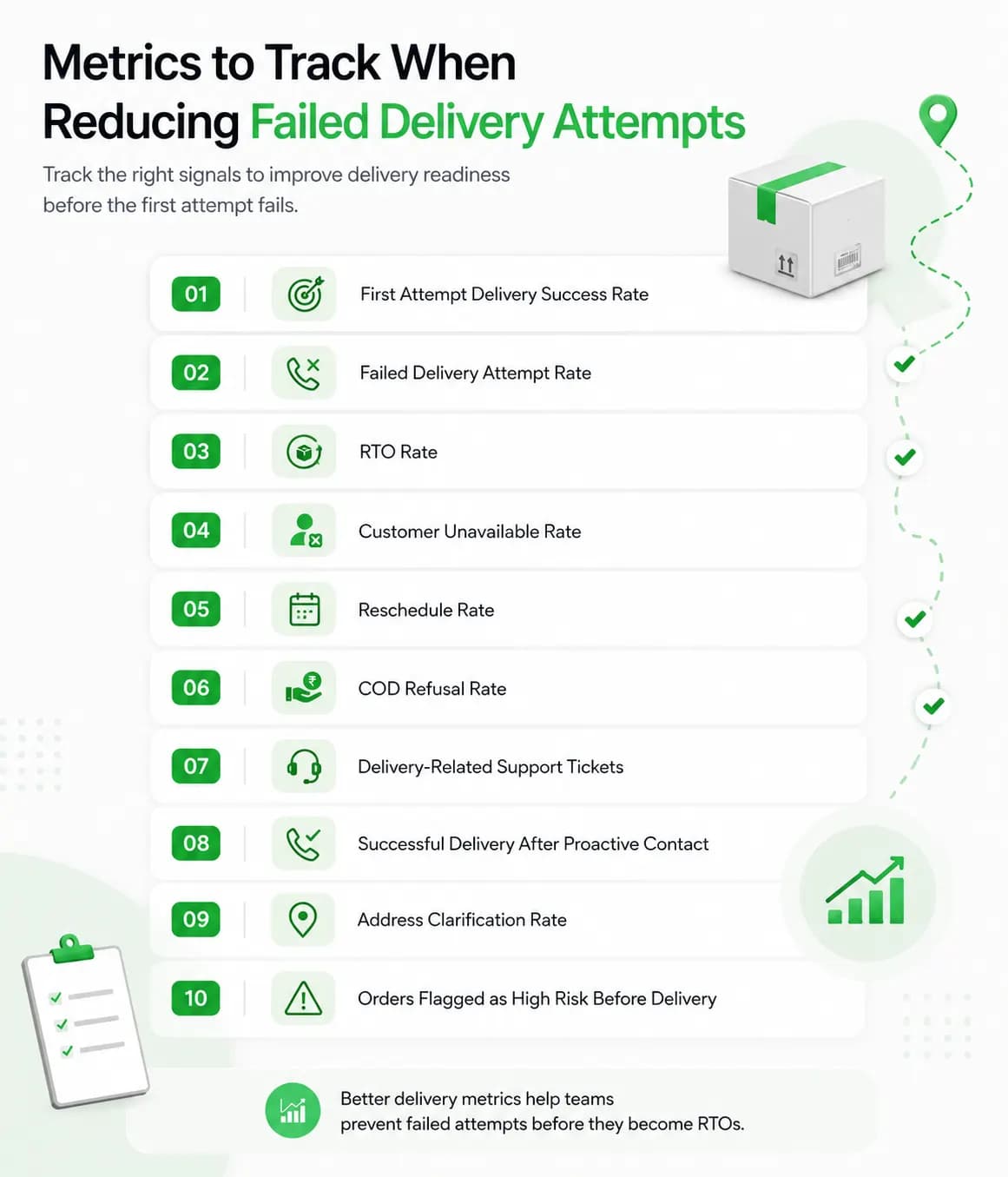
These metrics help teams understand whether failed deliveries are coming from customer availability, address quality, COD readiness, courier performance, communication gaps, or a mix of these issues.
The goal is not just to reduce failed deliveries once. The goal is to build a repeatable delivery communication system that improves over time.
Failed delivery attempts are not always unavoidable courier problems. In many ecommerce workflows, they happen because the customer was not reached, availability was not confirmed, the address was unclear, COD readiness was unknown, or rescheduling was too difficult.
Passive delivery notifications can help, but they do not always create action. Tracking links, SMS, email, and WhatsApp still depend on the customer noticing the message and responding in time. Manual calls can help, but they are difficult to scale across high-order volume.
The better approach is proactive delivery coordination.
By confirming customer availability, communicating delivery windows, collecting reschedule intent, verifying address details, and prioritizing risky orders, ecommerce brands can reduce failed delivery attempts before they become RTOs.
For teams ready to move beyond passive delivery notifications, AI voice agents create a scalable way to automate proactive delivery update calls and improve delivery readiness before the first attempt fails.

Get $5 free credit on signup — no credit card required. Set up your AI voice agent in minutes and start converting more leads today.