Delivery-Updates
What Is Post-Purchase Communication in Ecommerce and Why Does It Matter?



Premium Humanoid AI Voice Agents for your business.
Ecommerce brands spend heavily to attract shoppers, convert them, and get them through checkout. But the moment a customer places an order, the relationship is not complete
After checkout, the customer has paid but has not yet received the product. They are waiting, checking their inbox, watching for shipping updates, and expecting the brand to keep them informed. This is why post-purchase communication becomes very important.
Post-purchase communication is more than an order confirmation email or a tracking link. For ecommerce teams exploring broader automation, AI voice agents for ecommerce can help improve customer communication across delivery updates, support, reminders, feedback, and retention.
In this post, you’ll learn what post-purchase communication means in ecommerce, why it matters after checkout, and how better delivery updates can reduce confusion, support tickets, and missed customer trust.
Post-purchase communication in ecommerce is the set of messages, updates, and conversations a brand sends after a customer places an order.
It helps customers understand what happened, what happens next, when to expect delivery, how to get help, and how to stay connected with the brand after checkout.
This communication can include:
Order confirmation messages
Payment confirmation updates
Post purchase emails
Shipping and delivery updates
Delivery reminders
Return and exchange communication
Feedback and review requests
Support follow-ups
Loyalty and repeat purchase messages
A strong post-purchase communication strategy answers the questions customers naturally have after buying:
“What happens next?”
“When will my order arrive?”
“Is there a delay?”
“What should I do if I’m unavailable?”
“How can I return or exchange this?”
“Can I trust this brand again?”
Clear shipping and return information also matters for product visibility and buyer confidence, which is why Google’s guidance on shipping and returns information is a useful reference for ecommerce teams.
Post-purchase communication is important because customers judge the brand during the waiting period, not only at checkout.
The checkout experience may create the sale, but the post-purchase experience decides whether the customer feels confident, supported, and willing to return. Between purchase and delivery, customers are emotionally invested. They have spent money, but the value has not arrived yet.
Clear communication helps ecommerce brands in several ways:
Uncertainty is one of the biggest causes of post-purchase anxiety. If customers do not know whether the order was confirmed, shipped, delayed, or out for delivery, they start looking for answers.
That usually means checking tracking pages repeatedly, sending emails, opening support chats, or calling customer service.
If this pressure is showing up as repeated order-status queries, better delivery communication can help ecommerce teams reduce WISMO tickets before they reach support.
Good communication removes this uncertainty before it turns into a support request.
A good post-purchase customer experience makes the customer feel informed and in control. The brand does not disappear after payment. Instead, it guides the customer through each stage of fulfillment.
That guidance builds confidence.
Many post-purchase support tickets are not complex issues. They are simple questions caused by missing, unclear, or delayed updates.
Common examples include:
“Where is my order?”
“When will it arrive?”
“Can I change my address?”
“Can I reschedule delivery?”
“Why is my order delayed?”
When communication is proactive and clear, support teams do not need to answer the same repetitive questions manually.
Customers trust brands that communicate before they have to ask. Even when something goes wrong, a clear update can protect the relationship.
Silence creates doubt, and Proactive communication creates reassurance.
Repeat purchases are easier when the first purchase feels reliable. A customer may love the product, but if the delivery experience feels stressful, they may hesitate to order again.
Post-purchase communication helps turn fulfillment into a trust-building moment.
Post-purchase communication can happen across email, SMS, WhatsApp, chat, voice calls, tracking pages, and support channels. The right format depends on the urgency of the message and the action required from the customer.
Order confirmation is usually the first post-purchase message. It should confirm that the order was placed successfully and give the customer confidence that the brand has received the request.
A good order confirmation should include:
Order number
Items purchased
Payment status
Delivery address
Expected next steps
Support contact options
Estimated delivery timeline, if available
This message should not feel like a basic receipt only. It should set expectations for what happens next.
Post-purchase emails are commonly used for confirmations, shipping updates, product education, review requests, and retention campaigns.
They work well for detailed information because customers can refer back to them later. But they are not always the best channel for urgent updates, especially if the customer needs to take action quickly.
For example, an email may work for a receipt or product care guide. It may not be enough for an urgent delivery reschedule request.
Shipping and delivery updates are among the most important forms of ecommerce customer communication after checkout.
These updates should tell customers when the order is packed, shipped, out for delivery, delayed, delivered, or blocked due to an issue.
Strong delivery updates do more than say “your order is on the way.” They help customers feel prepared.
For example, a delivery reminder can tell the customer to keep payment ready for COD, confirm availability, or provide instructions if they need to reschedule.
Returns and exchanges are also part of post-purchase communication. Customers need clear instructions on eligibility, pickup timelines, refund status, exchange options, and next steps.
If the return process is confusing, support volume increases quickly.
Good return communication explains:
Whether the product is eligible
What the customer needs to do
When will pickup happen
When the refund or exchange will be processed
Who to contact if there is a problem
Feedback requests help brands understand whether the product, delivery, and support experience met expectations.
The best time to request feedback is after the customer has received the order and had enough time to form an opinion.
Feedback should also be routed properly. Delivery complaints should not only become product reviews; they should help the operations or support team identify issues.
Support follow-ups close the loop after a customer contacts the brand. If a customer asked about a delay, reschedule, refund, address issue, or delivery failure, the brand should confirm what happened next.
A simple follow-up can prevent repeated contacts and reassure the customer that the issue is being handled.
Most ecommerce brands already send some post-purchase messages. The problem is that these messages are often not clear, timely, or useful enough.
A customer may receive an order confirmation email, a courier tracking link, and a promotional message. But that does not mean they understand what is happening with their order.
Common issues include:
Updates are fragmented across tools
Messages arrive too late
Notifications are generic
Tracking links lack context
Customers have to search for answers
Channels do not match urgency
Support teams become the fallback for every unclear update
This is why a brand can technically “communicate” after purchase and still create a poor customer experience.
The real goal is not to send more messages. The goal is to send the right message, through the right channel, at the right moment, with enough context for the customer to know what to do next.
Poor post-purchase communication usually happens because brands treat it as a set of disconnected notifications instead of a customer journey.
Many ecommerce teams invest heavily in ads, product pages, conversion rates, and checkout optimization. Post-purchase communication often receives less attention because the sale has already happened.
But from the customer’s perspective, the experience is still incomplete until the order is delivered successfully.
Order confirmations may come from the ecommerce platform.
Shipping updates may come from the courier.
Support replies may come from a helpdesk.
Promotional messages may come from an email or WhatsApp tool.
When these systems do not work together, the customer receives fragmented communication.
Tracking pages, emails, and help center articles are useful, but they often require the customer to take action.
If the customer has to search for information, refresh a tracking link, or contact support, the communication system is already placing work on the customer.
Courier updates are operational. They may say “in transit,” “attempted,” or “exception,” but they do not always explain what the customer should do next.
For the brand, delivery is part of the customer experience. For the courier, it is a logistics event. That gap can create confusion.
Marketing may own email flows.
Operations may own logistics.
Support may own tickets.
Retention may own repeat purchases.
But customers experience all of this as one journey. When no team owns the complete post-purchase communication strategy, gaps appear.
Common post-purchase communication methods are useful, but each has limitations.
Email is good for receipts, summaries, return instructions, and product education. But it is not always reliable for urgent or time-sensitive moments.
A delivery issue sent by email may sit unread while the courier is already out for delivery.
SMS and WhatsApp are better for quick updates, but many brands use them as one-way notification channels.
That works for simple updates like “your order has shipped.” It works less well when the customer needs to respond, confirm availability, clarify an address, or choose a new delivery time.
An ecommerce tracking page is useful because it gives customers a place to check order status. But tracking pages are passive.
The customer has to click, visit, interpret the status, and decide whether to contact support. For high-friction moments, that may not be enough.
Baymard’s ecommerce UX research also highlights order tracking and returns UX as a dedicated area of post-purchase experience.
That is why brands need stronger ecommerce order tracking best practices that keep customers updated without making them search for every answer themselves.
Human agents are important for complex, emotional, or exception-based issues. But using human support for repetitive delivery questions is expensive and difficult to scale.
If most calls are about order status, delivery timing, or rescheduling, human agents lose time that could be spent on higher-value issues.
Automation can fail when it sends the same message to every customer without considering order type, delivery risk, payment method, customer history, or urgency.
A COD delivery reminder, delayed order update, failed delivery follow-up, and post-delivery feedback request should not all feel the same.
A better post-purchase communication strategy is timely, contextual, action-oriented, channel-appropriate, and two-way when needed.
Customers should receive updates before they become anxious or confused. If there is a delay, issue, or delivery attempt coming up, the brand should communicate early.
Messages should reflect the customer’s actual order, delivery status, payment type, location, and next step.
A generic “your order is on the way” message is less useful than a clear update that explains when the order is expected and what the customer should do if they are unavailable.
Good post-purchase communication tells the customer what to do next.
For example:
“Keep cash ready for delivery.”
“Confirm if you will be available today.”
“Reply to reschedule delivery.”
“Check your address details.”
“Contact support if this delivery time does not work.”
Different channels fit different moments:
Email works well for receipts, summaries, return instructions, and product education.
SMS and WhatsApp work well for quick order and delivery updates.
Chat works well for support resolution and help center workflows.
Voice calls work well for urgent, high-friction, or action-required delivery moments.
The channel should match the importance of the message.
Not every update needs a conversation. But some moments do.
If the customer needs to confirm availability, clarify an address, reschedule delivery, respond to a COD reminder, or explain a delivery issue, one-way communication is not enough.
This is where two-way post-purchase communication becomes more useful than simple notifications.
Delivery updates are one of the most important layers of post-purchase communication because the customer is waiting, uncertain, and emotionally invested.
Once the order is placed, delivery becomes the center of the customer’s attention. They want to know whether the order is moving, when it will arrive, and whether they need to do anything.
Important delivery update moments include:
Order confirmed
Order packed
Order shipped
Order delayed
Out for delivery
Delivery reminder
COD reminder
Address clarification
Delivery issue
Reschedule request
Delivered
Post-delivery feedback
Delivery updates should not only inform customers of the order's location. They should help customers feel prepared, reassured, and supported.
This is where AI voice agents for ecommerce delivery updates can help brands move from passive notifications to proactive, two-way customer conversations.
For example, an “out for delivery” update is more useful when it allows the customer to confirm availability or reschedule.
This is why clear, timely communication can also help brands reduce failed delivery attempts before they become avoidable RTOs.
Most of the post-purchase experience focuses on email flows, order tracking, delivery updates, returns, customer feedback, loyalty programs, and customer retention. Those are all important.
But the stronger ecommerce opportunity is not simply sending more updates. It is knowing when a customer needs a message and when they need a conversation.
There is a major difference between one-way notifications and two-way post-purchase communication.
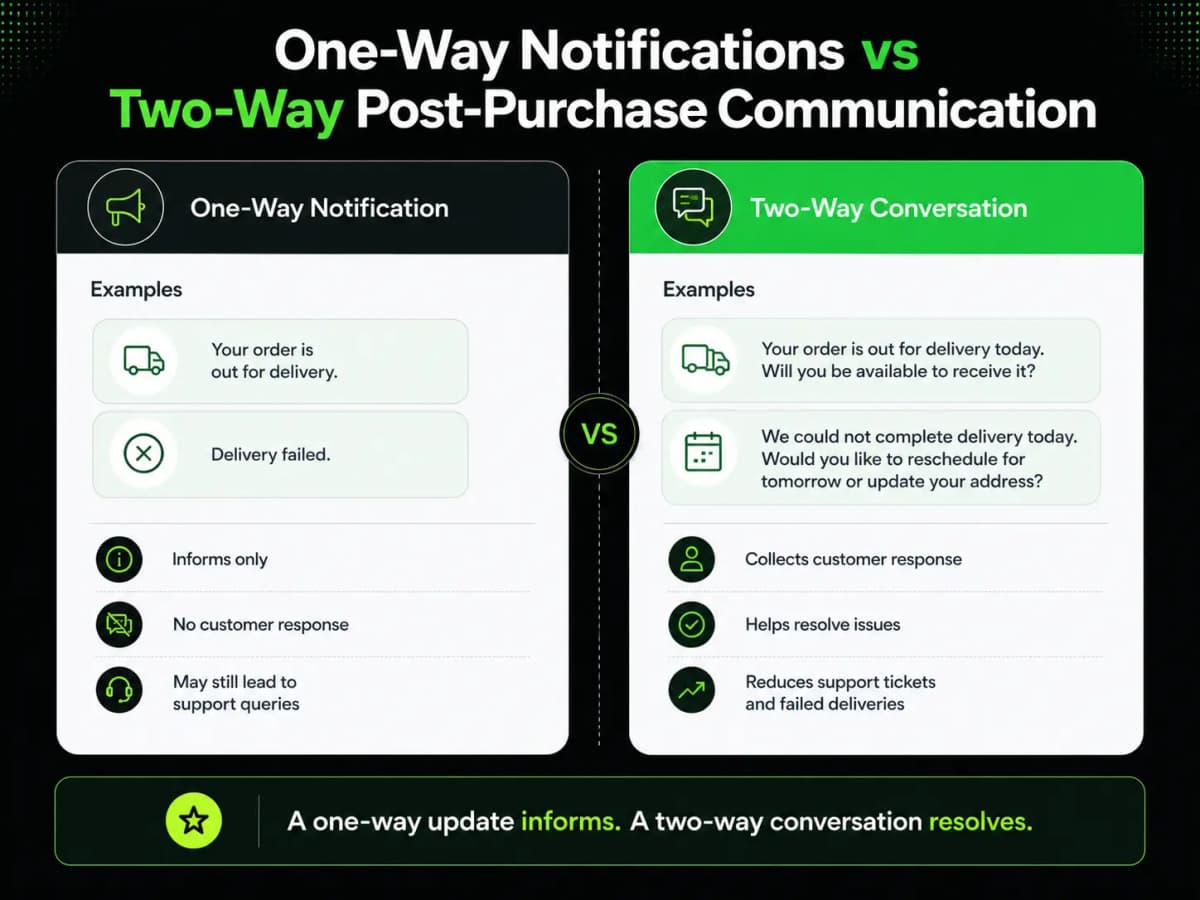
For ecommerce brands trying to reduce support tickets, failed delivery attempts, RTOs, and customer frustration, this difference matters.
AI voice agents for ecommerce can support post-purchase communication when the message needs to be more direct, human-like, and action-oriented than email, SMS, or WhatsApp.
They are especially useful for moments where customers need to respond quickly or where the brand needs to collect information before the next operational step.
For ecommerce delivery updates, AI voice agents can help with:
Delivery reminders
Confirming customer availability before delivery
COD reminders
Address clarification
Delivery rescheduling
Failed delivery follow-ups
Urgent delivery updates
Post-delivery feedback calls
Support escalation
Workflow updates inside CRM, helpdesk, or logistics tools
This does not mean every post-purchase message should become a phone call. Email, SMS, WhatsApp, and tracking pages still have a role.
The point is channel fit.
Routine updates can stay automated through digital channels. High-friction delivery moments may need a more direct conversation.
Salesix AI helps ecommerce brands automate human-like delivery update conversations at scale. For brands that want to reduce delivery-related uncertainty, missed customer responses, and repetitive support workload, AI voice agents can become a practical layer in the post-purchase communication system.
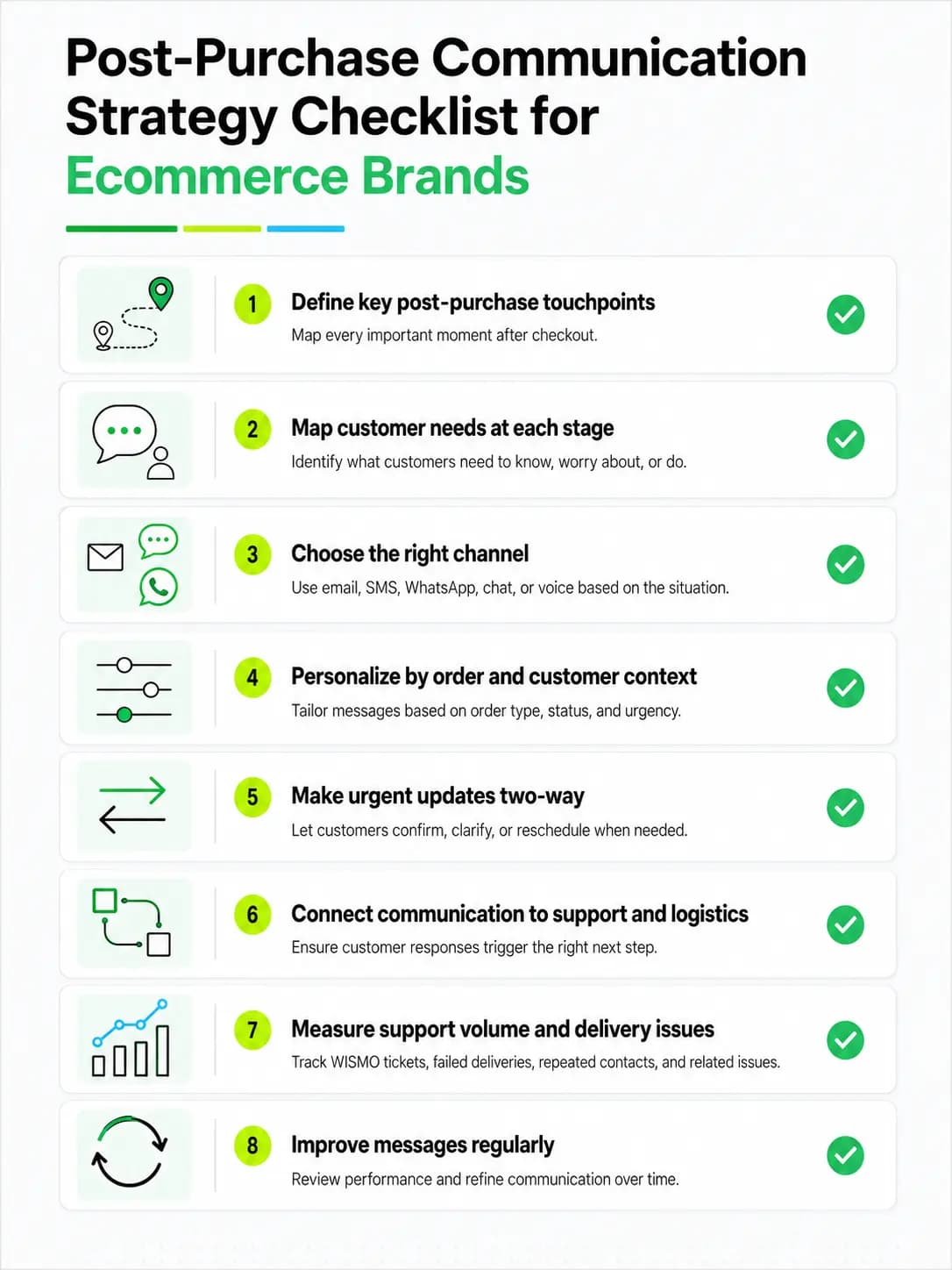
Map every important moment after checkout:
Order confirmation
Payment confirmation
Packing
Shipping
Out for delivery
Delay
Failed delivery
Delivery completed
Return or exchange request
Refund update
Feedback request
For every touchpoint, ask:
What does the customer need to know?
What are they likely worried about?
What action might they need to take?
What support question might this prevent?
Do not use one channel for everything.
Use email for detailed records, SMS or WhatsApp for quick updates, chat for support resolution, and voice calls for urgent or action-required moments.
Post-purchase communication should reflect the actual situation.
A prepaid order, a COD order, a delayed order, a high-value order, a failed delivery, and a return request each need different messaging.
When the customer needs to confirm, clarify, approve, reschedule, or provide information, make the communication interactive.
One-way updates are not enough for action-required moments.
A customer response should trigger the right next step.
If the customer confirms availability, update the workflow. If they need to reschedule, pass that information to the relevant system. If they need human help, escalate with context.
Track whether better communication reduces:
WISMO tickets
Delivery-related calls
Failed delivery attempts
COD cancellations
Return-to-origin cases
Repeated customer contacts
Post-purchase communication should not be set once and forgotten. Review customer questions, failed deliveries, support tickets, and feedback to improve the flow over time.
For a more practical implementation path, use the ecommerce delivery updates playbook to map key delivery moments, customer responses, and workflow actions.
Post purchase communication is not just a follow-up email, tracking link, or delivery alert. It is the system ecommerce brands use to keep customers informed, confident, and connected after checkout.
The strongest ecommerce brands do not treat post-purchase communication as a generic automation flow. They treat it as a customer experience layer that reduces uncertainty, supports delivery success, and prevents avoidable support pressure.
For routine updates, email, SMS, WhatsApp, and tracking pages can work well. But for urgent delivery moments that require action, brands may need a more direct, two-way channel.
That is where AI voice agents can support the next stage of ecommerce post-purchase communication.

Get $5 free credit on signup — no credit card required. Set up your AI voice agent in minutes and start converting more leads today.