Return-Coordination
How to Convert Returns Into Exchanges in Ecommerce



Premium Humanoid AI Voice Agents for your business.
Returns do not always mean the customer is lost. In many ecommerce cases, the customer still wants the product category, the brand, or the outcome they expected.
The problem can be the wrong size, the color looked different, the item arrived damaged, the variant was incorrect, or the customer was unsure which replacement would work better.
But when the return process is passive or refund-first, the customer often chooses the easiest visible option: “refund me.”
That is where many brands lose revenue unnecessarily.
To convert returns into exchanges, ecommerce brands need more than a return portal and a refund policy. They need a faster, clearer, more guided return conversation.
This does not mean pressuring customers to keep products they do not want. It means helping customers find the right next step before a fixable issue turns into lost revenue.
In this post, you’ll learn how ecommerce brands can convert more returns into exchanges by following up faster, understanding return reasons, and guiding customers toward the right replacement.
Returns often become refunds because customers feel refunds are simpler, safer, and faster for the customer.
A customer who has already had a poor experience may not want to spend more time figuring out another option. And if the exchange path is unclear, they default to the option they understand best, the option of getting their money back.
This usually happens for a few reasons:
The refund option is easier to find than the exchange option.
The return portal may ask for a reason, but it does not actively guide the customer toward a replacement.
Support teams may respond too late, after the customer has already decided they want their money back.
Exchange options may be too generic, such as “choose another item,” instead of being tied to the actual problem.
Customers also hesitate when they are unsure whether the replacement will solve the issue. If the first size did not fit, will the next size work?
Without a timely conversation, the customer is left to make that decision alone. A refund becomes the lowest-risk option.
Better return coordination can also help brands reduce avoidable returns before they become refund requests.
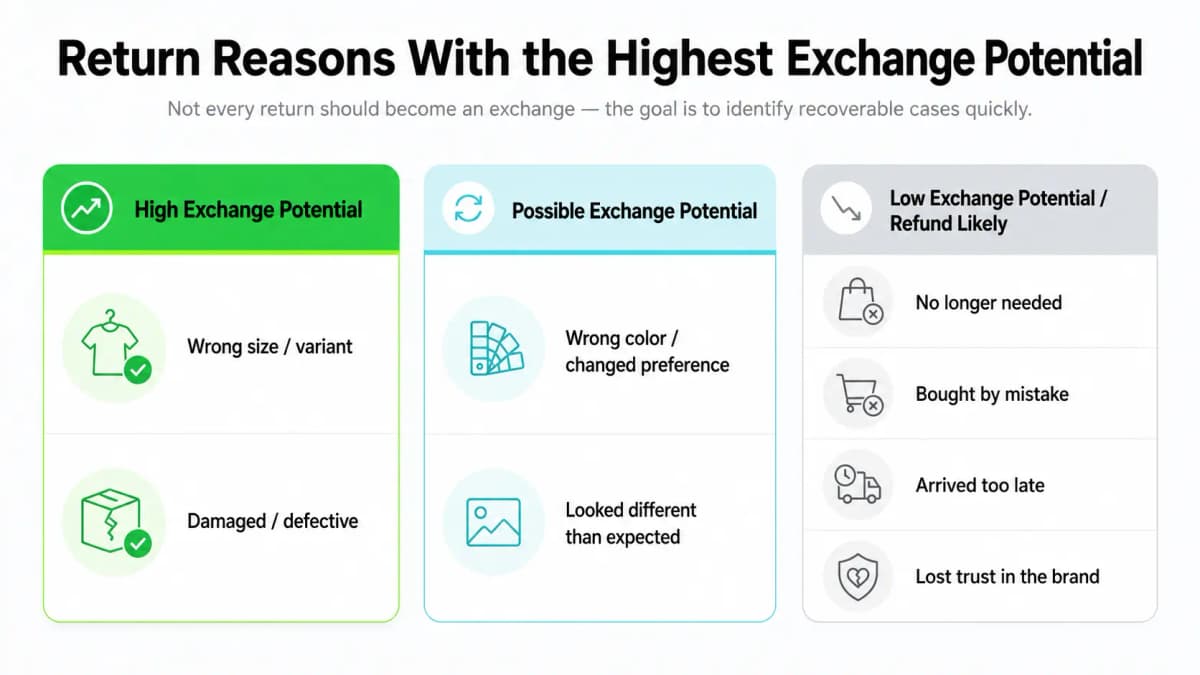
Not every return should become an exchange. Some customers genuinely want a refund, and the return process should respect that.
The best opportunities usually come from return reasons where the customer still wants the product, but something about the original order was wrong.
Exchange-friendly return reasons include:
These are often the clearest exchange opportunities. The customer may still want the item, but needs a different size, fit, model, quantity, bundle, or configuration.
If the product type is still relevant, a different color, style, or variant may solve the issue.
When the item arrived damaged or did not work properly, the customer may be open to a replacement if the brand responds quickly and makes the process easy.
This can become an exchange if the brand helps the customer find a closer match. It becomes a refund when the customer feels misled, ignored, or unsure what to choose next.
Refund-heavy reasons are different. If the customer no longer needs the product, bought it by mistake, lost trust in the brand, experienced repeated issues, regrets the price, or received the order too late for their need, an exchange may be unlikely.
The goal is not to force every return into an exchange. The goal is to identify which cases are recoverable and act quickly.
Ecommerce brands do not lose exchanges only because customers reject alternatives. They lose exchanges because the exchange conversation happens too late, too passively, or not at all.
Many return flows are built around processing the return, not recovering the order. The customer submits a request, selects a reason, receives instructions, and waits. The brand collects information, but does not use that information to guide the customer toward a better outcome.
Support teams also struggle to keep updated when return volume rises. They may not have time to call or message every customer. By the time someone follows up, the customer has already packed the item, mentally moved on, or purchased elsewhere.
This is why manual return management often breaks when ecommerce brands scale and return volume becomes harder to coordinate.
Other operational gaps make the problem worse:
Customers are confused about pickup timing, replacement delivery, refund adjustment, or whether they need to pay the difference for another item. Exchange offers are not personalized to the return reason. Store credit is offered without explaining why it helps. Human agents spend time answering repetitive return questions instead of recovering high-value cases.
The result is refund leakage: returns that could have become exchanges but became refunds because the recovery workflow was too slow or unclear.
To convert returns into exchanges, ecommerce brands need to treat every return request as a guided recovery workflow, not just a refund transaction.
Speed matters. The best time to influence the outcome is soon after the customer submits the return request, before they fully commit to a refund.
A quick follow-up shows the customer that the brand is paying attention. It also creates a chance to clarify the problem and offer a relevant fix.
Return portals often capture surface-level reasons. A customer may select “wrong size,” but the real issue could be that the product runs smaller than expected.
They may select “not as expected,” but the real problem could be color, texture, use case, or missing information.
A short conversation can reveal what the form does not.
Generic exchange offers rarely work. The replacement should connect directly to the reason for return.
If the size is wrong, suggest the right size. If the color is not preferred, offer available alternatives. If the item is damaged, make the replacement path simple.
Relevance is what makes the exchange feel useful instead of sales-driven.
If the exchange process feels harder than the refund process, most customers will choose the refund.
Brands should reduce friction wherever possible, like clear pickup steps, simple replacement confirmation, transparent timelines, easy price adjustment, and fewer repeated questions.
The exchange path should feel like the fastest way to fix the customer’s problem.
Customers may not immediately understand why an exchange is better. A clear explanation can help.
For example: “We can replace this with the correct size and arrange pickup in the same return flow,” or “You can switch to another color without placing a new order.”
The message should be helpful, not pushy.
Store credit can help reduce refunds in ecommerce, but it should not feel like the only option. If customers feel trapped, it can damage trust.
Use store credit when it genuinely helps the customer continue shopping, choose a better product, or avoid waiting for a refund. Make the terms clear.
The best exchange programs improve over time.
Track which return reasons convert into exchanges, which products create the most refund risk, which offers work, and where customers drop off.
This data helps customer support, merchandising, product pages, fulfillment, and return operations work from the same signal.
Manual follow-up can work at low volume. It breaks when return requests increase during scaling.
To recover one exchange, a team may need to call or message the customer, ask the reason, explain options, check inventory, confirm size or variant, coordinate pickup, answer refund questions, update the return system, and escalate exceptions.
Now multiply that across hundreds or thousands of return requests.
Human teams cannot reliably follow up with every return requester fast enough to save every possible exchange. They also should not spend most of their time repeating the same return questions when their judgment is needed for complex, emotional, or high-value cases.
This is why ecommerce returns and exchanges need better coordination, not just more agents.
AI voice agents for ecommerce can help brands automate the first return recovery conversation.
Instead of waiting for a human agent to manually follow up, an AI voice agent can call the customer soon after a return request is submitted.
The agent can ask why the customer wants to return the product, identify whether the case is exchange-friendly, explain relevant replacement or store credit options, confirm the customer’s preference, share pickup instructions, answer basic timeline questions, update workflows, and escalate complex cases to a human agent.
For a return coordination workflow, this is where a platform like Salesix AI fits naturally.
Salesix AI helps ecommerce teams automate phone-based return follow-up with human-like AI voice agents that can handle structured conversations, trigger workflow actions, and pass the right cases to human teams when needed.
For brands managing high return volume, this creates a more consistent way to reduce refunds in ecommerce without relying only on manual support capacity.
The value is not just automation. It is timing. The return conversation happens while the customer is still open to a solution.
Learn how Salesix supports ecommerce return coordination with AI voice agents built for return follow-up, exchange guidance, workflow updates, and escalation.
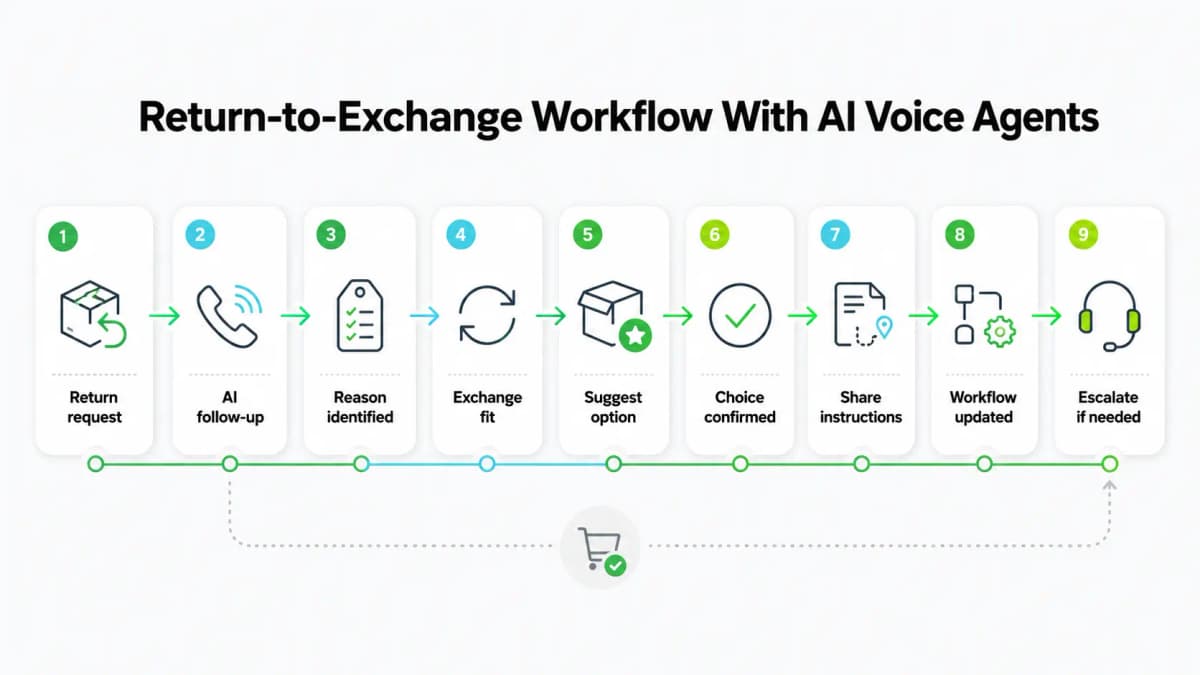
Here is what an exchange-first returns workflow can look like:
Customer submits a return request.
AI voice agent calls within minutes or hours.
The agent asks the return reason.
The agent identifies whether the case is exchange-friendly.
Customer is offered a relevant replacement, size, variant, or store credit.
Agent confirms the customer’s choice.
Pickup or return instructions are shared.
Workflow is updated in the brand’s system.
Complex cases are escalated to human support.
The purpose is not to pressure customers into exchanges. The purpose is to give them a clearer, faster path when an exchange actually solves their problem.
For a more implementation-focused breakdown, use the ecommerce return coordination playbook to map the workflow from return request to exchange recovery.
The biggest mistake is treating exchange conversion as a way to block refunds. That approach damages the brand’s trust & credibility.
Avoid forcing exchanges when the customer clearly wants a refund. Do not hide refund options.
Brands should also review the FTC’s guidance on the Mail, Internet, or Telephone Order Merchandise Rule when setting customer-facing refund, delay, and order communication practices.
Do not offer irrelevant alternatives just to preserve revenue. Do not wait too long to follow up. Do not make customers repeat information they already submitted.
Brands should also avoid using store credit as the only solution, ignoring return reason data, or failing to coordinate pickup and replacement timelines. A poor exchange process can create a second bad experience, which is worse than issuing a clean refund.
Exchange-first returns should still be customer-first.
Returns are not always lost revenue.
Many customers are still willing to buy from the brand if the issue can be fixed quickly, clearly, and with less effort. The brands that convert returns into exchanges are not just the ones with better return policies.
They are the ones who coordinate the return conversation faster, understand the customer’s reason, and guide them toward the right next step.
When the return process is passive, refunds win by default. When the return process is guided, exchange opportunities become easier to recover.

Get $5 free credit on signup — no credit card required. Set up your AI voice agent in minutes and start converting more leads today.