Return-Coordination
How to Reduce Returns in Ecommerce with Better Coordination



Premium Humanoid AI Voice Agents for your business.
Ecommerce returns are usually treated as a product page problem, a policy problem, or a logistics problem. Those things matter, but they do not explain the full cost of returns.
The 2024 Consumer Returns in the Retail Industry report also shows why returns should be treated as a major retail cost and operations issue, not just a refund problem.
The customer may be confused about the next step. The support team may not confirm the real return reason. A pickup may fail because the customer was unavailable. The customer may keep asking, “Where is my refund?” because updates are unclear.
That is why learning how to reduce returns in ecommerce is not only about stopping customers from returning products. It is about improving return coordination so that avoidable refunds are reduced, exchange opportunities are saved, return-related support workload drops, and customers still feel supported.
In this post, you’ll learn how to reduce returns in ecommerce by improving return coordination, saving more exchange opportunities, preventing failed pickups, and reducing return-related support workload.
Why Ecommerce Returns Are So Expensive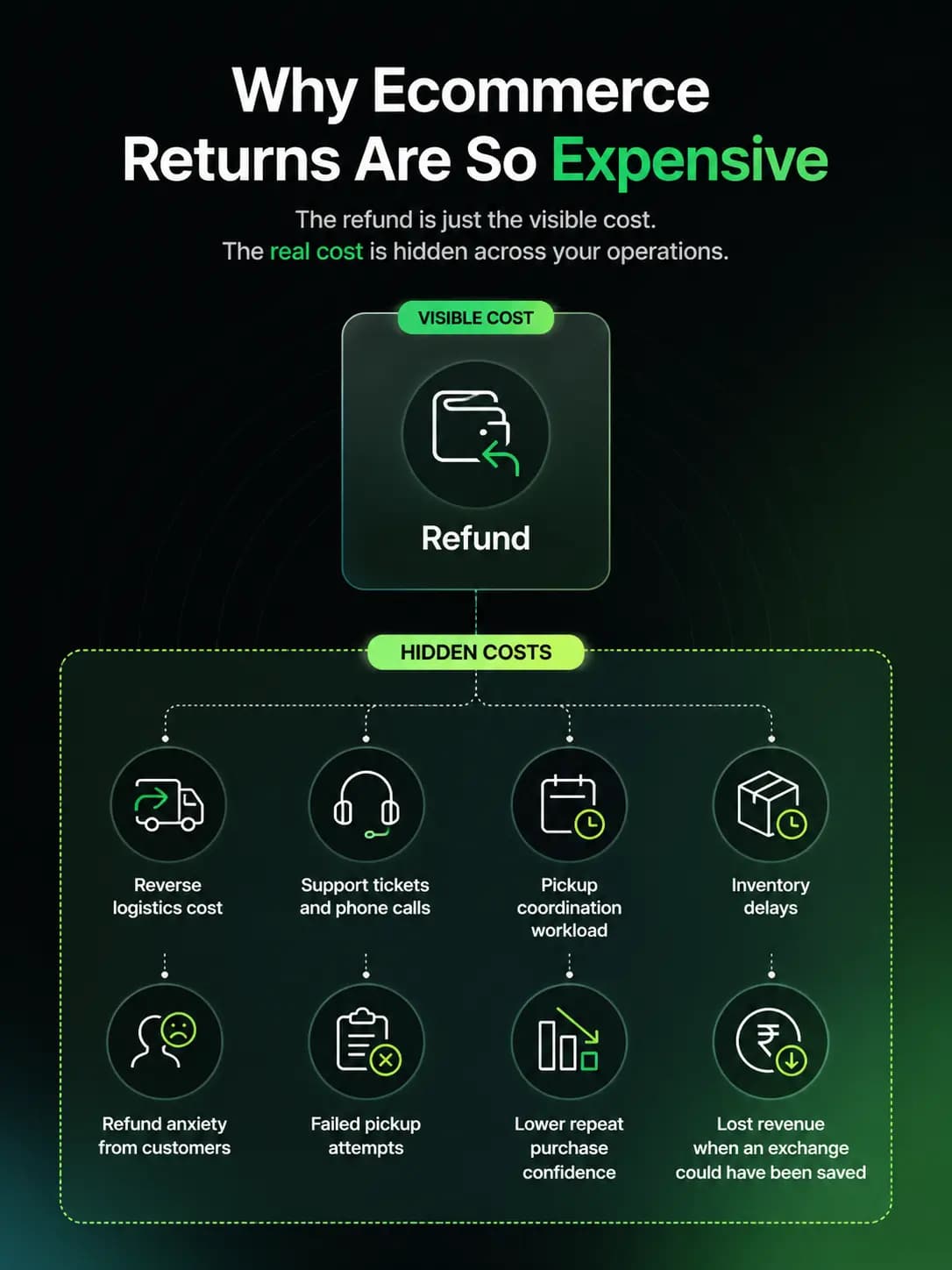
Returns are expensive because they create costs across multiple teams at the same time.
A single return can involve customer support, warehouse teams, logistics partners, payment operations, inventory management, and finance. The product may need to be picked up, inspected, restocked, replaced, refunded, or written off.
The visible cost is the refund. The hidden costs are often bigger.
A return can create:
Reverse logistics cost
Support tickets and phone calls
Pickup coordination workload
Inventory delays
Refund anxiety from customers
Failed pickup attempts
Lower repeat purchase confidence
Lost revenue when an exchange could have been saved
Poor return experiences also damage brand credibility & trust. If a customer who has to reach out to the support team multiple times for return status, refund timelines, or pickup details may hesitate before buying again.
So ecommerce returns reduction is not just about lowering return volume. It is also about lowering the operational drag that each return creates.
High return rates usually come from a mix of product, communication, and fulfillment issues.
Common causes include expectation mismatch, unclear product photos, inaccurate descriptions, sizing and fit issues, damaged items, wrong items, weak post-purchase communication, etc.
Some returns are unavoidable. A product may genuinely be defective, damaged, delayed, or unsuitable.
But many returns become avoidable when the business understands the reason early and responds with the right next step. A customer who says “wrong size” may accept an exchange. A customer who says “product not as expected” may need clarification, replacement, or support. A customer worried about a refund may only need a clear timeline.
To reduce ecommerce returns, brands need better information at the moment the return request begins.
Most advice on how to reduce product returns focuses on prevention before purchase.
That advice is useful. Better product pages, size charts, customer reviews, product videos, packaging, return policies, and analytics can all reduce customer returns.
But this only solves part of the problem.
Once a customer starts a return request, the brand enters a different workflow. At that point, the issue is no longer just product information. It becomes coordination.
Who confirms the reason?
Who explains eligibility?
Who offers an exchange?
Who schedules pickup?
Who updates the customer?
Who escalates exceptions?
Who logs the data for future improvement?
If these steps are slow, unclear, or manual, return rates and refund losses stay high even if the product page improves.
How to Reduce Returns in Ecommerce
The best way to reduce returns in ecommerce are mentioned below:
Improve product expectations before purchase
Start with the basics. Product pages should clearly explain size, fit, dimensions, material, color, use cases, limitations, delivery timelines, and return eligibility.
Customers return fewer products when they know exactly what they are buying.
Do not treat return reasons as generic labels. “Not satisfied” is not enough. Teams should know whether returns are driven by sizing, quality, late delivery, damaged packaging, misleading images, wrong product dispatch, or buyer hesitation.
This helps ecommerce teams fix the real cause instead of only processing refunds faster.
Many customers do not want to abandon the brand. They want the right size, color, variant, or replacement.
If the exchange path is difficult, customers choose refunds. If the exchange path is clear and fast, brands can reduce sales returns and protect revenue.
To protect more revenue from return requests, see how to convert more returns into exchanges in ecommerce.
Customers should know what happens after they submit a request. Clear next steps reduce repeat calls and tickets.
Explain pickup timing, packaging requirements, refund timelines, exchange options, and what happens if the pickup fails.
Failed pickups increase cost and delay resolution. Before pickup, brands should confirm customer availability, address details, preferred time windows, and required packaging.
This is especially important for high-volume ecommerce operations where manual coordination becomes difficult.
Some return requests can be saved with the right conversation. A replacement, exchange, troubleshooting step, or delivery clarification may solve the issue.
The key is timing. If the follow-up happens too late, the customer has already decided to refund.
Return teams often answer the same questions repeatedly:
Is my return eligible?
When will pickup happen?
Can I exchange instead?
When will I get my refund?
What if pickup failed?
Automating these repetitive conversations helps reduce ecommerce returns-related workload while keeping customers informed.
Manual return coordination may work when order volume is low. It breaks when the business starts scaling.
This is why growing brands also need to understand why manual return management breaks when ecommerce brands scale.
After sales campaigns, festive offers, product launches, or seasonal peaks, return requests can spike quickly. Support teams have to answer the same calls, confirm the same details, and repeat the same refund updates.
This creates three problems:
Follow-ups get missed. Customers who might have accepted an exchange are not contacted in time.
Pickup coordination becomes inconsistent. Failed pickups increase because customer availability, address details, or packaging instructions are not confirmed clearly.
Refund anxiety rises. Customers contact support again and again because they do not know what is happening.
At scale, reducing return rates is not only a CX challenge. It is an operational workflow challenge.
A strong return coordination workflow gives every return request a clear path.
The workflow should look like this:
The customer raises a return request.
Brand confirms the return reason.
Customer receives clear next steps.
Exchange, replacement, or troubleshooting is offered when relevant.
Pickup is scheduled or confirmed.
Customer receives refund or exchange updates.
Complex cases are escalated to human agents.
Return reason data is logged for future improvement.
This approach helps teams reduce avoidable refunds without blocking genuine returns. It gives customers clarity while helping the business protect revenue, reduce support workload, and improve operational control.
For brands building this workflow, the Salesix Ecommerce Return Coordination AI Voice Agent is designed to support the phone-based conversations that happen around return requests, pickup coordination, refund updates, and exchange recovery.
AI voice agents for ecommerce can help in reducing returns by handling repetitive return conversations quickly, consistently, and at scale.
They can call customers or answer inbound calls to confirm return reasons, explain return eligibility, offer exchanges, collect missing information, coordinate pickup details, and provide refund timeline updates.
For example, if a customer requests a return because the size is wrong, an AI voice agent can confirm the issue and offer an exchange before the request turns into a refund.
Or, if a pickup is scheduled, the agent can confirm availability and remind the customer about packaging requirements.
This does not mean every return conversation should be automated. Damaged products, angry customers, high-value orders, repeated complaints, and policy exceptions may still need human support.
The better model is task separation.
AI voice agents handle repetitive, high-volume coordination. Human agents handle sensitive, complex, or exception-based cases.
That is where ecommerce customer support automation becomes useful without hurting customer experience.
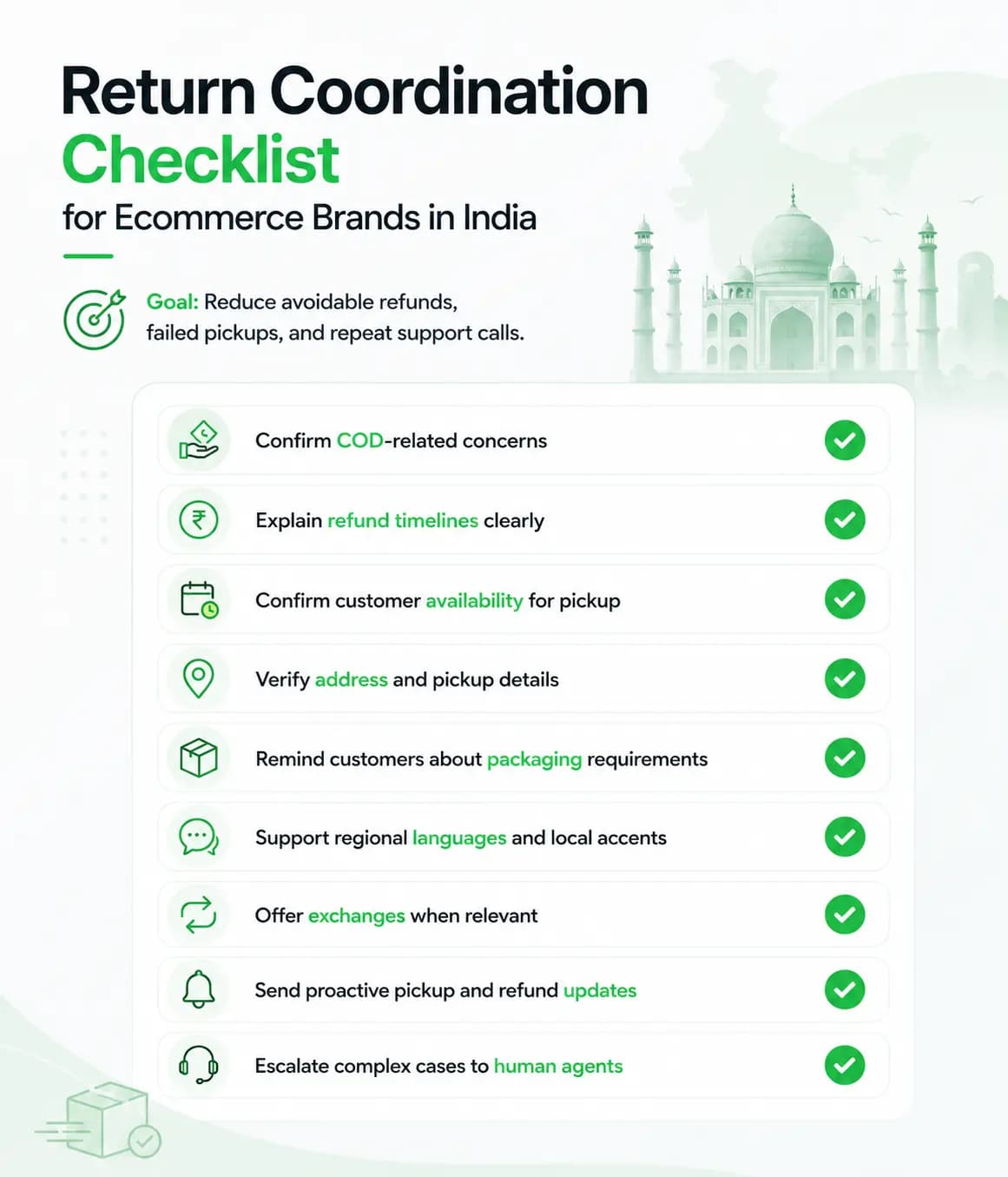
Reducing returns in ecommerce in India requires special attention to COD behavior, refund anxiety, failed pickups, support dependency, and language differences.
Indian ecommerce operators should also keep the Consumer Protection (E-Commerce) Rules in mind when improving customer-facing return and refund communication.
COD customers may be more likely to change their minds, delay pickup coordination, or need extra reassurance after purchase. Return pickups can fail because customers are unavailable, addresses are incomplete, or instructions are unclear.
Refund anxiety is also common. Customers may call repeatedly to confirm whether their money is being processed, when it will arrive, and what happens after pickup.
For Indian ecommerce brands, return prevention alone is not enough. They also need return coordination that works across phone calls, regional languages, local accents, COD workflows, and high-volume support spikes.
AI voice agents can help by confirming return reasons, explaining timelines clearly, reminding customers about pickups, and escalating complex cases to human agents. This makes return coordination more consistent without forcing teams to hire more support staff for every growth phase.
Learning how to reduce returns in ecommerce is not about making returns difficult for customers. It is about reducing avoidable returns, improving product expectations, saving exchange opportunities, coordinating return conversations clearly, and lowering return-related support workload.
Better product pages and policies help before purchase. Better return coordination helps after the customer raises a request.
When ecommerce brands treat returns as a workflow instead of a one-step refund process, they can reduce ecommerce returns, protect more revenue, prevent failed pickups, and give customers a clearer experience.
Better return coordination reduces ecommerce returns by confirming the real return reason, offering exchanges or replacements, explaining eligibility, preventing failed pickups, and giving customers timely refund or exchange updates. It helps brands save recoverable orders before every request becomes a refund.
Ecommerce stores can reduce refund requests by offering easier exchanges, replacement options, troubleshooting help, and proactive follow-ups. When customers receive the right alternative quickly, they are less likely to choose a refund as the default outcome.
AI can help reduce ecommerce returns by automating repetitive return conversations. AI voice agents can confirm return reasons, coordinate pickups, provide refund updates, collect missing details, offer exchanges, and escalate complex cases to human agents.

Get $5 free credit on signup — no credit card required. Set up your AI voice agent in minutes and start converting more leads today.