Return-Coordination
Why Manual Return Management Breaks When Ecommerce Brands Scale



Premium Humanoid AI Voice Agents for your business.
Returns do not usually break an ecommerce operation overnight. They break gradually.
At first, manual return management feels manageable. A customer emails support. An agent checks the order. Someone confirms the return window, shares pickup instructions, follows up with the logistics partner, and updates the customer when the refund is processed.
That works when the return volume is low.
But as ecommerce order volume grows, return volume grows with it. According to the National Retail Federation’s retail returns research, returns remain a major operational priority for online retailers, with ecommerce return rates expected to stay higher than store return rates.
So,More returns means more refund questions, more pickup follow-ups, more missing information, more failed pickup attempts, and more customers asking.
The real scaling problem is not just that brands have too many returns. It is that every return creates multiple conversations that must be coordinated clearly and on time.
In this post, you’ll learn why manual return management in ecommerce breaks as brands scale, what parts of the return process become harder to control, and how automated return coordination can reduce support pressure without adding more agents.
Returns management in ecommerce is the process of handling product returns from the customer’s request through pickup, inspection, refund, exchange, restocking, or final resolution.
A complete return management process usually includes:
return request initiation
eligibility and policy checks
customer communication
pickup or shipping coordination
packaging instructions
inspection and condition review
refund, replacement, or exchange processing
inventory and warehouse updates
status updates
exception handling
Many ecommerce teams think returns management is mostly about logistics, refunds, and warehouse workflows. Those are important, but they are only one side of the process.
At scale, the customer communication layer becomes just as important. Customers need to know what happens next, when pickup will happen, what they need to prepare, why a refund is pending, and who to contact if something goes wrong.
For brands focused on revenue recovery, return communication can also help convert more returns into exchanges in ecommerce instead of defaulting every request to a refund.
Manual return management is not always bad. It often works well in the early stage of an ecommerce brand.
When order volume is low, support agents can manage return requests one by one. They can check order details manually, send refund updates, call customers about pickup timing, and resolve exceptions personally.
A small team may use:
spreadsheets to track return status
helpdesk tickets to manage customer messages
manual calls for pickup confirmation
email templates for refund updates
internal notes for exceptions
direct coordination with logistics teams
This setup can work when the number of returns is small and exceptions are rare.
The problem starts when the brand grows faster than the team’s ability to coordinate every return manually. What once felt flexible becomes slow, inconsistent, and hard to control.
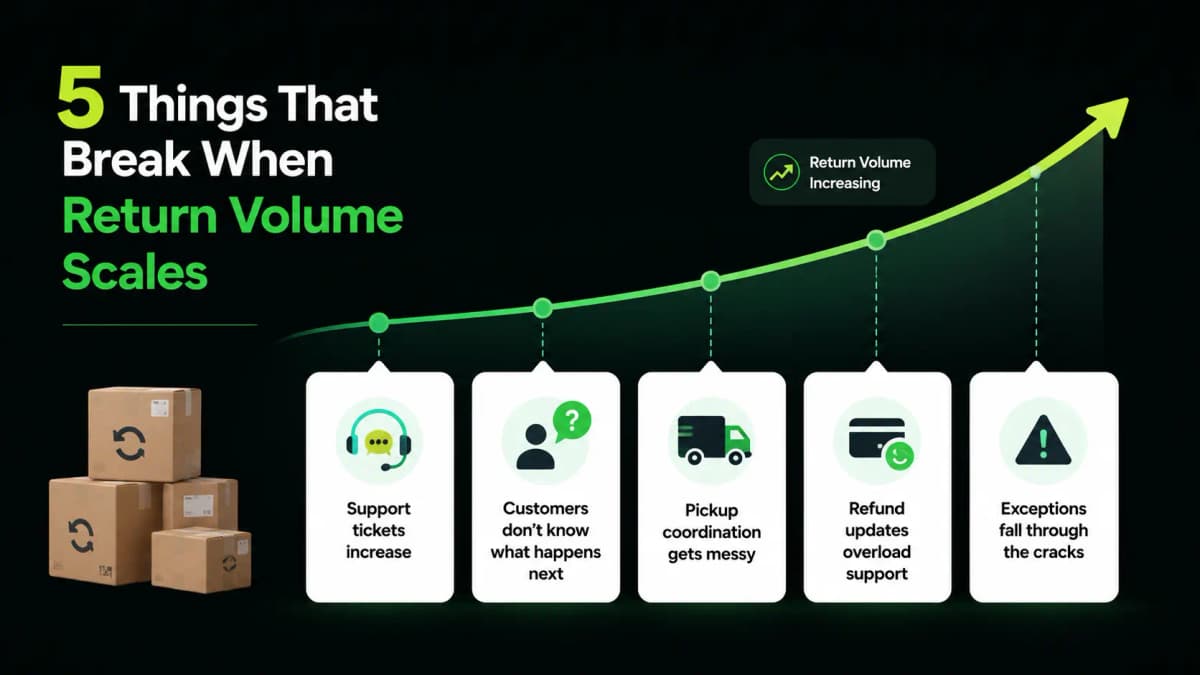
There are a lot of reasons of Why Manual Return Management Breaks When Ecommerce Brands Scale, some of most common are mentioned below:
As return volume grows, support teams do not just handle more returns. They handle more repeated questions about the same return.
Customers ask about return confirmation, pickup timing, refund status, packaging instructions, failed pickups, refund delays, exchange eligibility, and policy confusion.
Many of these tickets are repetitive. The answer may already exist in the system, but the customer still contacts support because they have not received a clear update.
For a deeper breakdown of this issue, read our guide on how to reduce return-related support tickets in ecommerce.
This creates a support loop: the return is already in progress, but the customer does not know what is happening, so they ask again.
Returns are a sensitive post-purchase moment. The customer has already decided something went wrong: the size was incorrect, the product was damaged, the item was not expected, or they changed their mind.
If the brand does not communicate clearly, uncertainty turns into frustration.
A customer may wonder:
Was my return request accepted?
Do I need to print a label?
Will someone call before pickup?
Has the warehouse received the item?
Why has my refund not been credited yet?
Proactive updates reduce this anxiety. Silence increases duplicate tickets and damages trust.
Failed pickups are often treated as logistics issues, but many are communication failures.
Customers may miss calls, forget packaging instructions, be unavailable at the pickup time, provide incomplete addresses, or misunderstand what needs to be handed over.
When coordination is manual, agents must chase customers, reschedule pickups, and update internal systems. Each failed pickup adds more work for support, logistics, and operations team.
At scale, even a small percentage of failed pickups can create a large operational backlog.
Refund questions are one of the most common return-related support issues.
The reason is simple: customers care about their money, and refund stages are often unclear.
There is a difference between:
return request submitted
item picked up
item received by warehouse
return inspected
refund approved
refund initiated
refund credited to the customer’s account
Customers usually do not know which stage they are in unless the brand tells them. When updates are unclear, refund delays feel worse, even if the return process is moving normally.
Exceptions are manageable when they happen occasionally. At scale, they become common.
For Examples - include missing tags, wrong items returned, damaged products, incorrect pickup addresses, partial refunds, expired return windows, etc.
Manual processes depend on agents remembering details, updating systems, and following up at the right time. As volume increases, exceptions are more likely to be missed, delayed, or handled inconsistently.
Spreadsheets can track return data, but they cannot coordinate conversations.
A spreadsheet cannot call a customer, explain pickup instructions, collect missing information, answer refund questions, or reassure someone waiting for an update.
This is why spreadsheet-based return management breaks down as soon as customer communication becomes the bottleneck.
Helpdesks are useful for organizing tickets, but they often depend on customers reaching out first.
That means the customer experiences a gap, gets frustrated, creates a ticket, and waits for a response. By then, the support team is already reacting to a problem that could have been prevented with a proactive update.
For ecommerce return management, reactive support creates unnecessary ticket volume.
A returns portal can help customers initiate returns, choose reasons, generate labels, and view basic status.
But a portal does not always solve pickup reminders, refund explanations, missing information collection, failed pickup follow-ups, or customer reassurance.
Portals are important, but they are not the full coordination layer.
Human agents can make return-related calls, and for complex or emotional cases, they should.
But using human agents for every return confirmation, pickup reminder, refund update, and missing-information follow-up becomes expensive and difficult to manage at scale.
As return volume increases, manual calls create longer queues, higher workload, and inconsistent customer experiences.
Manual return management does not only slow operations. It makes customers feel ignored during a sensitive post-purchase moment.
The hidden costs include:
higher support workload
repeated refund status tickets
slower return resolution
failed pickup attempts
inconsistent customer communication
lower customer trust
more pressure on logistics teams
less agent time for complex cases
poor post-purchase experience
The brand may think it has a returns problem, but in many cases, it has a coordination problem.
When customers are not updated clearly, they contact support. When pickup instructions are unclear, pickups fail. When refund stages are not explained, customers become anxious. When exceptions are not followed up, operations slow down.
A Better Approach: Automate Return Coordination, Not Just Return Tracking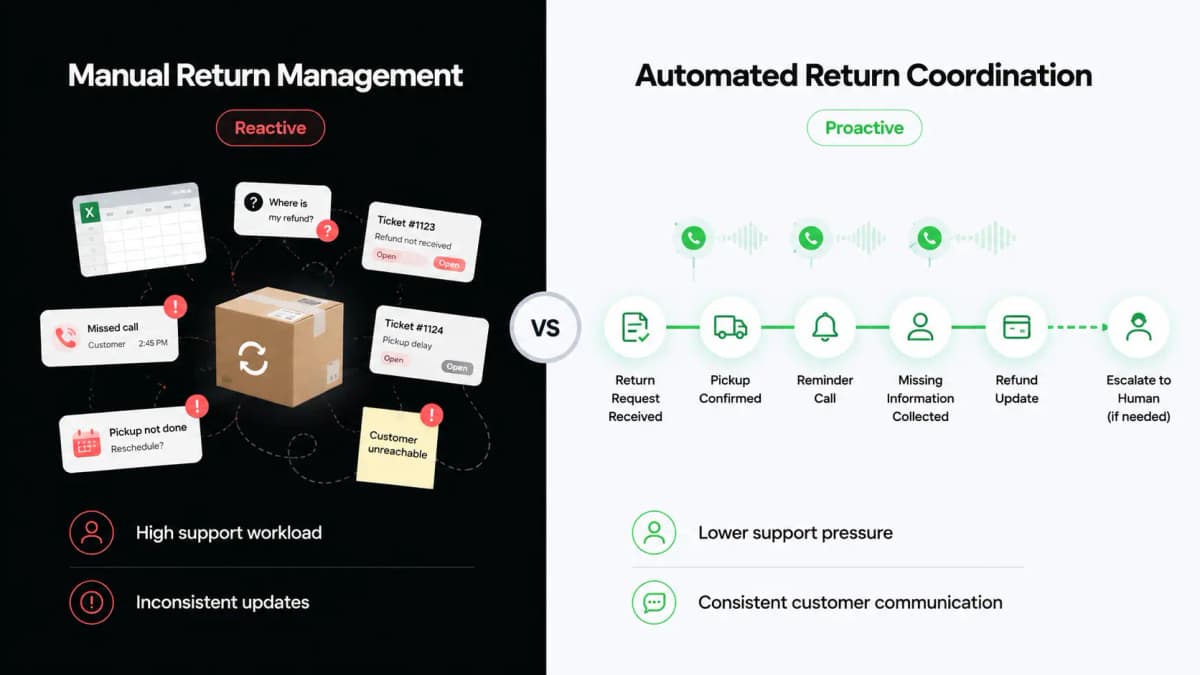
Scalable return management needs two layers.
The first layer is backend return management. This includes return portals, warehouse updates, refund workflows, inventory sync, logistics tracking, and return management systems.
The second layer is customer-facing return coordination. This includes return request confirmation, pickup reminders, availability checks, refund updates, missing information collection, policy explanations, failed pickup follow-ups, and escalation.
Most ecommerce brands focus on backend systems first. That makes sense because brands need structure, tracking, and operational visibility.
But backend tools alone do not remove the customer communication burden. If customers still need to call or message support for every update, support pressure continues to grow.
A stronger process combines backend return tracking with proactive customer coordination.
AI voice agents for ecommerce fits into return management by automating repetitive return-related conversations that would otherwise consume support and operations teams.
For example, an AI voice agent can:
call customers after a return request
confirm return details
explain pickup instructions
remind customers before pickup
collect missing information
confirm customer availability
share refund timeline updates
answer basic return questions
follow up after failed pickup attempts
route complex cases to human agents
sync call outcomes with CRM, helpdesk, order, or return systems
support multilingual or local-accent conversations
This does not replace return portals, logistics providers, or human support teams. It adds the missing coordination layer around them.
Salesix AI helps ecommerce brands automate these customer-facing return conversations with human-like AI voice agents. The goal is not to remove human judgment from complex return cases and to prevent support teams from being buried under repetitive calls, reminders, refund updates, and follow-ups.
See how Salesix supports the ecommerce return coordination across pickup confirmations, refund follow-ups, reminders, and return-related customer calls.
For brands scaling return volume, this creates a more consistent return experience without adding more agents for every increase in return workload.
Ecommerce brands should move beyond manual return management when returns start creating more communication work than the team can handle consistently.
Common signs include:
customers repeatedly asking about refund status
agents spending too much time explaining return steps
failed pickups caused by poor coordination
customer complaints about lack of updates
unclear refund timelines
return spikes after sales or peak seasons
rising helpdesk tickets related to returns
operations teams manually chasing missing information
inconsistent follow-up across agents
At this stage, the answer is not only to hire more support agents. More agents may help temporarily, but the workload pattern remains the same.
The better question is: which return conversations can be automated without hurting customer experience?
Manual return management works only while return volume is low.
As ecommerce brands scale, every return creates multiple coordination tasks: confirming the request, explaining next steps, coordinating pickup, sharing refund updates, handling missing details, and escalating exceptions.
Backend return tools are important, but they do not solve every customer communication gap. If customers still need to chase the brand for updates, the return process will keep creating support pressure.
The scalable approach is to combine return tracking with proactive return coordination.
AI voice agents can help ecommerce brands automate repetitive return calls, pickup confirmations, refund follow-ups, reminders, and basic return questions while human agents focus on complex cases.

Get $5 free credit on signup — no credit card required. Set up your AI voice agent in minutes and start converting more leads today.