Customer-Support
How to Scale Ecommerce Customer Support Without Adding More Agents



Premium Humanoid AI Voice Agents for your business.
Ecommerce support teams are under pressure from both sides. Order volume keeps growing, while customer expectations for speed, availability, and accuracy are also rising.
When that happens, many brands fall back on the same answer: “hire more agents."
That works for a short term, but not good for the long term. The problem is not just volume. Ecommerce teams face high volumes daily, like order questions, delivery issues, and return requests. Hiring more staff boosts capacity, but it doesn't change the ongoing workload that adds pressure to support.
So, how to scale customer support in ecommerce without continuously increasing headcount? The most effective answer is to redesign how support is handled.
In this post, you’ll discover how to scale ecommerce customer support without hiring more agents. You can achieve this by reducing repetitive tasks, improving support processes, and using an AI voice agent for ecommerce. This will boost efficiency and help manage more requests.
Ecommerce customer support becomes harder to scale because growth multiplies the number of customer touchpoints, not just the number of orders.
A growing store not only processes more purchases. It also creates more “Where is my order?” Calls. More requests to change addresses. More return questions. More delivery complaints. More clarifications before and after purchase. Even when the issue is simple, the volume adds up quickly.
A few support patterns make this especially difficult for ecommerce teams:
Support demand appears before, during, and after fulfillment. Customers often need help. They have questions about products, payment issues, and order confirmations.
They also ask about shipping times, delivery updates, returns, refunds, and exchanges. As the order volume increases, these requests also increase.
A large share of ecommerce support volume comes from routine questions. The issue is not that they are hard. The issue is that agents still spend time answering the same questions again and again.
That creates a scaling problem. Simple conversations consume the same queue capacity that complex issues need.
Ecommerce support is time-sensitive. A late reply about a shipment, cancellation, failed delivery, or return can lead to frustration, a refund request, or a lost customer.
Many ecommerce teams still get important support queries by phone, especially for urgent issues.
Phone support is harder to scale than email or chat because each interaction demands real-time attention.
This pressure becomes even more difficult during promotions and seasonal peaks, when brands need a reliable way to handle high customer support volume during ecommerce sales without overwhelming their agents.
Hiring more people can increase capacity, but it is not the same as building a scalable system.
At a certain point, adding agents becomes a costly way to manage an inefficient support model.
Every new support hire brings extra costs. This includes salary, onboarding, management overhead, scheduling complexity, and tool access. During busy seasons, this gets tougher. Teams often need extra help quickly.
New agents need time to learn policies, workflows, systems, escalation rules, and brand expectations. That slows down how fast new capacity becomes useful.
As teams expand, support quality can become uneven. Different agents may explain policies in different ways.
They might skip steps in the process. They can also handle similar cases inconsistently. That affects both customer trust and internal efficiency.
Customers do not limit their questions to business hours. Keeping 24/7 human support is costly and challenging, especially for growing brands with small teams.
This is the core problem. Hiring increases the number of people doing the work. It does not reduce the amount of repetitive work entering the system.
That is why brands looking at how to scale customer service without adding headcount need to think beyond hiring.
Most ecommerce teams already use some mix of help desk software, FAQs, chat, and outsourced support. These tools help, but they often fail to solve the real scaling issue.
A help desk can make tickets easier to track, assign, and resolve. It often manages support volume and does not clear repeated conversations from the queue.
FAQs are useful for simple questions, but many customers do not want to search for answers when the issue feels urgent to them. They want a direct response, especially when the issue involves an order, shipment, or refund.
Live chat can reduce phone volume in some cases, but it still needs people behind it unless the brand is using automated systems. As volume rises, chat queries can become as difficult to manage as phone lines.
Outsourcing can boost coverage. However, it may cause quality issues. Feedback can slow down, too.
There might be a weaker link to internal systems and policies. It adds capacity, but not always control.
Simple bots and rigid automation work well for specific tasks. However, they often struggle when customers ask questions casually, change topics, or need help with specific issues.
That is where many scalable customer service solutions disappoint. They automate the easiest cases, but leave the real inbound workload problem mostly untouched.
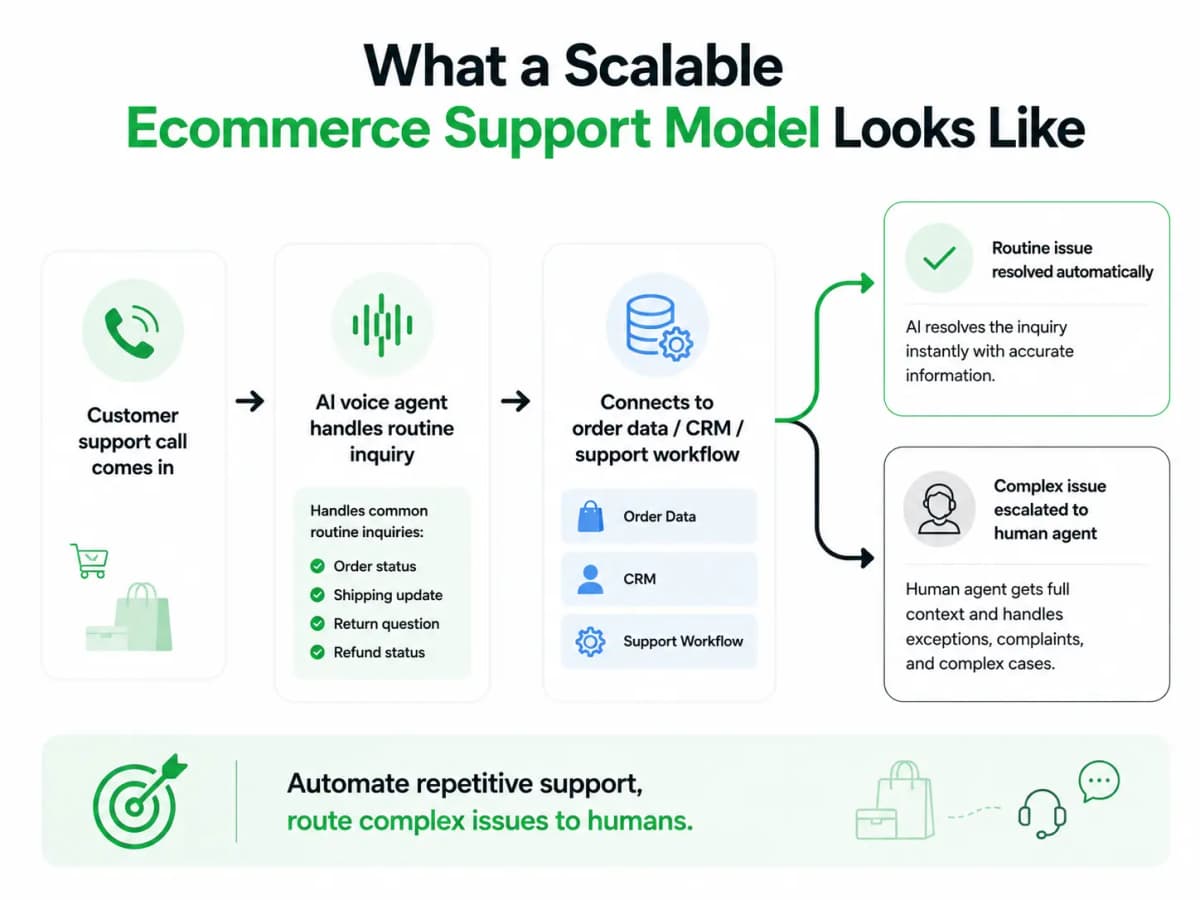
A scalable support model does not try to make humans handle everything faster. It changes who handles what.
The best approach is to separate routine support from exception handling.
Start with the support requests that happen every day and follow repeatable patterns. These often include:
Order status
Shipping updates
Delivery questions
Return and refund policy questions
Basic store policy questions
Simple post-purchase support
These conversations take time, but many do not require complex judgment.
Order-status questions are a strong example because customers often expect immediate answers from package tracking updates before contacting support.
Scalable support is not just about answering questions. It is about completing support tasks efficiently. This means connecting chats to order systems, CRM tools, refund processes, and escalation paths.
This is how brands truly reduce support workload without hiring more agents.
AI voice agents for ecommerce help support teams automate busy phone support. This way, customers still feel connected and valued.
AI voice agents can manage routine support chats naturally and in real time. This way, not all customers need to use self-service.
Salesix’s ecommerce customer support solution is built for this kind of workflow, helping brands automate routine support calls while keeping human escalation available when needed.
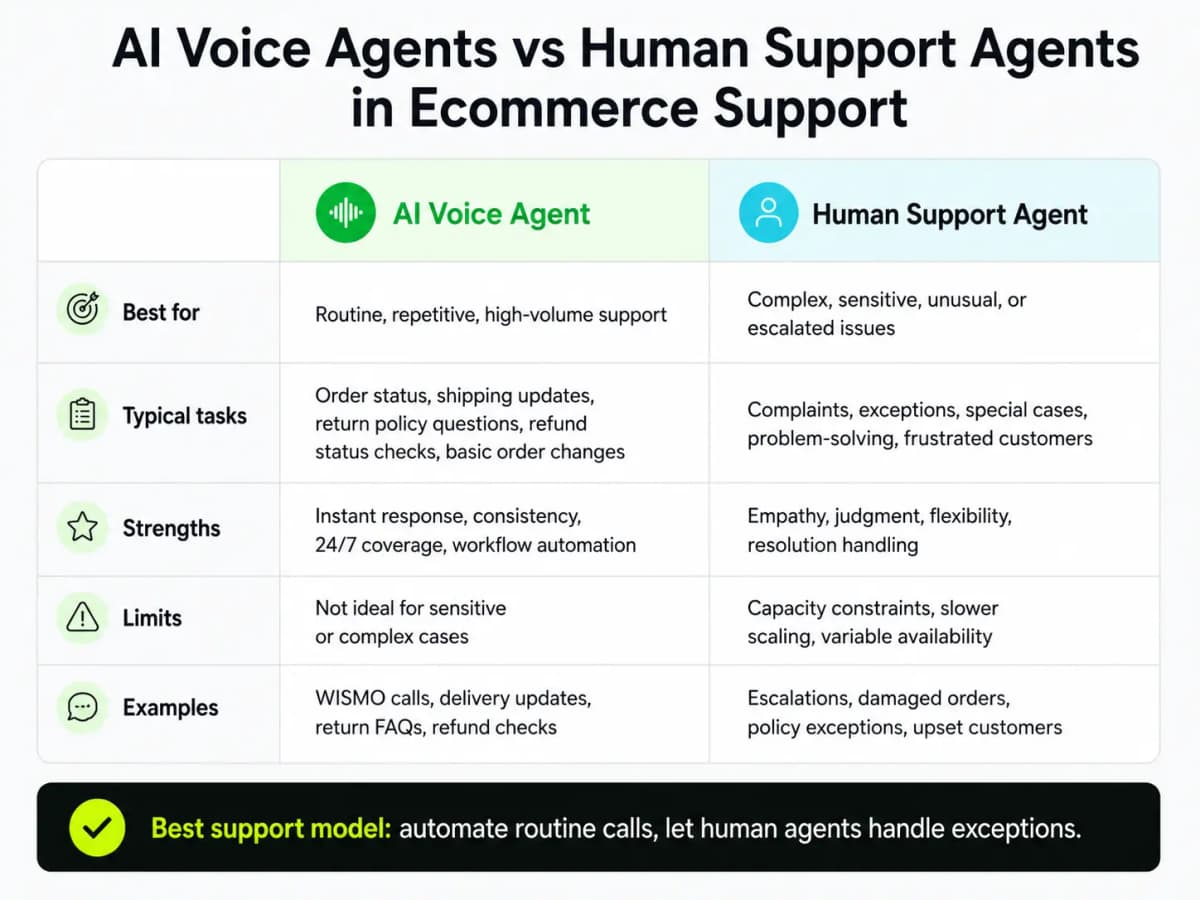
AI voice agents can manage many repetitive phone-based support interactions, such as:
Order status requests
Shipping and delivery updates
Return process questions
Refund status checks
Store policy clarifications
Basic order change requests
Escalation intake for more complex issues
This makes them useful for ecommerce customer support scaling, especially when phone volume is driven by routine requests.
Unlike human teams, AI voice agents can respond instantly and consistently across large call volumes. That helps brands maintain service quality during growth periods, sale events, and seasonal spikes.
The goal is not to automate every interaction. The goal is to reduce repetitive inbound pressure. This lets human agents focus on issues that need empathy, judgment, and problem-solving.
A strong AI voice support system should do more than talk. It should pull order data, update workflows, route escalations, log outcomes, and pass context to human teams when needed.
That is what makes customer support automation operationally useful in ecommerce.
Not every automation tool is built for real support volume. If you are evaluating a solution, focus on whether it can actually handle ecommerce support conditions.
If your team is comparing vendors, reviewing the best AI voice agents for ecommerce customer support can help you evaluate options based on conversation quality, integrations, escalation handling, and reliability.
The experience should feel clear, natural, and reliable. Customers should not feel trapped in a robotic flow when they are calling about a real order issue.
Support conversations should connect to the systems your team already uses. That includes order platforms, CRMs, help desks, and internal workflows.
A scalable solution must know when to hand off to a person. Complex or sensitive issues should move to human support with context, not restart from zero.
You need to see call reasons, containment, escalations, response patterns, and support volume trends. That helps teams improve performance and identify the biggest call drivers.
For many ecommerce brands, multilingual support is essential. A scalable system should help customers in different languages. It shouldn't need separate teams for each region.
If a support solution works only under normal conditions, it is not truly scalable. It should work well during busy times like sales campaigns, holidays, and after promotions.
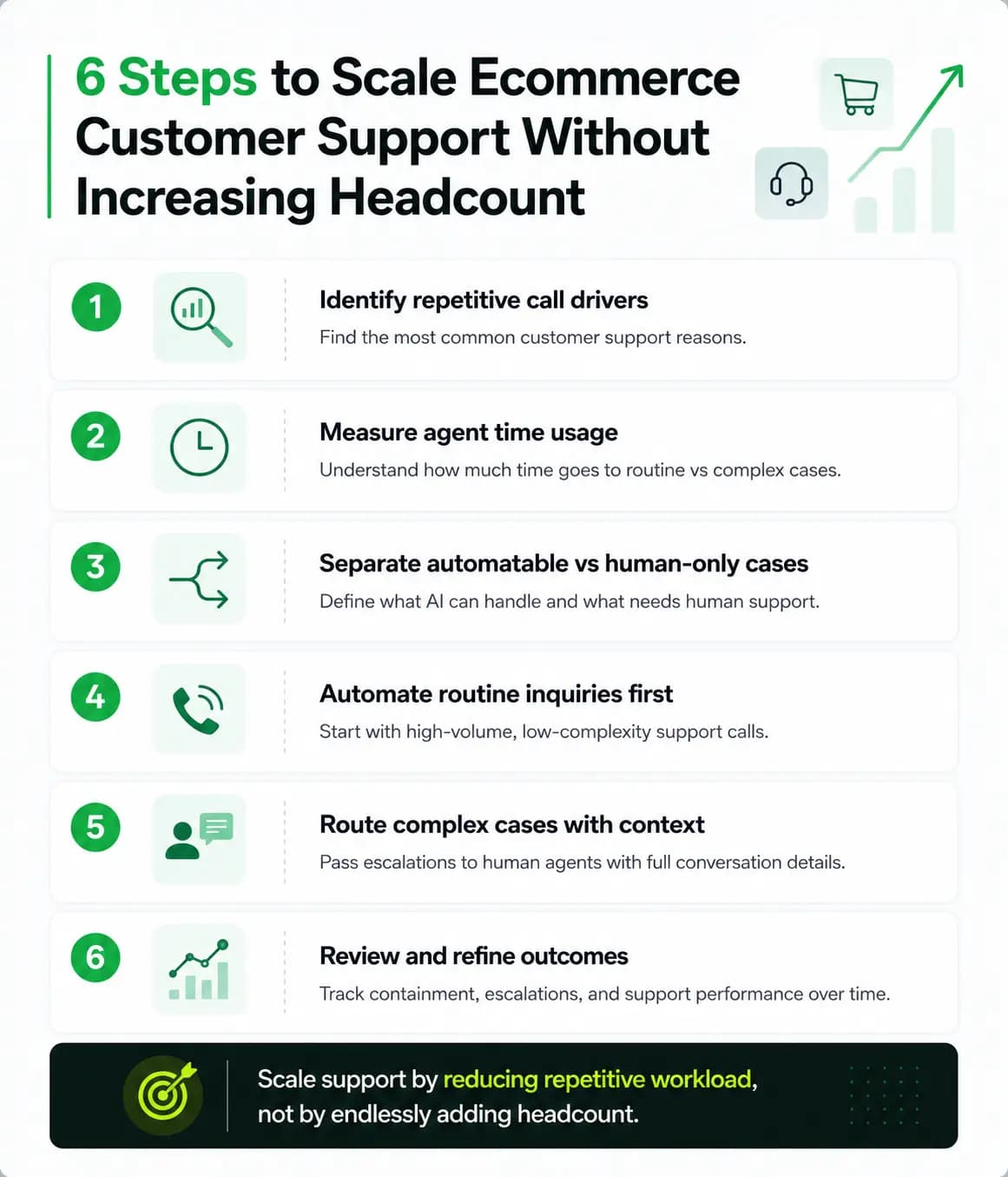
Look at the top reasons customers contact support. Focus first on issues that happen often and follow repeatable patterns.
Find out how much time your team spends on routine inquiries versus exception handling. This shows how much repetitive workload is consuming support capacity.
Not every conversation should be automated. Define which inquiries can be handled through structured workflows and which ones need a human from the start.
Start with the highest-volume, lowest-complexity conversations. This creates fast efficiency gains without disrupting more sensitive support flows.
When escalation is needed, make sure agents receive the full conversation and workflow context. That avoids repetition and improves resolution speed.
Scaling support is an ongoing operational process. Track containment, escalation rate, resolution quality, customer pain points, and peak performance. This will help improve the model over time.
For a step-by-step implementation path, use the ecommerce customer support playbook to map support call drivers, automation opportunities, and escalation workflows.
The answer to how to scale customer support in ecommerce is not endless hiring. It's making a support model. This model cuts down on repetitive tasks for human teams. It also handles routine questions better.
As ecommerce brands grow, support volume becomes harder to manage through headcount alone. Repetitive calls and urgent order issues can stress teams. This happens even if more agents are added. Phone-heavy demand makes it worse. A more sustainable way is to automate routine support chats. This links them to real workflows and lets human agents focus on exceptions.

Get $5 free credit on signup — no credit card required. Set up your AI voice agent in minutes and start converting more leads today.