Customer-Support
How to Handle High Customer Support Volume During Ecommerce Sales



Premium Humanoid AI Voice Agents for your business.
It’s important for ecommerce brands to manage high customer support volume. This is crucial during big sales, festive campaigns, flash drops, product launches, and busy shopping seasons.
When order volume rises, support demand usually rises with it. Customers reach out by call, email, chat, or tickets. They ask about order confirmations, delivery times, questions on failed payments, etc.
The issue is not just that more people are buying. It is that many customers are asking the same urgent questions at the same time.
That creates pressure across the entire support operation. Agents spend hours answering repetitive questions while complex cases wait. Calls get missed. First response times increase. Customers follow up again because they did not get an answer the first time.
High customer support volume during ecommerce sales is not only a staffing problem. It is a workflow design problem.
In this post, you’ll discover how to handle high customer support volume during ecommerce sales. You can do this by cutting repetitive questions. Simplify support workflows.
Ecommerce customer support gets busy when sales campaigns increase urgency and uncertainty. This leads to more questions after purchases.
Order Confirmation and Payments: Customers want quick confirmation of their purchases. This is important if emails are delayed. They may also contact support for issues with failed payment attempts.
Discounts and Stock: Support volume goes up. This is due to coupon issues, questions about sale prices, and urgent inquiries on limited stock or flash sales.
Logistics and Post-Purchase: Delivery anxiety causes questions about shipping times. It also leads to concerns about address changes. Post-purchase volume rises from inquiries about returns. Many ask about refunds related to sale policies.
Self-Service Gaps: Technical issues at checkout or confusing FAQs push customers to seek direct support. This happens when self-service options seem too slow or insufficient.
Ecommerce teams can also review checkout usability research to find friction points that may create avoidable payment, confirmation, or checkout-related support questions.
In short, ecommerce sales increase both revenue activity and uncertainty. If that uncertainty is not managed early, it becomes support volume.
Many ecommerce teams treat high support volume as a ticket-count problem. But the deeper issue is repetition.
During peak sales seasons, support teams often hear the same questions hundreds or thousands of times:
Where is my order?
Has my order been confirmed?
When will this be delivered?
Where is my refund?
How do I return this item?
Can I still use this discount code?
Can I change my delivery address?
These are not random questions. They are predictable support conversations.
When every repetitive question reaches a human agent, the queue becomes heavier than it needs to be.
Agents answer simple questions about orders and deliveries. They also handle refunds and policies. Customers with damaged items, payment problems, failed deliveries, or urgent complaints wait longer.
That is why the best way to manage high support volume is not simply to add more people to the queue. It is to reduce the number of repetitive conversations that require manual handling.
When support teams aren’t ready for the busy sales season, these problems appear fast:
Wait times increase.
A strong support workflow should also focus on how to reduce customer support wait times in ecommerce before customers abandon the conversation.
Calls are missed.
First responses are delayed.
Customers abandon support conversations and try again through another channel.
For example, A customer might first call, then later send an email, start a chat, or message on social media if they still need an answer.
This creates duplicate support ticket volume and makes the queue look even worse than the original issue.
Poor support during a sale also affects trust. Customers who were ready to buy again may hesitate if their first experience feels uncertain or ignored.
The risk is bigger than a slow response. Poor support during a sale harms the customer experience when their buying interest is at its peak.
Hiring more agents can help, but it is not always practical during sudden sales spikes. Recruiting, onboarding, training, and quality control take time.
Temporary agents might not understand product details. They might find return rules hard. Shipping exceptions can be tricky, too. Discount policies and escalation workflows may also be a challenge.
In short, More people can increase capacity, but they can also create inconsistency if the underlying process is not clear.
Extra hiring also adds cost. If most support questions repeat, ecommerce brands may pay human agents. These agents could answer questions that computers can handle automatically.
If your team is facing this problem often, it may be time to rethink how to scale ecommerce customer support without adding more agents.
Help centers and FAQs are useful, but they do not solve every support spike.
Customers with urgent delivery, payment, refund, or order concerns often want a direct answer. If the FAQ is hard to find, too generic, or not updated for the current sale, customers still create tickets.
Self-service reduces some pressure, but it depends on customers trusting that they can find the right answer quickly.
Chatbots can reduce written tickets, especially for simple questions. But many ecommerce support spikes are not limited to chat or email.
Customers often call when the issue feels urgent, emotional, or time-sensitive. Order problems, failed payments, delayed deliveries, and refund concerns often create phone-based pressure. If support automation only covers written channels, call volume in customer service can remain high.
Routing helps organize requests, but it does not reduce demand by itself.
If every simple question still becomes a ticket, the queue remains heavy. Routing can send the ticket to the right person faster. However, the customer is still waiting. The agent still has to handle it manually.
Better routing helps agents. Better demand management prevents overload.
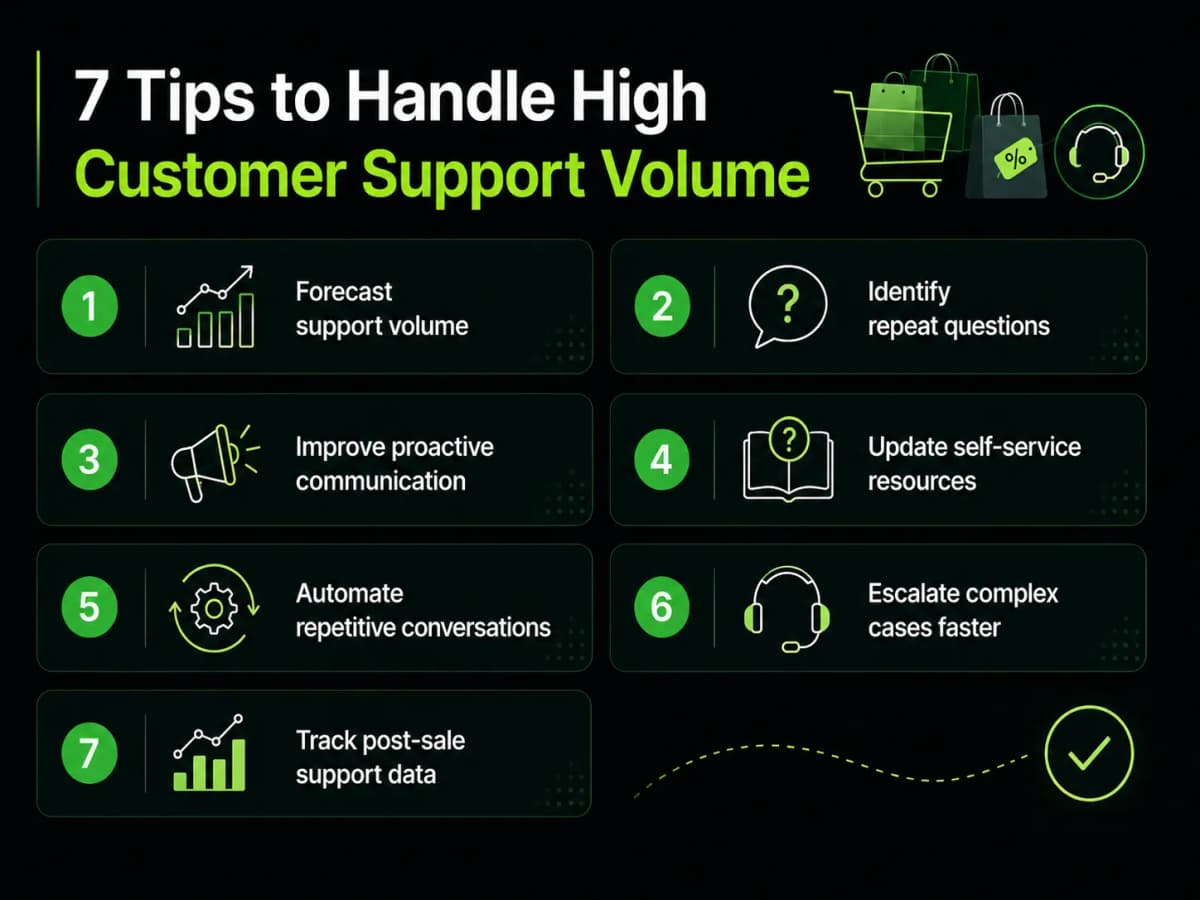
Start by reviewing past campaign data. Look at order volume, return rates, refund questions, delivery delays, missed calls, and call logs.
Identify when support demand usually peaks. Some brands see spikes immediately after launch. Others see pressure after shipping updates, payment failures, or delivery delays.
Forecasting helps with planning coverage. It updates workflows and prepares scripts. You can also decide which conversations to automate before the sale begins.
To manage high support volume, identify the questions that create the most repeat work.
Review tickets, call notes, chat logs, and email categories from previous campaigns.
Group issues by topic:
Order status
Order confirmation
Delivery timeline
Returns
Refunds
Payment issues
Discounts
Address changes
Stock availability
Then separate repetitive questions from complex cases.
Repetitive questions should be handled with automation, self-service, or proactive communication. Complex cases should reach human agents faster.
3. Improve Proactive Customer Communication
A large share of customer service for ecommerce comes from uncertainty. Clear communication reduces that uncertainty before customers contact support.
Some of the Proactive Customer Communication are:
Send clear order confirmations.
Provide delivery updates.
Explain sale terms before checkout.
Make return and refund policies visible.
Warn customers about possible delivery delays when needed.
The goal is simple: answer the question before the customer has to ask it.
Proactive communication won’t stop all support requests. It can lower unnecessary tickets and calls.
Before a campaign starts, update your FAQs, tracking pages, support pages, and checkout messaging.
Add sale-specific answers around the following:
Shipping Timelines: Orders usually ship within 3-5 business days.
Return Windows: You can return items within 30 days of purchase.
Coupon Rules: Coupons apply only to full-priced items, not on sales.
Stock Limits: We limit purchases to 5 items per customer to ensure availability.
Payment Failures: If your payment fails, please check your card details or try another method.
Refund Timelines: Refunds are processed within 7-10 business days after we receive the returned item.
Self-service works best when it is specific to the current sale, not just a generic help center page.
Still, self-service has a limit. Some customers will call when the issue feels urgent. That's why ecommerce customer service should have both written and voice support. Each option is important.
Repetitive questions should not always wait for human agents.
Automation can answer common questions fast. It does this well with clear information. This includes order number, delivery status, refund stage, return policy, and discount rules.
For ecommerce brands with heavy phone support, automation should include voice, not only chat. AI voice agents for ecommerce can take common calls when it's busy. They gather the customer's order number and provide clear answers. If a case is complex, they can escalate it with context.
This is really helpful for the following:
Order status
Delivery updates
Return instructions
Refund timelines
Payment confirmation
Coupon issues
The goal is not to replace the whole support team. The goal is to stop repetitive calls from flooding human agents.
Not every issue should be automated.
The key is understanding where AI voice agents and human support agents fit in ecommerce customer support.
Refund disputes need human judgment. So do damaged products and angry customers. VIP buyers, failed deliveries, and unusual payment issues might need it too. Automation should identify these cases and move them to the right person quickly.
When simple questions are handled at the first layer, human agents have more time and focus for sensitive cases. That improves both speed and quality.
After the sale, review what actually happened.
Look at the call reasons. Check ticket categories. Note missed calls. Review average response time. Track repeat contact rate. Look into refund questions. Check delivery complaints. Watch escalation patterns.
This data shows where your support system broke down. It also points out what to improve before the next sale. This includes:
FAQs
scripts
automation flows
escalation rules
proactive messages
staffing plans.
Peak support planning should improve after every campaign.
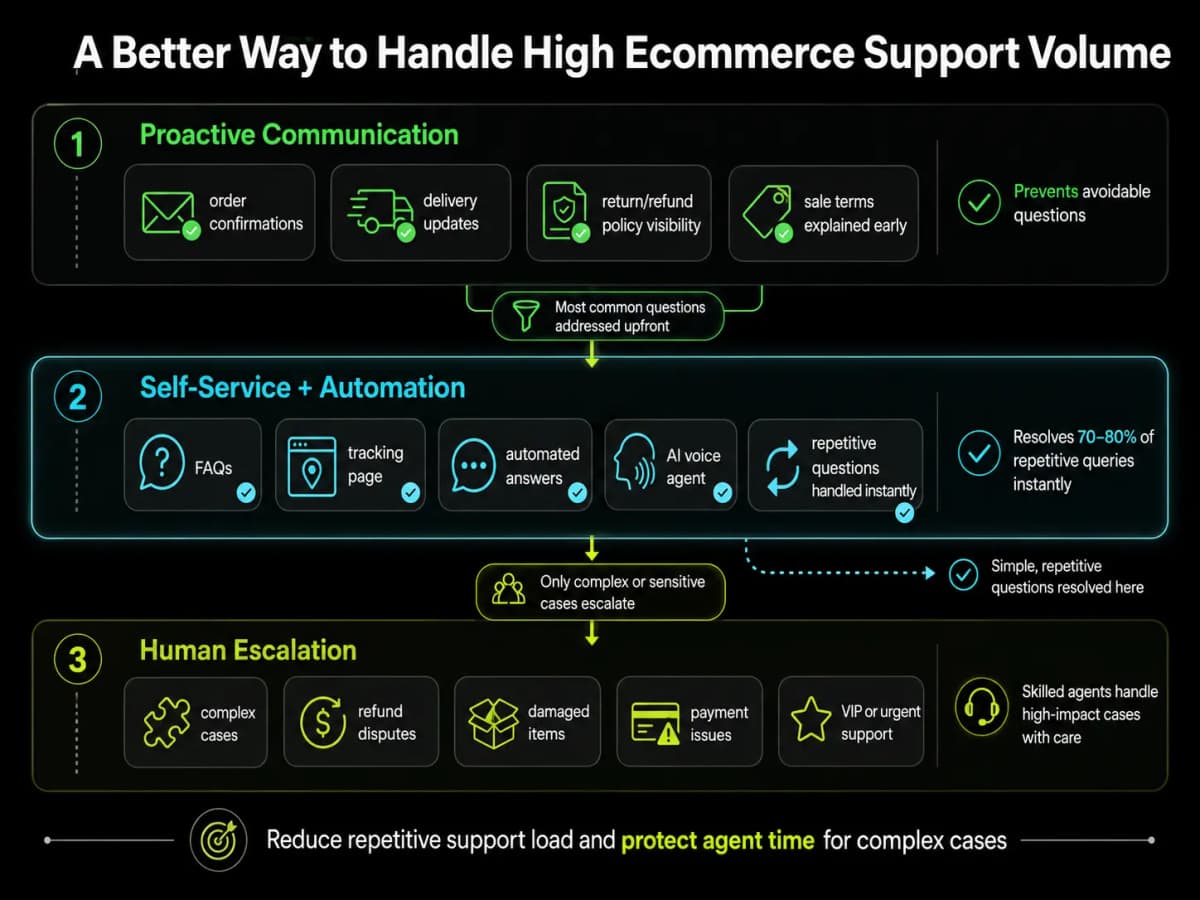
The best way to reduce customer support overload is to build a support system with three layers.
The first layer is proactive communication. This prevents avoidable questions by giving customers clear updates before they contact support.
The second layer is self-service and automation. This answers simple, repetitive questions instantly across key support channels.
The third layer is human escalation. This protects agent time for complex, emotional, or high-value cases.
This system works because it does not treat every support request the same.
For example, A customer asking “Where is my order?” should not create the same manual workload as a customer reporting a damaged product or payment dispute.
High-volume customer service is easier. Simple questions should be answered fast. Complex cases need quick human help.
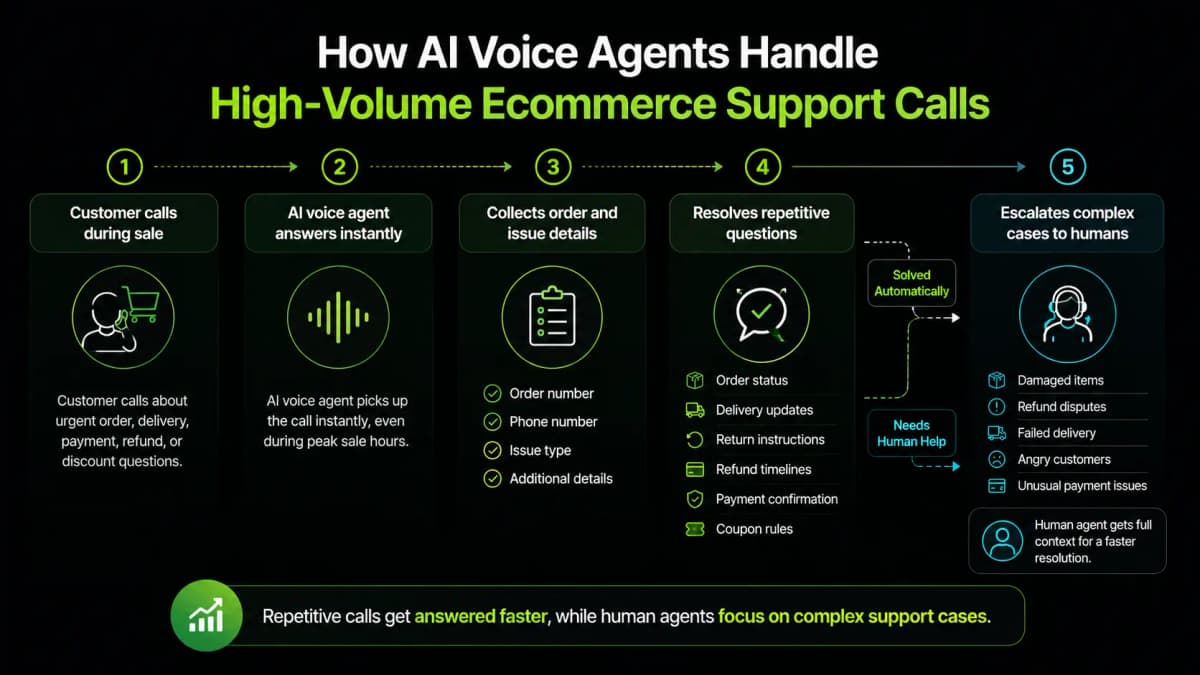
AI voice agents for ecommerce fit into customer support as a scalable first-response layer for repetitive, high-volume calls.
During sales campaigns, they quickly answer support calls, common order and delivery questions. If needed, they escalate cases and also provide clear answers. This includes return rules, refund timelines, payment questions, and sale policies.
Ecommerce brands with multilingual or regional customers can use AI voice agents like Salesix AI. With Salesix, ecommerce teams can use human-like AI voice agents to manage repetitive support calls, reduce missed conversations, and give agents more room to handle complex customer issues.
For brands building a more scalable support operation, the ecommerce customer support use case page is the logical next step.
Avoid the following most common mistakes brands make at peak sales spikes:
Waiting until the sale starts to prepare support workflows. By then, the queue is already filling.
Hiring more agents without fixing the repetitive question flow. More people may help temporarily, but the same inefficient process remains.
Focusing only on written tickets while ignoring phone support. Many urgent ecommerce questions still happen through calls.
Generic FAQs that do not answer sale-specific questions. Customers need clear answers about the current campaign, not broad policy language.
Letting every simple question reach a human agent. That is how support teams become overloaded.
Treating automation as a replacement for support. It should act as a response, routing, and filtering layer that helps humans work better.
Knowing how to handle high customer support volume during ecommerce sales starts with understanding that the pressure is predictable.
Most support spikes come from repetitive, time-sensitive questions. Customers want to track their orders. They also need to know if the payment went through, when the delivery will occur, how refunds work, and if the sale terms apply.
Ecommerce brands should get ready before the sale. They should communicate early and improve self-service options. Automating repetitive chats is important, too. Human agents should handle tricky or sensitive issues.
The brands that handle sales spikes best are not just the ones with bigger support teams. They are the ones with better systems for managing repetitive support demand.
Use the ecommerce customer support playbook to plan support workflows, automation rules, and escalation paths before your next campaign.
Customer support volume rises during ecommerce sales. More customers place orders and use discounts. They check delivery timelines and ask about stock. They also raise questions about payments, returns, and refunds.
Ecommerce brands can cut down on support tickets during sales by:
Answering common questions ahead of time.
Updating sale-specific FAQs.
Sending clear orders and delivery updates.
Automating repetitive support chats.
Route support calls during ecommerce sales by:
Using a first-response layer for repetitive questions.
Collecting customer details early.
Answering simple order or delivery questions right away.
Escalating complex calls with context.
Yes. Customer service automation can cut ticket volume. It answers common questions. These include orders, delivery, returns, refunds, payments, discounts, and product availability. This happens before customers reach a human agent.

Get $5 free credit on signup — no credit card required. Set up your AI voice agent in minutes and start converting more leads today.