Customer-Support
How to Reduce Customer Support Wait Times in Ecommerce



Premium Humanoid AI Voice Agents for your business.
Ecommerce customers want quick answers. Customers hate waiting. They have urgent questions about orders, delivery, returns, refunds, payments, or products.
When someone calls support, they are usually looking for reassurance. They may be worried that an order is delayed, a payment has failed, or a return window is closing. If they wait too long, the issue becomes bigger than the original question.
Long support wait times affect more than one support metric. They can cause cancellations and lead to refund requests, which leads to bad reviews. This means fewer repeat purchases
The real problem is that ecommerce support wait times are not only a staffing issue. In many brands, they are a repetitive call-volume issue.
The quickest way to cut down customer support wait times is to automate simple, high-volume calls. This lets human agents concentrate on issues that require judgment, empathy, and escalation.
In this post, you’ll discover why ecommerce support wait times rise. You'll see what causes long delays and how AI voice agents for ecommerce can cut down on repetitive calls. This helps prevent your team from getting overwhelmed.
Customer support wait times are important. Ecommerce questions relate to trust, money, and urgency.
A delayed answer about a delivery date can turn into a cancellation. A slow refund response can turn into a complaint. A missed call about a payment issue can become a lost order. When customers cannot get clear answers quickly, they lose confidence in the brand.
This is important for ecommerce customer support team. Customers often reach out to them after they have paid. They are waiting for someone to arrive, to fix something, to refund them, or to confirm something.
That makes response speed part of the customer experience, not just a support operations metric.
Cutting response time in customer service is vital for ecommerce teams. It protects revenue and boosts customer satisfaction. It also reduces repeated follow-ups. Plus, it keeps support teams from getting overloaded.
Long wait times usually happen when too many simple, repetitive questions reach human agents at the same time.
A large share of ecommerce customer service volume comes from questions like:
Where is my order?
Has my order shipped?
Why is my delivery delayed?
Can I change my address?
Can I cancel before dispatch?
These questions are important to customers, but many do not require a human agent from the start. When all order status calls go into the same queue, agents waste time on repeated questions. This causes more complex cases to wait longer.
Returns, refunds, and cancellations often create emotional pressure. Customers want fast answers because money, product expectations, and timelines are involved.
Agents may need to verify order details, check policies, update systems, create tickets, and confirm next steps. If this work is fully manual, customer service response time increases quickly.
Customer support wait times during major sales are often much worse than normal. Festive campaigns, product price drops, and influencer promotions can cause call spikes. Holiday shipping deadlines and end-of-season sales can do the same.
Hiring for every temporary spike is difficult. Without automation or better routing, the queue grows faster than the team can respond.
If peak-season volume is your biggest support challenge, see our guide on how to handle high customer support volume during ecommerce sales.
Even skilled agents lose time when they must switch between systems.
They might need to:
Check order history
confirm identity
review delivery status
update a CRM
Create a helpdesk ticket
escalate the issue
write notes after the call
These steps are necessary, but when they are manual, they increase average handling time and slow down the entire queue.
When every request goes to a human agent, support capacity gets used on basic questions.
Complex cases take more time. Angry customers wait longer. Payment disputes also cause delays. Complaints about damaged products take time, too. High-value customer issues are also slow to resolve.
That is why ecommerce brands need to separate repetitive support from complex support.
Many ecommerce teams try to reduce wait times by improving the current queue. That helps, but it often does not solve the root problem.
Hiring boosts capacity, but it also brings more work. You’ll need to handle recruitment, onboarding, training, scheduling, QA, payroll, and management tasks. It is especially weak during sudden peaks because support spikes can happen faster than teams can hire and train.
Hiring more agents can lower customer service response times. However, it won't create a scalable support model by itself.
For a deeper look at this problem, read our guide on how to scale ecommerce customer support without adding more agents.
Knowledge bases and FAQ pages are useful. They help customers find answers without contacting support.
But customers with urgent delivery, refund, payment, or cancellation concerns often still prefer to call. They want confirmation, not just an article.
Chatbots can reduce website and chat volume. However, many ecommerce customers still call when the issue feels urgent or emotional.
If phone support is still overloaded, chat automation alone may not reduce support wait times enough.
Canned replies and macros can improve customer service response, especially for email and chat. But they do not answer phone calls instantly when agents are unavailable.
Templates make agents faster. They do not remove repetitive calls from the queue.
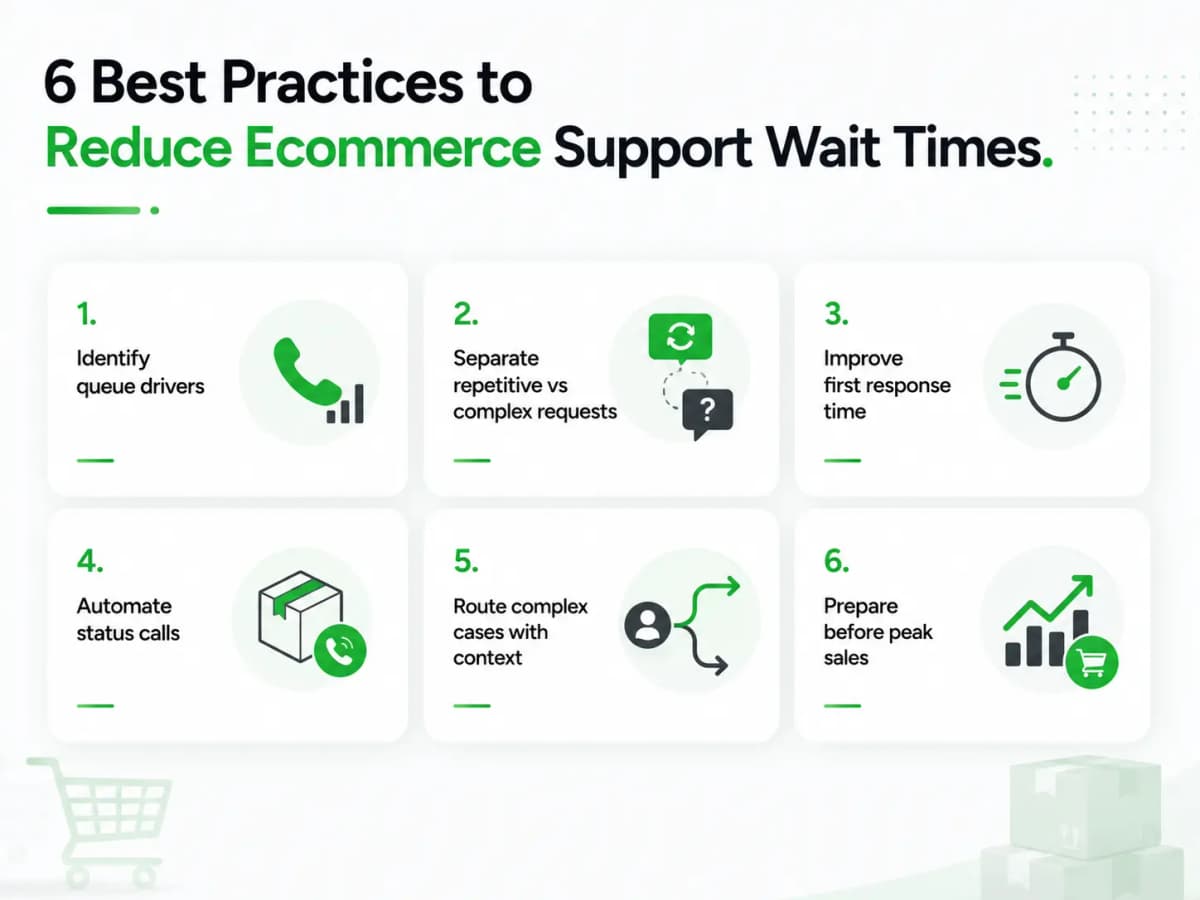
To lower customer support wait times, ecommerce teams must change how they handle support volume. This should happen before it reaches human agents.
Start by tracking the biggest support drivers.
Common categories are:
Order status
Delivery delays
Returns
Refunds
Cancellations
Payment issues
Product questions
Complaint follow-ups
Address changes
The goal is to find which questions are frequent, repetitive, and safe to automate.
Not every support request deserves the same handling path.
Repetitive questions should be automated where possible. Complex, emotional, or high-value cases should go to trained human agents.
This speeds up response time. Agents aren't buried in simple requests anymore. Those can be handled right away.
When customers contact support, the first response matters. Even when the issue cannot be solved immediately, customers want to know they have been heard and what will happen next.
The best tools for faster response times help teams. They can quickly acknowledge customers and gather important details. Then, they identify the issue and route the case properly.
For ecommerce brands, quick responses are key. This often means answering urgent phone questions right away. This avoids making callers wait in a queue.
Many ecommerce support calls are repetitive but still important.
Customers want clear information on:
Order status
Delivery timelines
Return steps
Refund progress
Product availability
Cancellation options
AI voice agents can quickly handle common inbound calls. They collect customer details, check order status, guide callers on next steps, and escalate issues when necessary.
This cuts down customer service response time. It also means human agents don’t have to manage every simple call.
Automation should not block customers from human support when they need it.
A good support workflow spots when a caller is angry, confused, valuable, or facing a sensitive issue. Send damaged product complaints to the right agent. Tackle payment disputes. Handle unusual refund requests, policy exceptions, and complex delivery issues similarly.
The difference is that the agent receives context before taking over.
To understand which issues should be automated and which should stay with people, read AI voice agents vs human support agents for ecommerce.
Ecommerce teams should plan support before big events. This means preparing for campaign launches and festive sales. Also, consider influencer promotions, holiday deadlines, and end-of-season events.
That means preparing call flows, escalation rules, delivery-status messaging, return-policy answers, and automated support coverage before volume increases.
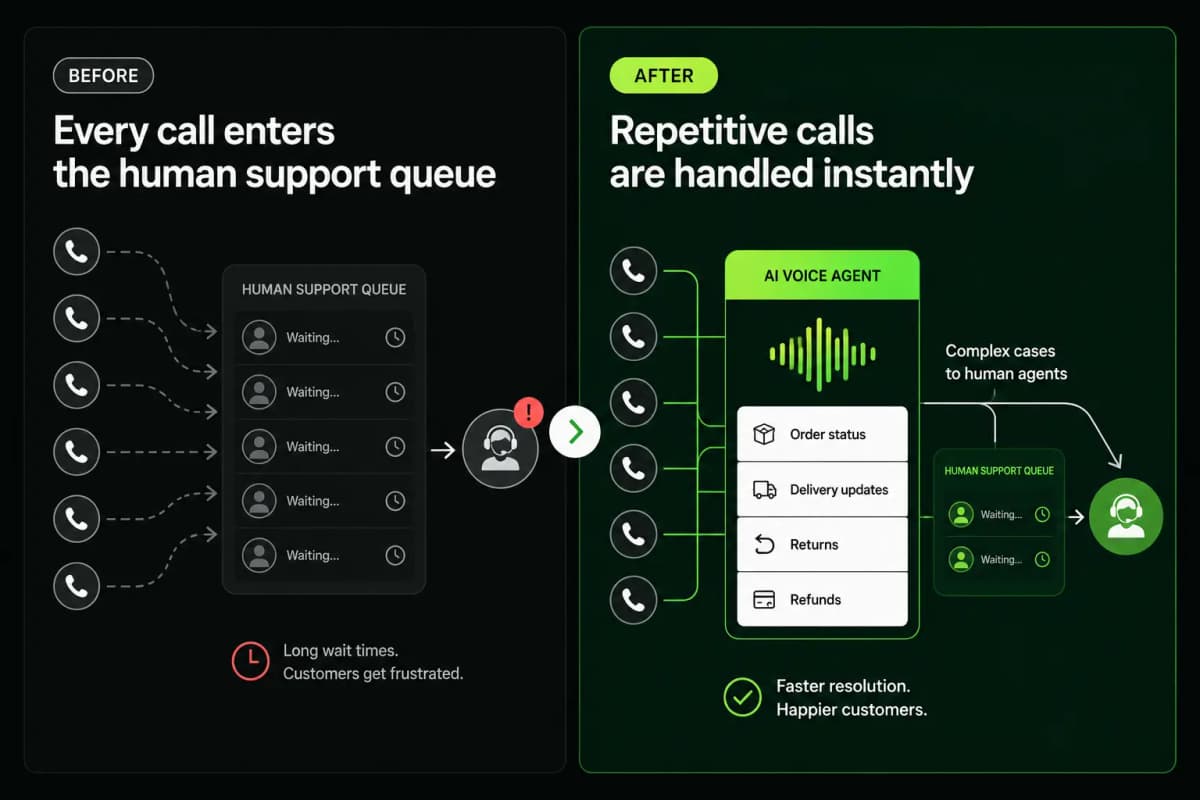
Most ecommerce brands try to reduce wait times after the queue is already full. A better approach is to stop repetitive calls from becoming queue items in the first place.
Faster agents help, but they are still limited by human capacity. Better routing helps, but it still assumes the customer has entered the queue.
The better approach is to handle simple, high-volume questions right away. Save the human queue for cases that require human judgment.
That is how ecommerce brands can improve customer support response time without only adding headcount.
AI voice agents for ecommerce fit into customer support by handling repetitive phone-based requests in real time.
AI voice agents can take calls right away. They also cut down wait times for common support questions.
This is especially helpful for:
Order status
Delivery updates
Return instructions
Refund status
Address changes
Basic product questions
Customers who call support often want reassurance. They do not only want a ticket number.
A strong AI voice agent should enable natural conversations. It must have low latency and support multilingual customers. Also, it should recognise local accents to ensure a clear and responsive experience.
Modern AI voice agents should do more than read from scripts.
They can:
Collect customer details
Check order context
Book follow-ups
Create tickets
Update CRM or helpdesk records
Escalate cases
Send post-call summaries
This makes customer support automation more useful because it reduces manual work after the call, not just during the call.
Post-call analytics help ecommerce teams understand why customers are contacting support. Teams can find repeated delivery complaints. They can also see refund problems and product confusion. Campaigns may cause spikes. Plus, there are common reasons for escalation.
That visibility helps improve support operations, not just answer more calls.
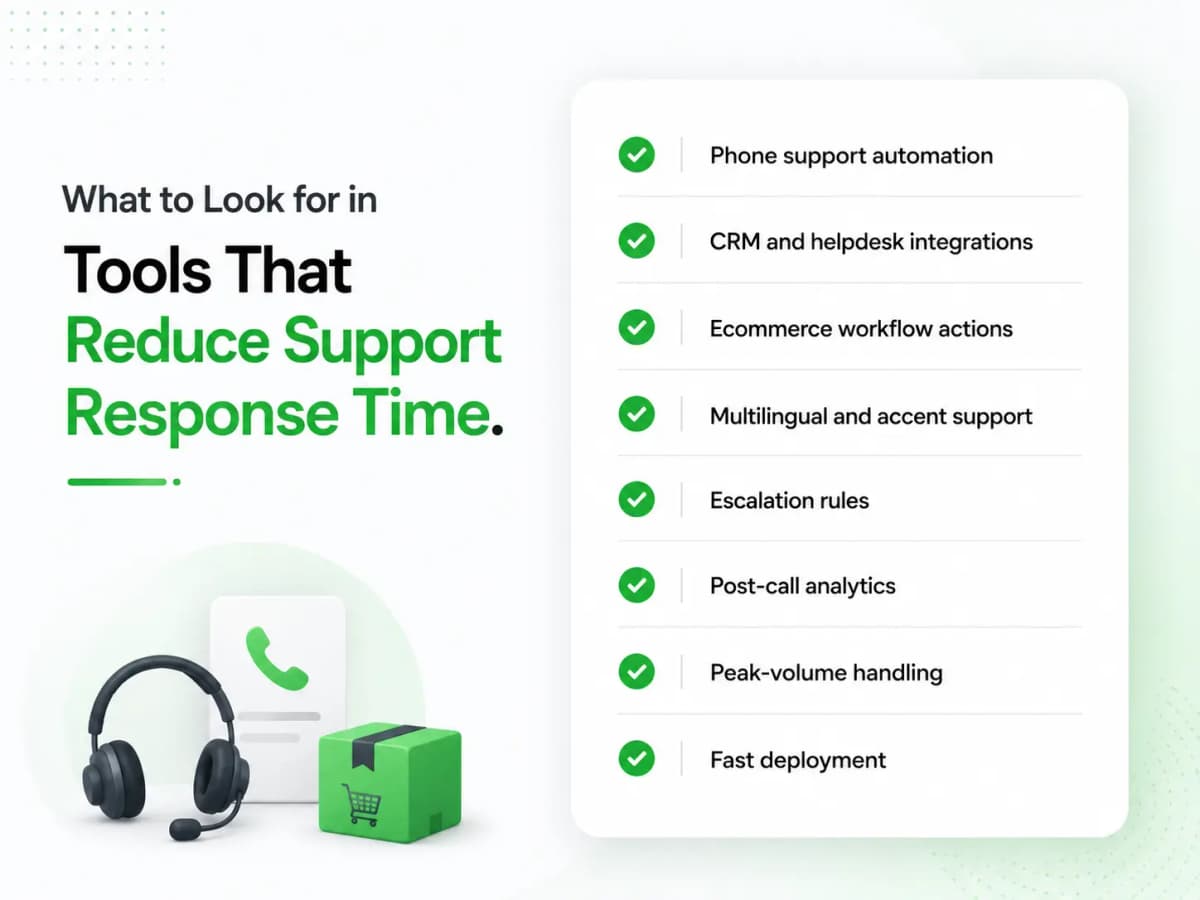
The best tools for cutting support response time help e-commerce teams manage real-time support volume. They do this without harming the customer experience.
Find tools that provide:
Phone support automation
CRM and helpdesk integrations
E-commerce workflow integrations
Multilingual and accent support
Escalation rules
Analytics
Peak-volume handling
Fast deployment
Inbound and outbound support workflows
The best tools for quicker responses should give customers useful answers right away. They shouldn’t just create another ticket.
You can compare options in our list of the best AI voice agents for ecommerce customer support.
Salesix AI helps ecommerce brands cut down customer support wait times. It does this by automating repetitive phone support chats.
Salesix helps with ecommerce customer service. It manages inbound and outbound workflows. This includes orders, deliveries, returns, refunds, and product questions. It also handles follow-ups, reminders, and customer service inquiries.
It allows human-like chats. Responses are quick. It supports multiple languages and recognises local accents. You can use workflow actions. It integrates with CRM and business tools. You can escalate to human agents. There are also post-call analytics.
This helps ecommerce teams respond to customers quickly. It eases pressure on support agents, manages call spikes during big sales, and lets human agents focus on cases needing empathy, judgment, or escalation.
Teams wanting a scalable model should visit the Salesix ecommerce customer support use case page. They can also read the ecommerce customer support playbook.
Reducing ecommerce support wait times requires more than faster replies, better routing, or more agents.
The sustainable path is to reduce customer support wait times before repetitive calls overload the queue. Ecommerce brands should automate common support questions. This speeds up first responses and keeps human agents for cases needing empathy, judgment, or escalation.
When phone support is quick, customers receive faster answers. This also gives agents more time for important tasks.
Ecommerce brands can cut customer support wait times by:
Automating repetitive calls.
Improving first response times.
Routing complex cases to agents.
Preparing workflows ahead of peak sales times.
Long customer service response times often happen for a few reasons. Repeated order status questions are one. Return and refund requests are another. Busy seasons also add to the delays. Manual processes slow things down, too. Plus, too many simple issues go to human agents.
A good average response time depends on the channel and urgency. For ecommerce phone support, customers usually expect a near-immediate answer, especially when the issue involves delivery, payment, refunds, or cancellations.
Yes. AI can cut customer support wait times. It answers repeated calls right away. It collects customer context. It starts workflows. It sends complex cases to human agents.
Brands can cut customer support wait times during big sales. They can do this by:
Forecasting call spikes
Automating answers to common questions
Preparing escalation paths
Updating delivery and refund messages
Using AI voice agents for peak call volume
These steps help manage support more efficiently.

Get $5 free credit on signup — no credit card required. Set up your AI voice agent in minutes and start converting more leads today.