Customer-Support
AI Voice Agents vs Human Support Agents for Ecommerce: Where Each Fits



Premium Humanoid AI Voice Agents for your business.
The debate around AI voice agents vs human support agents often starts with the wrong question: “Can AI replace human customer support?”
For ecommerce brands, the main question is: what support tasks can AI manage? Also, which conversations still need humans?
Most ecommerce support teams are not overwhelmed because every customer issue is complex. They feel overwhelmed because the same queue receives too many repetitive calls.
Customers call to ask about their orders and want to know if discounts were applied. Some ask when refunds will arrive. These are important questions, but many of them follow predictable workflows.
At the same time, ecommerce support agents still need human judgment. Angry customers, damaged products, refund issues, and failed deliveries are serious. VIP complaints and policy exceptions need attention, too. They shouldn’t be handled by the same blind automation.
That is why the best model is not AI-only or human-only. It’s an AI-first, human-escalated support model. AI voice agents for ecommerce take care of routine phone support.
Meanwhile, human agents handle conversations that need empathy, judgment, and decision-making.
In this post, you’ll see how AI voice agents and human support agents team up in ecommerce customer support. And also learn which tasks to automate and how to create a hybrid support model. This model ensures customers receive help while keeping the human touch.
AI voice agents for ecommerce perform best with conversations that are:
Repetitive
Predictable
High-volume
Linked to clear business rules
In ecommerce customer support, many phone calls fall into this category:
A customer asks about an order status.
Another wants a delivery update.
Someone else wants to know the return policy, refund timeline, store hours, warranty process, or whether support can call them back.
These calls matter, but they do not always need a human agent from the start.
An AI voice agent can:
Answer routine questions
Collect customer details
Identify the reason for the call
Check available context
Trigger follow-up workflows
Route the case when needed
This makes AI voice support especially useful for:
Order status calls
Delivery ETA questions
Return policy questions
Refund timeline updates
Frequently asked questions
After-hours customer calls
Support triage
Detail collection before escalation
Callback scheduling
Multilingual or region-based routing
The key advantage is consistency at scale. An AI voice agent can quickly answer common questions. This means customers won’t have to wait in line, and human agents won’t need to repeat the same script all day.
The best use of an AI voice agent customer support layer is as the first layer for routine phone support.
If you are comparing tools, this guide to the best AI voice agents for ecommerce customer support can help you evaluate your options.
Human support agents are important. They help with empathy, judgment, negotiation, and exceptions.
Ecommerce support is not only about answering questions. Sometimes a customer is upset because an expensive product arrived damaged. A refund can be delayed, and the customer may have contacted support several times, etc.
These situations need more than a correct answer. They need tone, patience, discretion, and the ability to make judgment calls.
Human agents are better suited for:
Angry or emotionally charged customers
Damaged or missing product complaints
Refund disputes
Complex return requests
VIP customer issues
High-value order problems
Fraud-sensitive cases
Policy exceptions
Repeated complaints
Customer recovery conversations
The point is not to remove humans from ecommerce customer support. The point is to stop using skilled human agents for repetitive work that does not need human judgment.
When AI takes care of predictable calls, human agents can focus more on conversations that truly matter.
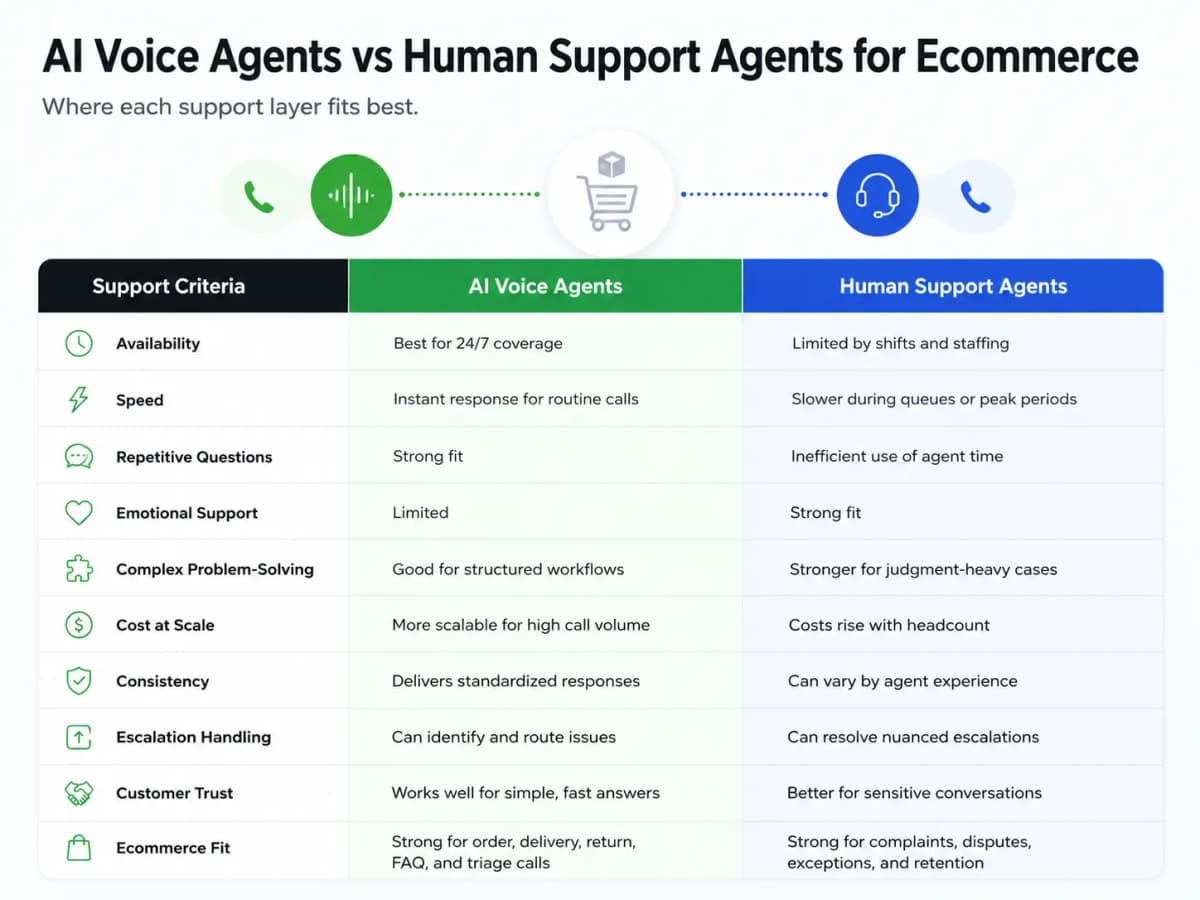
The goal is not to declare one winner. The goal is to design the support model around what each layer does best.
AI agents should handle routine speed and scale. Human agents should handle complexity, emotion, and sensitive outcomes.
Human-only support can struggle. Calls are put into one queue, regardless of their urgency or complexity. This leads to issues in handling different needs effectively.For a deeper look at queue pressure, see our guide on how to reduce customer support wait times in ecommerce.
For example, A simple “Where is my order?” call may wait behind a refund dispute. Or, A customer asking about return eligibility may sit in the same queue as someone reporting a damaged product.
This creates several problems:
Long wait times for simple questions
Burnout from repetitive call handling
Rising support costs as volume grows
Missed after-hours calls
Delays for complex cases
Poor visibility into recurring issues
Inconsistent customer experience during sales or peak seasons
The issue is not that human agents are ineffective. The issue is that human agents are being asked to handle every type of call with the same process.
As ecommerce order volume grows, support demand grows with it. Without automation, brands usually hire more agents. They may stretch their teams or accept slower response times.
None of these solves the root problem: too much repetitive support work is still flowing to humans.
If your team is reaching this point, read our guide on how to scale ecommerce customer support without adding more agents.
A balanced comparison of AI support agents vs human agents also has to acknowledge the limits of automation.
AI-only support can fail when brands automate the wrong conversations or do not create clear escalation paths. Customers do not want to feel trapped in automation when their issue is urgent, emotional, or unusual.
AI voice agents can become frustrating when they are used for:
Angry customer complaints
Non-standard refund requests
Repeated failed delivery issues
Complex return exceptions
Fraud-sensitive situations
Missing or conflicting customer context
High-value customer recovery
Cases where policy flexibility is needed
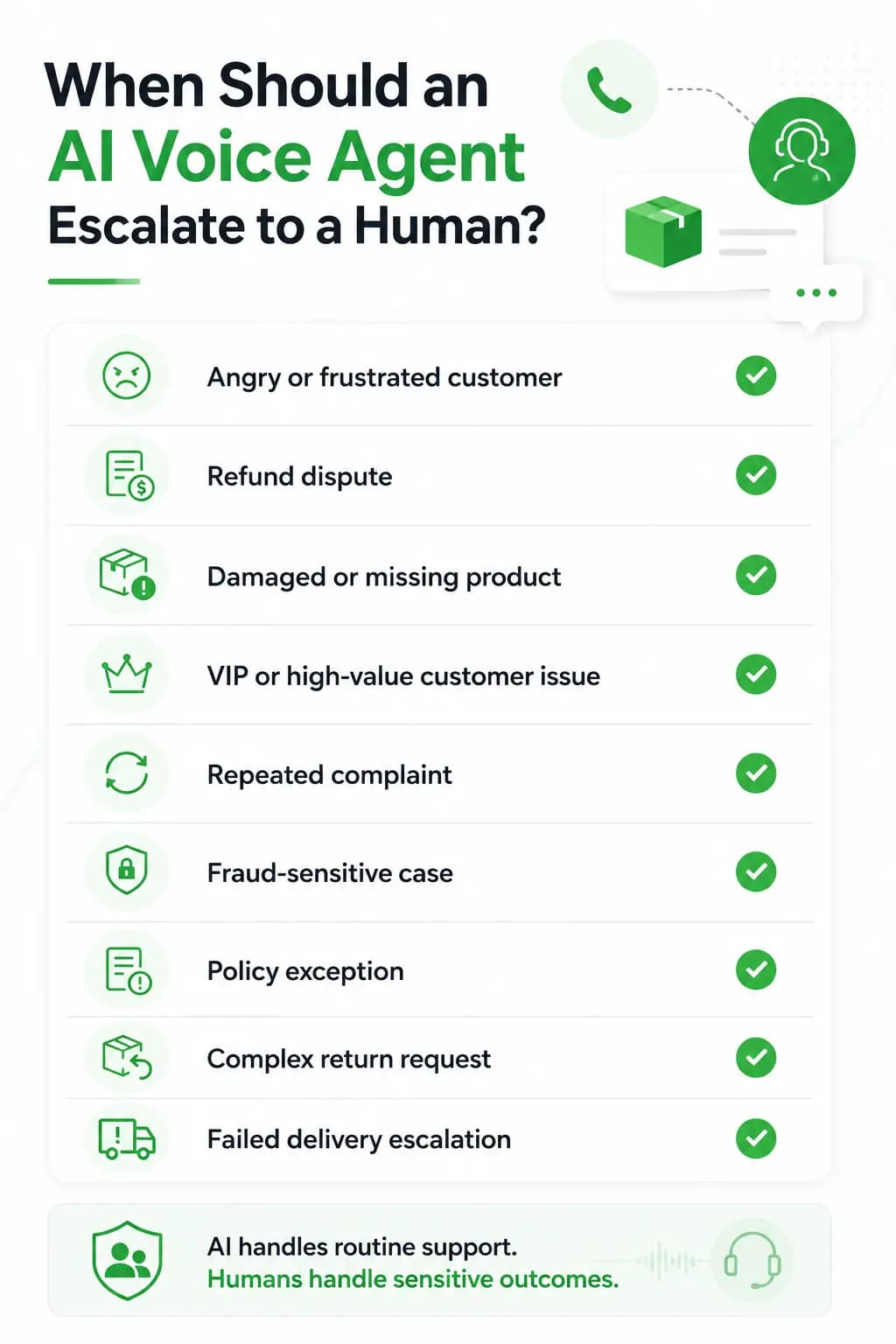
The goal is not to remove humans. The goal is to stop using humans for support tasks that are predictable, repetitive, and workflow-driven.
The strongest ecommerce support model is AI-first and human-escalated.
In this model, the AI voice agent answers first:
It finds out why the customer is calling.
It answers common questions. It gathers key details.
It checks context when possible. It starts workflows.
It also records the outcome.
If the call is complex, sensitive, or risky, it escalates to a human agent with the context already captured.
This changes the role of the human support team.
Instead of starting every call from zero, human agents receive a clearer picture:
who the customer is
what they need
what has already been asked
why the issue needs human review
A hybrid customer support model works because it separates support by task type:
AI handles speed, coverage, consistency, and routine workflows.
McKinsey also frames the future of contact centers around finding the right mix of humans and AI, where AI supports scale while people remain important for higher-value service moments.
Humans handle judgment, empathy, exception handling, and customer recovery.
That is the practical middle ground between full manual support and over-automation.
A useful support model starts with task ownership. Ecommerce brands should decide which conversations can be automated, which should stay human-owned, and which should begin with AI but escalate when risk appears.
AI voice agents are a strong fit for predictable, high-volume customer support calls such as:
“Where is my order?” calls
Delivery ETA questions
Return policy questions
Refund status updates
After-hours FAQs
Support triage
Callback scheduling
Basic product or policy questions
Routine order and delivery-related inquiries
These calls usually follow a defined path. Customers want a fast answer, and the business needs a consistent process.
Human agents should own sensitive, complex, or emotionally charged conversations, such as:
Refund disputes
Damaged product complaints
Angry customer calls
VIP customer issues
Repeated failed delivery complaints
Complex return exceptions
High-value order problems
Customer retention conversations
These calls can affect trust, repeat purchase behavior, and brand perception. They deserve human attention.
Some conversations sit in the middle. AI can collect details and start the workflow, but escalation should happen if the case becomes risky.
Examples include:
Address correction before dispatch
Return or refund edge cases
Delivery issue investigation
Payment-related confusion
Repeated customer complaints
Suspected fraud or suspicious order activity
The key takeaway is simple: AI should own predictable conversations. Humans should own sensitive outcomes.
Salesix AI, a platform for ecommerce customer support, fits into the AI-first, human-escalated model. It handles repetitive phone tasks, so human agents can focus on complex cases.
Salesix helps ecommerce brands with AI voice support. It handles common customer calls, order questions, and delivery updates, etc.
It can reduce manual work, answer common phone questions, route complex cases, and sync customer and order details, etc.
This lets the support operation grow without making the brand pick between automation and human service.
The Customer Support Playbook helps teams create a clear support workflow. It shows how to set up AI voice agents for 24/7 support, solve routine issues, and escalate to humans when needed.
The comparison between AI voice agents vs human support agents should not end with one replacing the other.
AI voice agents are better for repetitive calls, instant responses, 24/7 availability, high-volume support, standard workflows, basic triage, and routine ecommerce questions.
Human support agents are best for complex cases, emotional support, handling exceptions, managing complaints, and resolving refund disputes. They help with customer recovery and build strong relationships.
The best ecommerce support teams will not replace every human with AI. They will redesign support. AI will take care of repetitive phone tasks, while humans will focus on conversations that truly need their attention.

Get $5 free credit on signup — no credit card required. Set up your AI voice agent in minutes and start converting more leads today.