Customer-Feedback
What Is Voice of Customer in Ecommerce and Why Does It Matter After Purchase?



Premium Humanoid AI Voice Agents for your business.
Ecommerce brands often believe they understand their customers because they track reviews, star ratings, support tickets, return reasons, and repeat purchases.
Those signals are useful, but they do not always explain the full customer story.
A five-star review may not reveal why the customer was happy. A repeat purchase may suggest satisfaction, but it may not explain what convinced the customer to come back. This is where Voice of Customer becomes important.
Reviews, ratings, and surveys are part of the voice of the customer, but they are not the whole picture. A strong voice of the customer program helps ecommerce teams turn scattered customer feedback into a better customer experience.
In this post, you will learn what Voice of Customer means in ecommerce and why it becomes especially important after a customer completes a purchase. Let’s dive in.
What Is Voice of Customer?
Voice of Customer, also known as VoC, is the process of collecting, analyzing, and acting on customer feedback, opinions, expectations, and experience signals.
In simple words, Voice of Customer helps a business understand what customers are really saying about their experience.
For ecommerce brands, the voice of customer means understanding the full customer experience from the customer’s point of view.
That experience does not start and end with checkout. It includes product discovery, product page expectations, pricing, checkout, order confirmation, delivery updates, packaging, product quality, product usage, support, returns, exchanges, feedback, reviews, and repeat purchase decisions.
Customer voice appears across many touchpoints, including:
Product reviews
Star ratings
Post-purchase surveys
Support tickets
Customer calls
Chat transcripts
Return reasons
Delivery complaints
Social media comments
Community feedback
Repeat purchase behavior
Cancellation or churn signals
The challenge is that ecommerce teams often look at these signals separately. Like, Support teams see complaints. Product teams see product issues. Marketing teams see reviews. Operations teams see delivery failures. Retention teams see repeat purchase behavior.
But customers do not experience the brand in separate departments. They experience one journey.
A good voice of customer program connects these signals so the brand can understand the customer story behind each order.
Voice of Customer matters after purchase because this is when customer expectations meet reality.
Before purchase, customers are evaluating product photos, descriptions, reviews, shipping promises, return policies, and brand messaging. After purchase, they discover whether those promises were accurate.
This post-purchase stage reveals some of the most useful customer experience feedback because customers can now judge the actual experience.
They can tell you:
Whether the product matched expectations
Whether delivery was clear and reliable
Whether packaging felt premium, safe, or disappointing
Whether instructions were easy to follow
Whether support was helpful
Whether the return or exchange process was simple
Whether they would buy again
Whether they are willing to leave a review
For ecommerce brands, the customer feedback after purchase is valuable because it connects customer sentiment to operational reality.
A customer may not complain publicly, but they may still feel disappointed. Another customer may love the product but feel confused by delivery communication.
Post-purchase feedback helps brands catch these insights before they become negative reviews, repeat support tickets, lost repeat purchases, or silent churn.
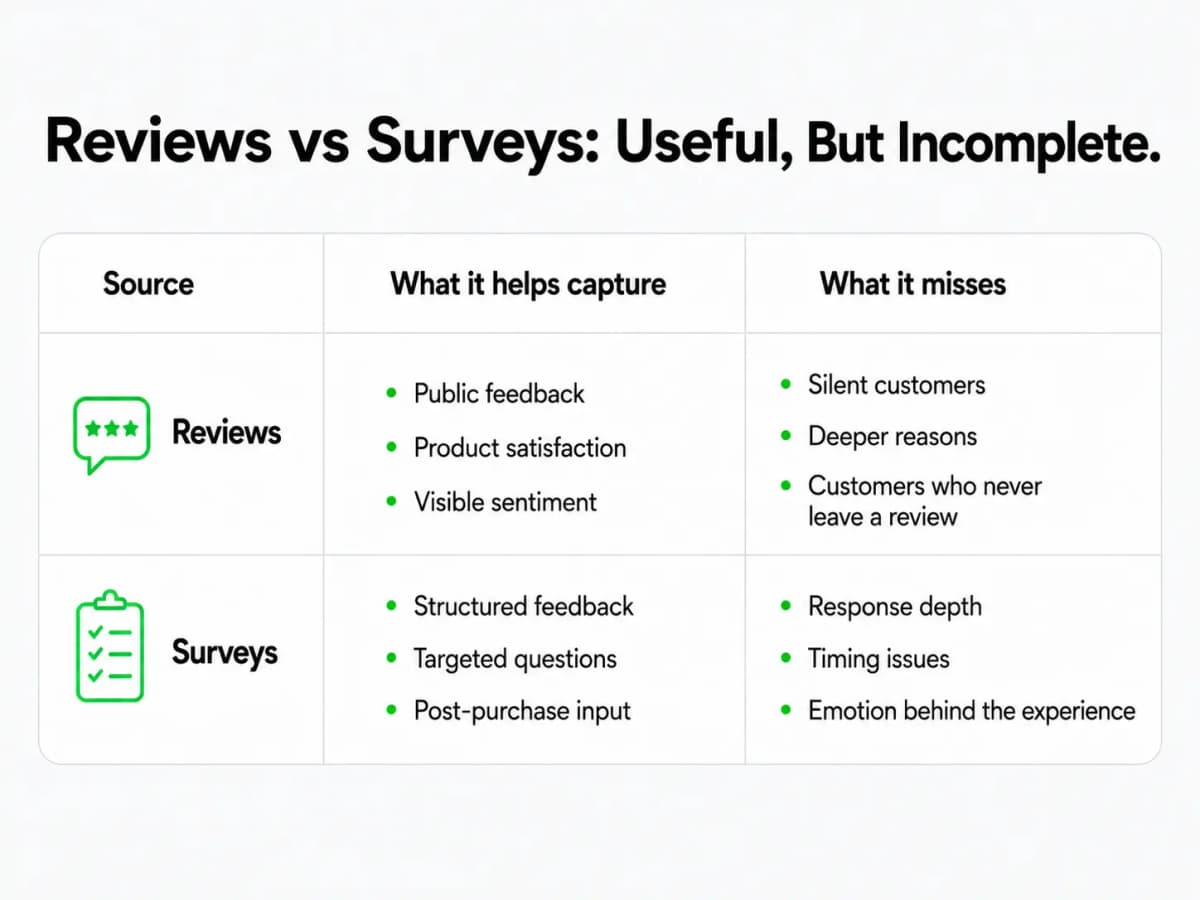
Reviews and surveys are useful, but they do not show the full voice of the customer.
A review tells you what a customer decided to share publicly. A survey tells you what a customer was willing to answer in a form. Both are valuable, but both have limits.
Customer reviews are still a powerful trust signal in ecommerce, with PowerReviews research showing that review volume and recency impact purchase behavior across ecommerce product pages.
Surveys also depend on timing and effort. If the customer receives the survey too early, they may not have used the product yet. If it comes too late, the emotion behind the experience may be gone. If the form is too long, customers may ignore it.
Reviews and surveys often miss several things:
Silent customers who had an average or disappointing experience
The emotional reason behind a rating
Delivery issues that affected trust
Product-use confusion after delivery
Customers who need support before they are asked for a review
Customers who are satisfied but never leave public feedback
The difference between a product problem and a communication problem
This is why customer feedback and management is important for e-commerce growth because e-commerce brands need a feedback loop that captures both structured signals and deeper customer context.
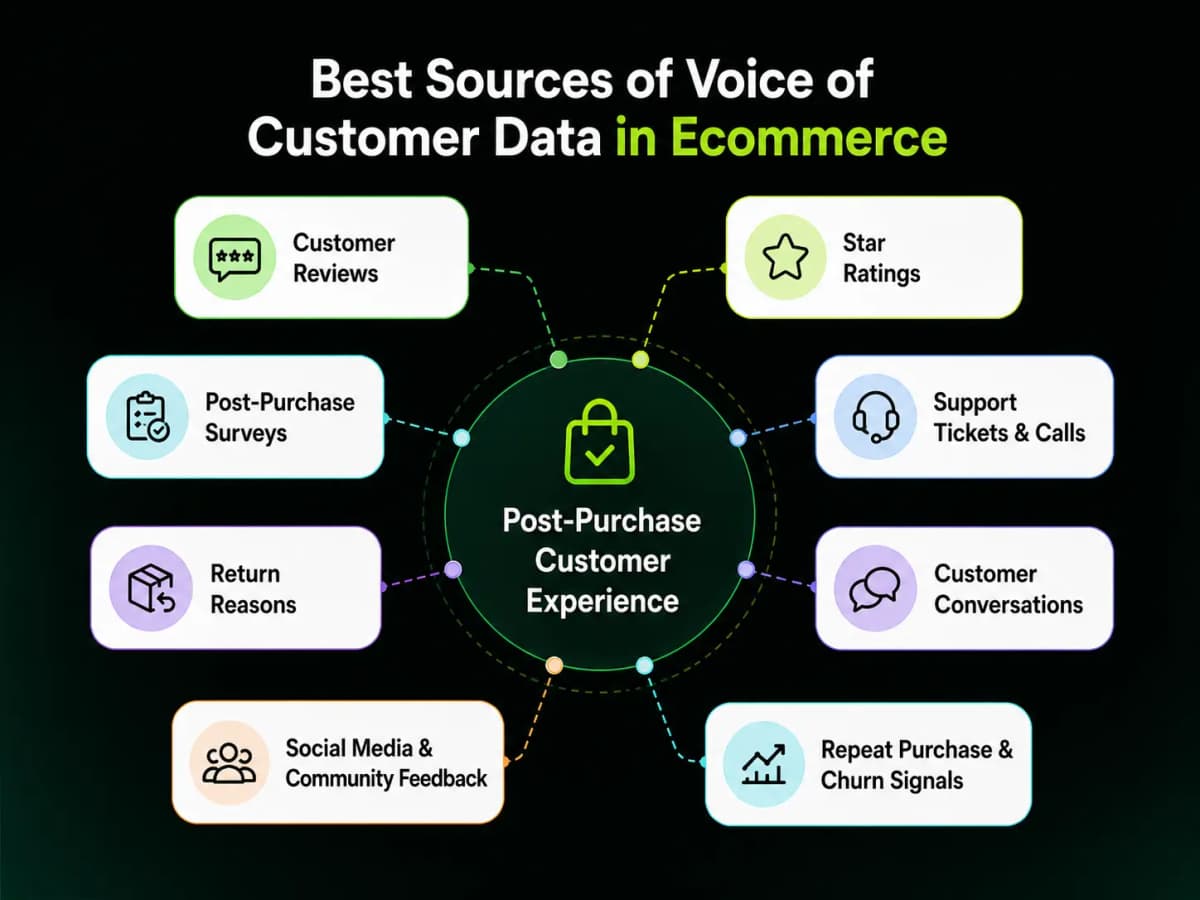
Ecommerce brands can collect Voice of Customer data from several sources. The strongest programs combine multiple signals instead of relying on one channel.
Customer reviews show public customer sentiment. They are useful for understanding product satisfaction, trust signals, objections, and common complaints.
However, reviews are often selective. They usually represent the customers who were motivated enough to leave feedback.
Star ratings makes easy to capture the satisfaction of customers. They help brands spot patterns across products, categories, and order experiences.
The weakness is that ratings often lack context. A three-star rating may be caused by product quality, delivery delay, wrong expectations, packaging, or poor support.
Post-purchase surveys help brands ask targeted questions after delivery. They can capture satisfaction, product fit, delivery experience, support quality, and repeat purchase intent.
They work best when they are short, timely, and connected to clear workflows.
Support tickets and customer calls reveal friction that customers could not solve by their own. These are strong VoC signals because they show where the customer journey breaks.
They can reveal recurring issues around delivery, returns, refunds, exchanges, product usage, and communication gaps.
Return reasons help brands understand why customers send products back. They can show issues with size, fit, product descriptions, damaged items, incorrect expectations, or fulfillment errors.
But return reasons are often too generic unless teams ask follow-up questions.
Customer conversations are one of the richest sources of voice of customer data. Unlike static forms, conversations can reveal emotion, urgency, confusion, objections, and intent.
This is especially useful after purchase, when brands need to understand not just what happened, but why the customer feels a certain way.
Social comments, tagged posts, community discussions, and direct messages can reveal how customers talk about the brand in their own words.
These signals are useful, but they can be scattered and hard to connect to specific orders or workflows.
Behavioral data also contributes to voice of customer analysis. Repeat purchases, delayed reorders, cancellations, and churn patterns show what customers do after the experience.
The key is to connect behavior with feedback so teams can understand the reason behind the action.
Voice of customer analysis turns customer feedback into useful business insight.Instead of simply collecting comments, the brand looks for patterns, causes, and actions.
For ecommerce teams, voice of customer analysis can reveal:
A customer may be happy because delivery was fast, the product matched expectations, packaging felt premium, or support solved an issue quickly.
A customer may be dissatisfied because the product looked different from the photos, delivery communication was unclear, sizing was inaccurate, or the return process felt slow.
VoC analysis helps teams understand the reason behind satisfaction, not just the score.
Customer feedback often exposes expectation gaps.
If customers repeatedly mention size, material, fit, setup, color, etc, the product page may not be setting clear expectations.
This feedback can help product and merchandising teams improve product descriptions, images, FAQs, comparison tables, and buying guidance.
Returns are not always caused by product failure. Sometimes they happen because customers misunderstood the product, ordered the wrong variant, missed delivery instructions, or did not receive enough support after purchase.
Voice of customer analysis helps identify preventable return reasons.
Delivery problems do not only affect logistics. They affect customer confidence.
Customers may forgive a delay if communication is clear. But vague updates, missed delivery, failed delivery attempts, or silence after dispatch can damage trust quickly.
Post-purchase customer experience feedback helps ecommerce brands see where communication needs to improve.
Customers compare the experience with the promise they believed before purchase.
VoC data helps brands understand whether ads, product pages, influencer content, reviews, and support conversations created expectations that the product or process did not fulfill.
A customer may like the product but hesitate to buy again because of delivery uncertainty, difficult returns, unclear sizing, poor support, or lack of confidence in the next order.
Voice of Customer helps retention teams understand what blocks repeat purchase intent.
Not every customer should be asked for a public review at the same moment.
A strong feedback loop can identify happy customers who are review-ready and route dissatisfied customers into support or recovery workflows first.
This improves the review request experience and reduces the risk of pushing unhappy customers toward public complaints.
Many ecommerce brands collect feedback, but still struggle to act on it.The problem is not always a lack of data. It is usually a lack of connected workflows.
Surveys, reviews, and tickets often create more data than teams can process. If no one owns the next step, feedback becomes a dashboard instead of a decision-making tool.
A voice of customer program should define what happens after feedback is received.
Reviews may live on one platform. Support tickets in another. Return reasons in another. Surveys in another. Customer calls somewhere else.
When feedback is fragmented, teams struggle to see the full customer story.
Dashboards show what customers said. Workflows decide what the business does next.
For example, a low satisfaction score should not only appear in a report. It should trigger a support follow-up, issue category, product insight, or retention action.
Many brands treat reviews and support separately. But they are closely connected.
A negative review may be the final public version of an unresolved support issue. A positive review may come from a customer who had a problem but received excellent recovery.
Connecting reviews with support context gives teams a clearer picture.
Product feedback should reach product or merchandising teams. Delivery feedback should reach operations. Support complaints should reach CX leaders. Review-ready customers should reach marketing or review collection workflows.
If all feedback stays inside one tool or team, the business loses the value of customer insight.
A better ecommerce feedback loop helps brands capture feedback, understand it, route it, and act on it.
Here is a practical framework.
Do not limit customer feedback to one survey or review request.
Capture signals from product reviews, post-purchase surveys, support tickets, calls, chats, returns, delivery issues, and customer conversations.
This gives the brand a more complete view of ecommerce customer experience.
A score is not enough.
If a customer gives a low rating, ask why. If they return a product, understand the reason. If they contact support, identify the root cause. If they are happy, learn what created that satisfaction.
The goal is to understand the customer story behind the signal.
Not all feedback requires the same action.
Group feedback into categories such as product quality, product expectation, delivery issue, packaging issue, support issue, return friction, review opportunity, repeat purchase risk, or urgent recovery need.
This makes feedback easier to route and act on.
Customer feedback should trigger action.
Examples:
Dissatisfied customers go to support recovery.
Delivery complaints go to operations or delivery coordination.
Product-page confusion goes to merchandising or product content.
Happy customers go to the review collection.
Repeat purchase objections go to retention workflows.
Return-related feedback goes to return coordination.
This is where customer feedback management becomes operational, not just analytical.
Customers are more likely to trust a brand when they feel heard.
Closing the loop means following up when needed, resolving issues, explaining next steps, and showing customers that their feedback mattered.
This is especially important after purchase, when dissatisfaction can still be recovered before it becomes a lost customer or negative review.
Many ecommerce VoC programs rely heavily on passive feedback channels.
They send forms. They collect ratings. They monitor dashboards. They review tickets. They read reviews.
These methods are useful, but they often wait for customers to take action.
Post-purchase conversations add a more active layer.
A conversation can ask the customer how the experience went, understand the reason behind their response, detect whether they need help, identify whether they are ready to leave a review, and route the next step based on what they say.
This matters because customers do not always express their experience clearly in forms.
A customer might say, “It was fine,” but a follow-up question may reveal that delivery was confusing. Post-purchase conversations help ecommerce brands hear the customer voice in a more natural way.
They are especially valuable for:
Understanding satisfaction after delivery
Finding hidden product or delivery issues
Recovering unhappy customers before review requests
Identifying customers who are ready to leave public reviews
Capturing richer customer experience feedback
Turning unstructured conversations into useful VoC insights
For growing ecommerce brands, this is often the missing layer between passive feedback collection and truly actionable customer understanding.
AI voice agents for ecommerce can help brands capture better customer voice by running scalable, human-like post-purchase feedback conversations.
Instead of relying only on email surveys or review request flows, AI voice agents can call customers after key moments in the journey, such as after delivery, after product usage, after a return request, etc, and collect the feedback & review.
A platform like Salesix AI can help ecommerce brands utilize AI voice agents to collect richer feedback and integrate it with workflows.
For example, an AI voice agent can:
Ask how the customer’s order experience went
Ask follow-up questions based on the customer’s answer
Capture satisfaction or dissatisfaction
Detect delivery, product, support, or return issues
Identify whether the customer needs help
Route unhappy customers into recovery workflows
Identify happy customers who may be ready to leave a review
Turn conversations into structured customer insights
Help teams understand recurring feedback themes
This does not replace reviews, surveys, or support teams. It adds a conversational feedback layer that helps ecommerce brands capture the “why” behind customer experience.
AI voice agents for ecommerce can make Voice of Customer more active, not just more automated.
Voice of Customer helps ecommerce brands understand what customers actually experience after purchase.
Reviews, surveys, ratings, support tickets, and return reasons are all useful signals. But on their own, they often miss the deeper context behind satisfaction, frustration, repeat purchase intent, and customer trust.
The strongest ecommerce Voice of Customer programs connect feedback to action. They capture signals across the journey, understand the reason behind each response, route insights to the right team, and close the loop with customers.
For ecommerce brands, the post-purchase stage is one of the most important places to build this feedback loop. It is where customers find out whether the product, delivery, support, and brand promise matched their expectations.
And it is where brands can learn what to fix, what to repeat, who needs help, and who is ready to become a public advocate.

Get $5 free credit on signup — no credit card required. Set up your AI voice agent in minutes and start converting more leads today.