Return-Coordination
Ecommerce Return Policy Best Practices (2026) That Reduce Support Tickets



Premium Humanoid AI Voice Agents for your business.
Returns are not only a logistics problem. For ecommerce brands, they are also a communication problem.
A customer may understand that your store accepts returns, but still ask:
Is my item eligible?
When will I get my refund?
Who pays for shipping?
Can I exchange instead?
What happens after I submit the request?
When those answers are unclear, customers do not wait quietly. They contact support.
That is why a strong ecommerce return policy should do more than list rules. It should reduce confusion, set expectations, guide customers through the next step, and prevent repetitive support tickets before they reach your team.
For growing ecommerce brands, the next layer is even more important: turning the return policy from a static page into a guided return coordination workflow.
In this post, you’ll learn how to write an ecommerce return policy that reduces customer confusion, answers common return questions, and prevents repetitive support tickets.
What Is an Ecommerce Return Policy?
An ecommerce return policy is a set of rules that explains how customers can return products purchased from an online store.
A good ecommerce return policy usually explains:
Which items can be returned
Which items cannot be returned
How long customers have to start a return
What condition the product must be in
Whether customers can get a refund, exchange, or store credit
Who pays for return shipping
How long refunds take
What steps customers need to follow
A return policy is not the same as a refund policy, exchange policy, or return process.
A refund policy explains when and how customers get their money back and a exchange policy explains how customers can replace one product with another.
The ecommerce return policy sits at the front of all of this. It tells customers what is allowed and what they should expect.
Return policies create support tickets when customers cannot quickly understand what they have to do in their specific situation.
Many ecommerce business returns customer policy pages are only static rule pages. They may technically include the right information, but they often fail to answer the customer’s immediate question clearly.
For example, a policy might say:
“Refunds are processed after returned items are received and inspected.”
That sounds clear to the business. But to the customer, it raises more questions:
How long does return shipping take?
How long does inspection take?
When will the refund appear in my account?
Will I get a refund notification?
What happens if the pickup fails?
Can I exchange the item instead?
This is where return-related support volume grows. Customers are not always asking because the policy is missing. They are asking because the policy is not specific enough, not visible enough, or not connected to the actual return journey.
For a broader look at this operational problem, see how better return coordination can help ecommerce brands reduce preventable returns before they become support-heavy workflows.
Customers do not read return policies like legal documents. They read them to get the answer to a few practical questions.
The most important questions are:
Can I return this item?
How many days do I have?
Who pays for return shipping?
When will I get my refund?
Can I exchange instead?
What happens after I submit the return?
This is where many policies fail. Customers need to know what happens next: confirmation, pickup or drop-off instructions, inspection, refund approval, exchange processing, and status updates.
The best ecommerce return policy best practices focus on clarity, visibility, and actionability. The goal is not only to protect the business. The goal is to help customers complete the return without needing support.
Return eligibility should be one of the clearest parts of the policy.
Instead of writing broad statements like “products must be eligible for return,” explain eligibility by product type, condition, and timing.
A better structure is:
Returnable items
Non-returnable items
Conditional returns
Damaged or defective items
Final sale items
Gift returns
This helps customers quickly understand whether they should start a return request or contact support for an exception.
For example, apparel brands may need to clarify tags, wear condition, and hygiene rules. Electronics brands may need to clarify packaging, accessories, and warranty cases.
The more specific the eligibility rules, the fewer “Can I return this?” tickets your support team receives.
Refund timelines are one of the biggest causes of return-related support tickets.
A static written policy says:
“Refunds may take several business days.”
A stronger policy explains the full timeline:
Return request is submitted
Product is picked up or dropped off
Product reaches the warehouse
Product is inspected
Refund is approved
Refund is issued to the original payment method
Bank or payment provider processing time may apply
Customers are more patient when they know where they are in the process. And they become frustrated when the timeline feels invisible.
Your ecommerce return policy should explain both the business-side timeline and the payment-side timeline.
This prevents customers from asking for updates too early and gives support teams a clear reference point when customers do reach out.
Customers should not need to guess how to manage returns.
A strong policy explains the return management process in simple steps:
Start a return request.
Enter order details.
Select the return reason.
Choose refund, exchange, or store credit if available.
Confirm pickup or drop-off details.
Pack the item according to instructions.
Wait for inspection and approval.
Receive refund, exchange, or store credit update.
This step-by-step format reduces confusion because customers can see what they need to do and what the business will do next.
It also helps prevent incomplete return requests. If customers know they need order number, product condition details, photos, invoice, or packaging, they are less likely to submit unclear requests that require back-and-forth.
Return shipping is also the area where often the policy clarity breaks down.
Your ecommerce return policy should clearly answer:
Is return shipping free?
Does the customer pay for return shipping?
Is the cost deducted from the refund?
Are exchanges treated differently from refunds?
Are damaged or incorrect items handled differently?
Is pickup available?
Is drop-off available?
What happens if a pickup attempt fails?
This section should be written in practical language. Avoid hiding shipping costs in long paragraphs. Use direct statements and examples when needed.
For example:
“Return shipping is free for damaged, defective, or incorrect items. For size or preference-based returns, a return shipping fee may be deducted from the refund.”
That kind of clarity prevents customers from contacting support after seeing a lower-than-expected refund amount.
Refunds, exchanges, and store credit should not be blended into one confusing section.
Each option answers a different customer need:
Refunds are for customers who want their money back.
Exchanges are for customers who still want the product but need a different option.
Store credit is for customers who may want to buy something else later.
Separating these options helps customers choose the best path without needing support.
This matters because ecommerce returns policy impact on orders goes beyond refund cost. It affects customer retention, inventory flow, support workload, and repeat purchase behavior.
That’s why it is especially important for brands trying to convert more ecommerce returns into exchanges instead of defaulting every return to a refund.
Exceptions should not be hidden behind in a fine print.
Customers often contact support when their case does not fit the standard policy. Examples include:
Return window just expired
Item arrived damaged
Wrong item was delivered
Pickup failed
Exchange item is out of stock
Refund has not appeared
Customer no longer has original packaging
Partial order return
Promotional bundle return
A good ecommerce return policy does not need to approve every exception automatically. But it should explain how exceptions are handled and when customers should contact support.
This helps support teams because customers arrive with better context. It also prevents customers from feeling that the policy is rigid or unclear.
Return policies need to protect the business, but they should still be easy for customers to understand.
Legal-heavy copy creates friction. Customers skim it, misunderstand it, or ignore it completely. Then they contact support.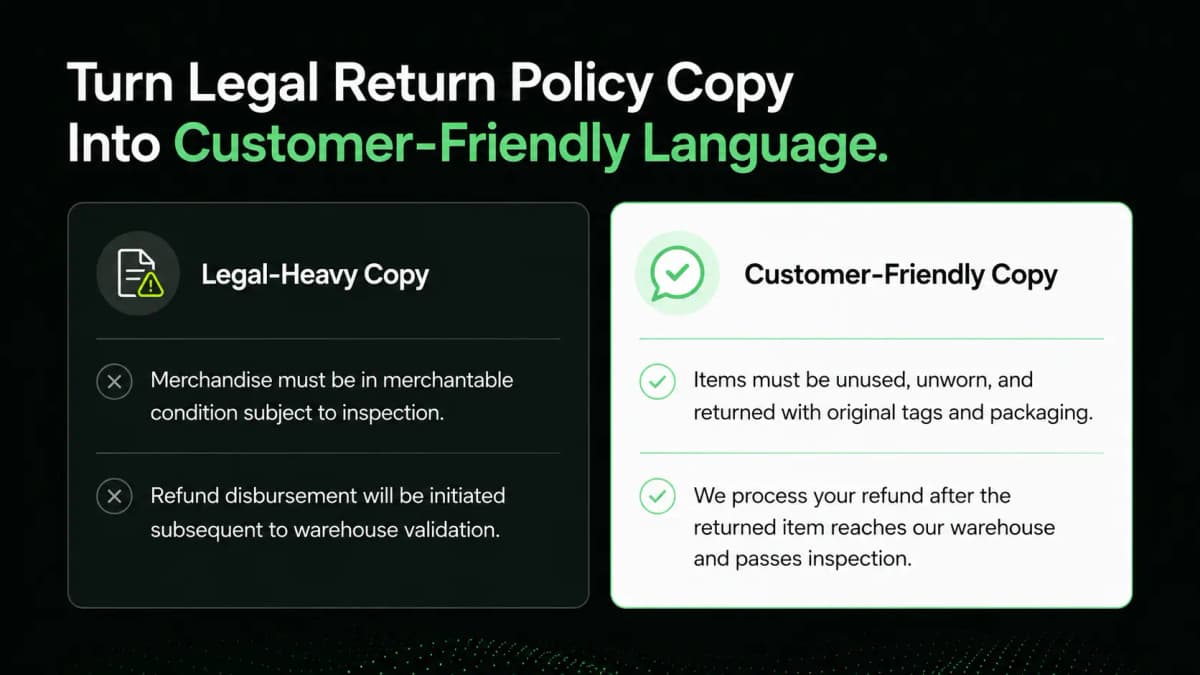
Simple language reduces support tickets because it reduces interpretation.
Your return FAQs should not be generic. They should be built from the questions your customers already ask.
Useful return FAQ topics include:
Can I return a sale item?
When does the return window start?
Can I exchange for a different size?
What if my pickup is missed?
Why is my refund amount lower than expected?
Can I return only one item from a bundle?
What if my item arrived damaged?
How do I track my return status?
When FAQs reflect real support tickets, they become a support deflection tool. They also help answer-engine visibility because the policy page contains direct answers to customer questions.
A clear ecommerce return policy reduces confusion, but it does not eliminate every return-related support ticket.
That is because many return questions are customer-specific.
For example:
A pickup failed and the customer needs another attempt.
A refund is delayed because the item has not passed inspection.
The customer wants an exchange, but the replacement is out of stock.
The return window has passed by one day.
The item was returned without required packaging.
The customer selected refund but now wants store credit.
The customer submitted incomplete return details.
A static policy cannot fully resolve these cases because it does not interact with the customer. It cannot ask a follow-up question, confirm intent, explain the next step, or update internal systems.
This is why growing ecommerce brands need more than a better policy page. They need better return coordination.
Most ecommerce teams try to reduce return-related tickets through manual support, email updates, chatbots, and self-service portals. Each method helps, but each has limits.
Manual support is flexible but hard to scale. Human agents can explain policies well, but they become overloaded when every customer asks similar return questions. For scaling brands, this is where manual return management starts to break because every unclear policy question becomes another support task.
Email updates are useful but often ignored, missed, or misunderstood. Customers may not read long email threads, especially when they want a fast answer about refund status or pickup instructions.
Chatbots can answer basic questions, but they often struggle with customer-specific return situations. If the customer needs clarification, reassurance, or exception handling, the experience can become frustrating.
Self-service portals help customers submit return requests, but they do not always reduce communication workload. Customers may still contact support after using the portal because they do not understand refund timing, pickup status, exchange availability, or policy exceptions.
These methods fail when they treat returns as a form submission problem. In reality, returns are a coordination problem.
This reflects a broader ecommerce UX principle: brands should minimize the need for customer service by designing clearer journeys that help customers complete tasks without extra support.”
The better approach is to make your return policy actionable.
Instead of expecting customers to read a static page and figure out the next step, brands can guide customers through the return journey.
A guided return coordination workflow helps customers:
Confirm whether the item is eligible
Share the return reason
Choose refund, exchange, or store credit
Confirm pickup or drop-off details
Understand refund timelines
Receive proactive status updates
Resolve exceptions before they become tickets
Escalate complex cases to a human agent when needed
This makes the policy part of the operating workflow, not just a page on the website.
For ecommerce operators, the benefit is simple: fewer repetitive tickets, clearer customer expectations, better return data, and less manual follow-up.
For customers, the benefit is also simple: they know what is happening and what to do next.
AI voice agents for ecommerce can help brands in reducing return policy support tickets by turning return communication into proactive, human-like conversations.
Instead of waiting for customers to submit tickets, an AI voice agent can call customers or respond to return-related calls to clarify key details.
For example, AI voice agent can support return coordination by helping customers:
Understand whether their item is eligible for return
Confirm order and return details
Explain refund timelines in simple language
Capture whether the customer prefers a refund, exchange, or store credit
Coordinate pickup instructions
Follow up after failed pickup attempts
Answer common return policy questions
Update CRM, helpdesk, or business tools after the call
Escalate complex or sensitive cases to human support
This does not replace the ecommerce return policy. It makes the policy easier to act on.
The policy still defines the rules. The AI voice agent helps customers move through those rules without creating unnecessary support workload.
For brands managing higher return volume, this communication layer can be the difference between a policy that customers read and a return process customers can actually complete.
Salesix AI supports this through ecommerce return coordination that helps automate return calls, refund explanations, pickup updates, exchange preference capture, and support workflow updates.
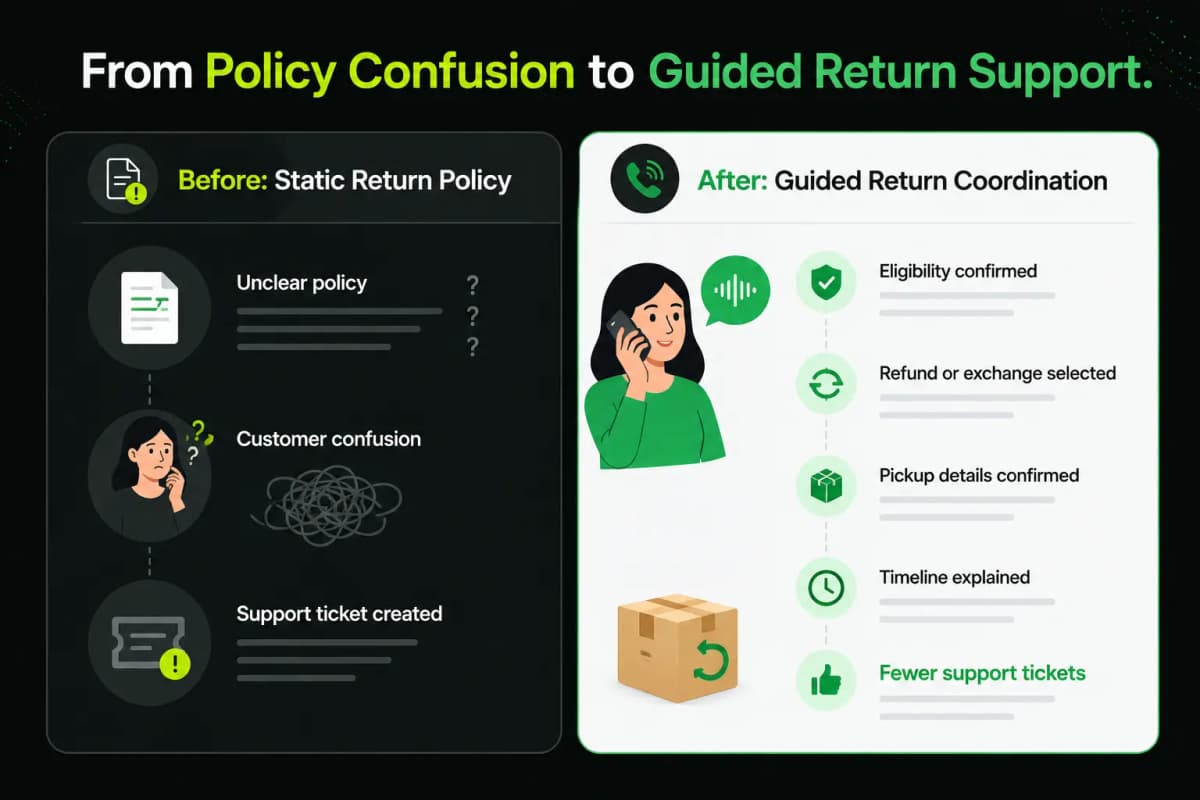
Imagine a customer wants to return a pair of shoes because the size is wrong.
With a static return policy, the customer visits the policy page and reads through return windows, eligibility rules, refund notes, exchange instructions, and shipping terms.
They are not sure whether an exchange is faster than a refund. They are also unsure whether pickup is available. So they open a support ticket.
Now the support team has to answer a question the policy was supposed to prevent.
With guided return coordination, the experience is different.
The customer starts the return. The system confirms the order, product, and return reason. A voice agent explains that the item is eligible, asks whether the customer wants a size exchange or refund, confirms pickup details, explains the refund or exchange timeline, and updates the return record.
If the requested size is unavailable, the case can be routed to support or handled through store credit options.
In the first version, the policy creates more work because the customer has to interpret it. In the second version, the policy becomes a guided workflow that reduces uncertainty.
Use this checklist when reviewing or writing an ecommerce return policy.
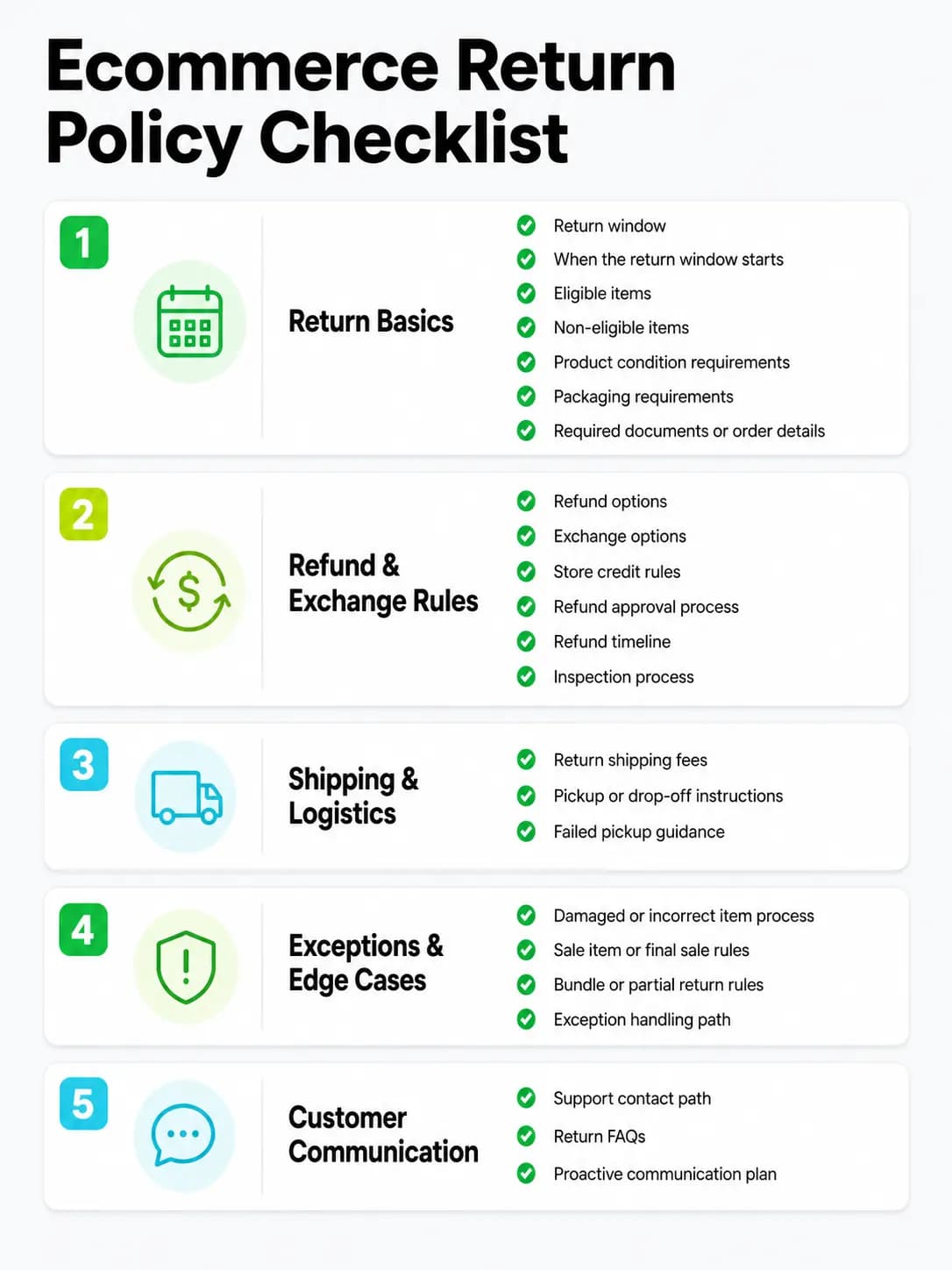
The last point is important. A return policy can explain the rules, but proactive communication helps customers follow them.
For a more implementation-focused next step, use the ecommerce return coordination playbook to map return policy questions into a guided customer communication workflow.
Even well-intentioned return policies can increase support workload when they are unclear, hidden, or disconnected from the return process.
Here are common mistakes to avoid.
“Refunds are processed soon” is not enough. Customers need to know what happens after pickup, inspection, approval, and payment processing.
If customers cannot easily find the return policy before and after purchase, they will contact support. Link it from product pages, checkout, order confirmation emails, help centers, and return portals.
Unexpected return shipping costs create frustration and tickets. Make fees visible before the customer submits the return.
If exchanges are available, explain them clearly. Customers should know whether they can exchange for size, color, variant, replacement, or store credit.
Failed pickups are common in ecommerce return management. If the policy does not explain what happens after a missed pickup, customers will contact support.
FAQs should reflect current support tickets. If your return process changes, update your FAQs quickly.
Email is easy to miss. For urgent or high-friction return moments, proactive voice communication can reduce confusion faster than another email update.
A strong ecommerce return policy should protect the business, guide the customer, and reduce support tickets.
The best policies do not only explain what is allowed. They answer the practical questions customers ask before they contact support: eligibility, return windows, shipping fees, refund timelines, exchange options, exceptions, and next steps.
But as ecommerce brands scale, a clear policy page is not always enough. Return questions become customer-specific, time-sensitive, and operationally messy. That is when brands need return coordination, not just return rules.
By turning the ecommerce return policy into a guided workflow, brands can reduce repetitive tickets, improve customer trust, and help support teams focus on the return cases that truly need human judgment.

Get $5 free credit on signup — no credit card required. Set up your AI voice agent in minutes and start converting more leads today.